Key takeaways
- Tray capacity. Six cubic feet is the common full-size steel option; four cubic feet is easier to handle fully loaded. A full barrow of wet soil or gravel can weigh far more than its listed load rating suggests, so do not fill to the brim.
- Tires. Flat-free tires, as listed on the True Temper model, never need pumping but ride rougher than air tires. Air tires cushion the load but go flat.
- Handles. Wooden handles are comfortable and repairable. Steel tube handles resist rot but are colder and more likely to transmit vibration.
- Assembly. Most barrows arrive in a box. Tighten all bolts after the first few uses.
- Frame and legs. Look for a sturdy steel frame under the tray and stable legs that keep the barrow level when parked.
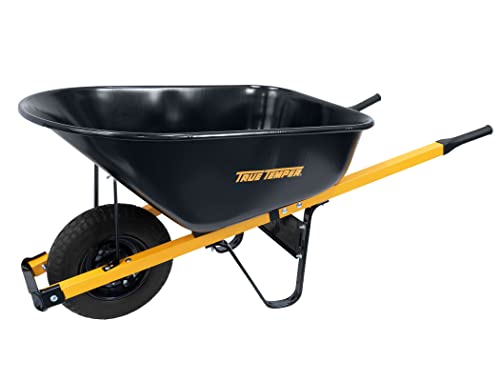
For most homeowners, a single-wheel six cubic foot steel wheelbarrow such as the True Temper R6STSP14 is the best use of a budget under $150, a two-wheel garden cart such as the Gorilla Carts GOR4PS is the better pick if balance, a bad back or shifting loads are your concerns, and a dual-wheel budget barrow is only worth it for light, occasional jobs. Steel trays suit rocks, soil and rubble; poly trays are lighter and rustproof but flex under sharp point loads.
Our top picks


As an Amazon Associate we earn from qualifying purchases at no extra cost to you.
Comparison table
| Model | Type | Stated points | Best for | Limits |
|---|---|---|---|---|
| True Temper R6STSP14 | Single-wheel steel, 6 cu ft | Listings describe a 6 cu ft tub (20-gauge steel according to one aggregator), steel handles and a 15.5 in flat-free tire, about 46 lb assembled; one listing gives a 370 lb capacity | General yard, soil, mulch, rubble | Takes balance and steering effort; price varies a lot between sellers and listings contain errors, so confirm the model number |
| Jackson M6T22 | Single-wheel steel, 6 cu ft, contractor style | Listings show a powder-coated steel tray, a 16 in tubed (pneumatic) tire, wood handles and leg stabilizers, about 52 to 59 lb depending on the seller | Heavy, frequent use | Price may land above the cap depending on the seller; warranty terms differ between listings |
| Gorilla Carts GOR4PS | Poly two-wheel dump cart, 4 cu ft | Listed at 600 lb overall capacity (300 lb maximum when dumping), 10 in tires, steel frame, about 31.5 lb | Moving mulch, plants and tools on level ground | Poly tub; not for heavy rubble |
| Gorilla Carts GOR6PS | Poly two-wheel dump cart, 6 cu ft | Listed at 1,200 lb capacity with 13 in pneumatic tires and a quick-release dump, about 54 lb | Large loads that you want to keep stable | Bulky; may sit above the cap, so check the price |
| Gorilla Carts GCR-4 | Steel mesh utility cart | A third-party site lists 300 lb capacity and 10 in pneumatic tires; no maker spec sheet was found | Hauling bulky light items | Specs unconfirmed; smaller capacity |
| Budget dual-wheel barrow (several brands) | Dual-wheel budget | Typically about 5 cu ft with a capacity in the low hundreds of pounds; figures differ by brand | Light, occasional use | Often light-duty, not suited to heavy use such as mixing concrete |
Single wheel, dual wheel or garden cart?
Single wheel
A single-wheel barrow concentrates the load over the wheel, so you lift less and can turn in tight spaces and along narrow paths. It also tips easily, so the user supplies the balance. Steel single-wheel models are still favoured for heavy-duty jobs because the wheel can roll over uneven ground and into narrow gaps.
Dual wheel
Two wheels are stable at rest and when loading, which is helpful for people who struggle with balance. The trade-off is width: a dual-wheel barrow will not fit narrow gates, turns more slowly and can be hard to push on soft or uneven ground. Budget dual-wheel models are often light-duty.
Garden carts
Garden carts like the Gorilla Carts range pair a poly or steel bed with a steel frame and two larger wheels, and some other carts use four. Gorilla’s GOR4PS is listed at 600 lb with a 300 lb limit when dumping, and the GOR6PS has a quick-release dump. They are stable, easier on the back than a single-wheel barrow and good for mulch, pots, potting soil and bags, but they need open, reasonably level ground and take up more storage space.
Steel versus poly trays
Steel trays are stronger and handle rocks, rubble, wet soil and concrete mix, but they can rust if the paint wears through. A 20-gauge tub like the one listed for the True Temper is a reasonable middle ground. Poly trays are lighter, will not rust and are quieter, but they can flex under heavy point loads like large rocks and can crack with abuse. For most gardens an all-steel barrow is a safe choice. For plants and mulch on a lawn, poly is easier to handle.
Other things to check
- Tray capacity. Six cubic feet is the common full-size steel option; four cubic feet is easier to handle fully loaded. A full barrow of wet soil or gravel can weigh far more than its listed load rating suggests, so do not fill to the brim.
- Tires. Flat-free tires, as listed on the True Temper model, never need pumping but ride rougher than air tires. Air tires cushion the load but go flat.
- Handles. Wooden handles are comfortable and repairable. Steel tube handles resist rot but are colder and more likely to transmit vibration.
- Assembly. Most barrows arrive in a box. Tighten all bolts after the first few uses.
- Frame and legs. Look for a sturdy steel frame under the tray and stable legs that keep the barrow level when parked.
Decision table
| Pick this if… | Choose | Why |
|---|---|---|
| You want the best general-purpose barrow | True Temper R6STSP14 | 6 cu ft steel tub with a flat-free tire |
| You do heavy, frequent work | Jackson M6T22 (if the price fits) | Contractor-style 6 cu ft steel |
| You worry about balance or your back | A two-wheel cart such as the Gorilla Carts GOR4PS | Two wheels carry the load, so there is less balancing |
| You move large light loads, mulch and plants | Gorilla Carts GOR4PS or GOR6PS | Stable, quick-release dump on the GOR6PS |
| You need something cheap for light chores | Dual-wheel budget model | Cheapest, but light-duty |
| You mix concrete or move heavy rubble | Steel single-wheel | Strongest in the class |
Budget tiers within the cap
At the lowest end are light-duty dual-wheel barrows and small poly carts. The mid-range holds the main steel barrows and the smaller Gorilla Carts. At the top of the cap are contractor-style steel barrows such as the Jackson M6T22, which may land just over the cap depending on the seller. Street pricing varies a lot between sellers, so a model may be inside or outside the cap on a given day. If a premium barrow is out of reach, the True Temper or a Gorilla cart is the usual step-down.
Safety and care notes
- Load sensibly. Keep heavy items low and over the wheel. Overloading is a common cause of tipped barrows and back strain.
- Lift with your legs. Use your whole body, not just your back, and take smaller loads if you have a back condition. Check with a doctor if you have ongoing pain.
- Slopes. Avoid steep slopes with a heavy load. Push uphill, and keep control going downhill.
- Keep clear of children and pets when tipping loads.
- Maintenance. Rinse out wet soil and cement after use, touch up chipped paint to limit rust, check bolts, and store under cover. Keep tires at the stated pressure if you have air tires.
Alternatives
- Folding or collapsible garden carts that store flat, for small sheds.
- Garden tarps or heavy-duty bags for dragging leaves and prunings.
- Hiring or borrowing a contractor barrow for a one-off job like moving gravel.
A note on sourcing: figures for the True Temper, Jackson and Gorilla Carts models come from retail listings and the Gorilla Carts maker pages, and some differ between sellers. Treat capacities and sizes as approximate and read the maker’s specifications before buying.
Short buying checklist
- List the heaviest loads you move, such as soil, gravel, rubble or just mulch and plants.
- Measure your narrowest gate or path, since a dual-wheel barrow or cart may not fit through it.
- Be honest about your strength and balance; a smaller tray or more wheels can prevent strain and tipped loads.
- Decide between flat-free and air tires based on the ground you cover.
- Think about storage space and whether a cart that does not fold will fit in your shed.
Frequently Asked Questions
Is a steel or poly wheelbarrow better?
Steel is stronger and better for rocks, rubble and wet soil. Poly is lighter and will not rust, but it can flex under heavy point loads. For general gardening, either is fine; for heavy work, choose steel.
How big a wheelbarrow do I need?
A six cubic foot barrow is the usual full-size choice, but when full of wet soil or stone it can be too heavy for many users. A four cubic foot barrow or cart is easier to control. Choose the size you can comfortably move when loaded.
Are two-wheel barrows more stable?
Yes, they are more stable at rest and when loading, which helps with balance. They are wider and harder to steer on narrow or soft ground. Many gardeners with back problems prefer two-wheel carts.
Do I need a flat-free tire?
It saves you pumping and fixing punctures, and one True Temper listing describes a flat-free 15.5 in tire. The ride is firmer than with air-filled tires. If you roll over thorny or rough ground, flat-free is often more practical.
Can I mix concrete in a wheelbarrow?
A steel barrow is generally used for this, and light-duty dual-wheel models are not suited to it. Wash out the tray right after use to prevent damage and rust.
How do I stop a steel wheelbarrow rusting?
Rinse out soil and cement after use, let it dry and store it under cover. Touch up chipped paint to protect exposed steel. Poly trays do not rust, but their frames and fittings still can.