Key takeaways
- Light use (lights, phone charging, a pump): a smaller kit may be enough, provided the daily watt-hour total is low.
- Typical use with a compressor fridge: about 200 W is a common starting point.
- Heavy use or winter travel: 400 W and a larger battery, usually with an MPPT controller.
For a caravan with a single 12 V leisure battery, a roof-mount kit of about 200 W with a 30 A controller, such as Renogy’s 200 W RV kit, covers most weekend and light-touring needs, while owners with fridges, heaters or long off-grid stays should plan for more panel area and a lithium battery; a portable folding suitcase suits owners who park in shade or cannot drill the roof.
Our top picks


As an Amazon Associate we earn from qualifying purchases at no extra cost to you.
What a caravan solar kit includes
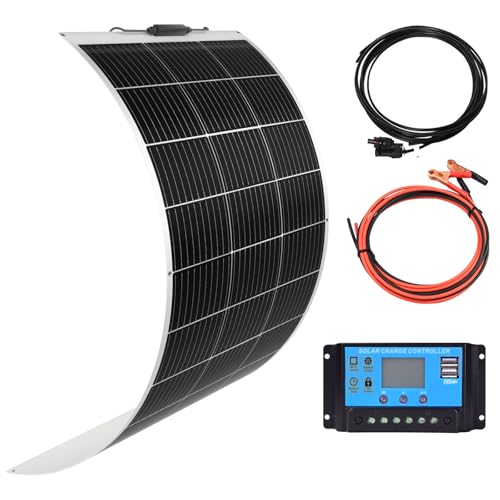
A caravan solar kit is a bundle that normally contains one or more panels, a charge controller, cabling and mounting hardware. The goal is to keep the leisure battery topped up while the caravan is parked off mains hook-up. “Caravan” is the UK, Australian and New Zealand word for what North American buyers call a travel trailer, and the same equipment applies to campers, trailers and vans. Kits differ mainly in panel type, controller type (PWM or MPPT) and whether the roof cable entry parts are included.
How much solar does a caravan need?
Start with what runs on the battery: lights, a water pump, a 12 V fridge, device charging, a diesel heater fan. Add up each device’s watts multiplied by hours per day to get daily watt-hours, then compare with what panels can supply. Renogy’s own suitcase page estimates about 1 kWh per day from a 200 W suitcase assuming 5 hours of sun, which is the maker’s estimate and will not apply on a cloudy winter day. Real output depends on sun angle, shade, temperature, panel type and controller.
- Light use (lights, phone charging, a pump): a smaller kit may be enough, provided the daily watt-hour total is low.
- Typical use with a compressor fridge: about 200 W is a common starting point.
- Heavy use or winter travel: 400 W and a larger battery, usually with an MPPT controller.
At a glance
| Kit | What the maker lists | Best for | Limits |
|---|---|---|---|
| Renogy 12V 200W RV Solar Kit | Two 100 W N-Type panels, Adventurer 30A PWM controller, BT-1 Bluetooth module, 30 ft of 10 AWG solar adaptor cable, 16 ft tray cable, branch connectors and cable entry housing (some listings also include mounting brackets); expandable to a maximum of 400 W with that controller | Permanent roof install, first-time kit buyers | PWM controller; some regional pages show it as backordered |
| Renogy 200W portable suitcase | Two 100 W panels folding into a case, 20A controller, alligator-clip cable; listed size and weight vary by version | Renters of pitches with shade, owners who will not drill the roof | Heavy to carry; backorders appear on some pages |
| Add-on: Victron SmartSolar MPPT 100/30 | 30 A, 440 W at 12 V, Bluetooth, 100 V max PV | Upgrading a kit or building your own | Premium tier; parts must be sourced separately |
| Add-on: Renogy Rover 2 30A | 450 W at 12 V, built-in Bluetooth, compact | Upgrading from the PWM controller | Match the array to its PV limits |
PWM or MPPT for a caravan?
A PWM controller works well with 12 V nominal panels and a 12 V battery, and it keeps the cost lower. An MPPT controller can accept higher-voltage panel strings, harvests more in cool or low-light conditions and suits arrays with long cable runs, but it costs more. The Renogy RV kit lists a 30 A PWM controller, expandable to 400 W, which is reasonable for a first caravan system. Anyone expecting to add a lithium battery or more panels later should consider an MPPT controller, bought separately or as a kit that includes one if the maker lists it.
Fit and roof considerations
- Roof space: measure the free area clear of vents, aerials and rooflights. Panels dislike shade; even partial shade on one panel can cut output of a series string.
- Roof load and material: follow the caravan maker’s guidance on mounting and weight. Do not drill through the roof without checking where structure, wiring and water channels run.
- Cable entry: the Renogy kit lists a cable entry housing. Seal anything that penetrates the roof with a sealant suitable for the roof material.
- Wire runs: shorter runs lose less power; use the wire gauge the controller manual specifies.
- Battery location: the controller should sit near the battery, not on the roof.
Batteries that suit solar
Solar only helps if the battery can store it. Many caravans ship with a lead-acid leisure battery. A lithium iron phosphate battery can accept charge faster and be discharged deeper. Battle Born lists its 100Ah 12 V battery with a BMS of 100 A continuous and a recommended charge voltage range of 14.2 to 14.6 V, and Renogy lists a Core 100Ah with a 14.4 V charge voltage. Cold weather matters: Battle Born states its standard BMS blocks charging below 0 C, and Renogy lists self-heating versions. If the caravan will be used in winter, choose a battery with heating or keep it in a warmed space.
Whichever chemistry you choose, set the controller’s battery profile to match the battery maker’s recommended voltages. Wrong settings are a common cause of undercharged or stressed batteries.
Safety and wiring notes
- Install fuses or breakers sized to the cable and to the controller manual, close to the battery.
- Panels produce voltage whenever light hits them. Cover them or follow the manual when connecting or disconnecting.
- Follow the controller’s required connection order.
- Avoid creating shortcuts around the caravan’s existing protection devices.
- Work on the caravan’s 230 V or 120 V mains system, or any hardwired changes, belongs with a licensed electrician following local code. Use only listed equipment as the maker states.
- Some caravans have a built-in solar prewire or a roof-mounted charge controller from the maker. Read the caravan handbook before adding anything.
Budget tiers
- Budget: a 100 W starter kit or the standard 200 W PWM kit. Suitable for light use and lead-acid batteries.
- Mid-range: a 200 to 400 W kit with MPPT controller and lithium battery.
- Premium: larger arrays with a Victron controller and monitoring, or a portable suitcase in addition to the roof array for shaded pitches.
Pick X if…
| If you… | Pick | Why |
|---|---|---|
| Want a complete roof kit in one box | Renogy 200W RV kit | Includes panels, controller, Bluetooth module, cables and entry housing per the maker |
| Plan to expand later | Renogy Rover 2 or Victron MPPT 100/30 | Higher PV limits than the kit’s PWM controller |
| Cannot drill the roof | Renogy 200W suitcase | Portable, clip leads to the battery |
| Camp in cold weather | Heated lithium battery | Makers list low-temperature charging limits and heating options |
| Want phone monitoring | Kit with BT-1 module or Victron SmartSolar | Both makers list Bluetooth |
Alternatives
- Portable power station plus folding panel: easier to install, but with limited storage and no integration with the caravan’s 12 V system.
- Dashboard or trickle panels: low-power panels for keeping a battery from drifting down while stored.
- Upgrading alternator or mains charging: if you rarely park off-grid in sun, a lithium-capable mains charger or a DC-DC charger from the tow vehicle may do more good than extra panels.
Planning the energy budget before you buy
The steps below are a general planning method, not a maker figure, and real use will differ. Write down every 12 V device and how long it runs each day. A compressor fridge cycles on and off, so its daily total is lower than its running wattage suggests, while a water pump runs only in short bursts. Add a margin for losses in wiring, the controller and the battery itself. Then compare the total with the battery’s usable capacity: a 100Ah 12 V battery stores roughly 1,200 watt-hours at nominal voltage, and lead-acid batteries should not be routinely drained as deeply as lithium ones, so the usable share is smaller. If a day’s use is close to the battery’s usable capacity, the panels will have to refill it every sunny day with little room to spare.
Also consider where the caravan is stored and used. A site under trees, a north-facing pitch or a winter trip in low sun can cut harvest sharply. Tilting panels helps in winter but is only practical with portable panels or a tilting mount. If shade is common, small panels wired in parallel can hold up better than a long series string, because shade on one panel in a series string affects the whole string. Check the controller’s voltage and current limits before choosing a wiring layout, and follow the kit manual.
Frequently Asked Questions
How many watts of solar does a caravan need?
It depends on daily consumption, battery size and sunlight. Many caravanners start around 200 W for a fridge and lights and add more when they find the battery drained in winter.
Can solar run my caravan air conditioner?
Generally not from a small roof kit. A 200 W kit like the one Renogy lists is aimed at charging a 12 V battery, and the maker notes that a 12 V battery and inverter are needed for 120 V outlets.
Do I need a lithium battery for solar?
No. Solar can charge lead-acid batteries too if the controller is set correctly. Lithium accepts charge more readily and offers more usable capacity, but costs more and needs cold-weather care.
Can I fit panels myself?
Many owners fit panels and controllers themselves, following the kit manual. Anything involving mains wiring should be handled by a licensed electrician, and roof penetrations need proper sealing.
Will solar charge the battery on cloudy days?
Output drops sharply under heavy cloud but is not zero. Makers’ per-day estimates assume good sun, so plan for less in winter.
Should I choose a portable suitcase or fixed panels?
Fixed panels charge automatically while you are out. A suitcase can be placed in the sun while the caravan sits in shade but must be set up each time, which suits some pitches and travelers better than others.