Key takeaways
- Roof work. Cutting a hole in the roof deck and flashing a curb is roofing work. A poor flashing job is the main source of leaks. Use a roofer if you are not experienced, and work safely on ladders and slopes.
- Roof pitch and covering. Choose the flashing for your pitch and roof type. Solatube lists different flashing heights for different conditions, and a tile or metal roof needs a matching flashing.
- Panel orientation. A panel on the unit works best facing the sun. If the roof has shade, a remote panel can sit in a better spot.
- Wiring. Most units are plug-in low-voltage connections between panel and fan. If a model uses any mains wiring or a thermostat on mains power, follow the manual and local code and use a licensed electrician.
- Combustion appliances. If a gas furnace or water heater vents in the attic or nearby, ask a qualified professional about backdrafting before adding exhaust ventilation.
- Warranty and wind rating. Solatube lists a hurricane-rated version for no-pitch flashing. In high-wind areas, check the rating the maker states.
The best solar power attic vent for most houses is a roof-mounted solar attic fan with a panel in the 25 to 40 watt range, such as an Attic Breeze model, matched to a roof that gets decent sun; a remote-panel version suits shaded or north-facing roofs, a gable-mounted unit suits houses where you do not want to cut the roof, and a Solatube or Lomanco model suits buyers who prefer those brands. “Solar power attic vent” here means a fan or vent whose motor runs directly from a small photovoltaic panel, with no wiring to the house and no electricity bill, to push hot air out of an attic. It is not a whole-house fan, and it does not replace intake vents.
Our top picks


As an Amazon Associate we earn from qualifying purchases at no extra cost to you.
How a solar attic vent works and what it can and cannot do
A solar attic fan draws hot air out through a roof or gable opening. A panel on or near the fan powers a small direct-current motor, so the fan runs faster in stronger sun, which is also when the attic is hottest. There is usually no battery and no connection to the home electrical system, which keeps installation simpler than for a wired powered vent.
An exhaust fan can only exhaust as much air as is allowed in. If soffit or other intake vents are blocked or too small, the fan may pull conditioned air from the living space through ceiling gaps instead, which wastes energy. Makers of attic ventilation talk about balancing exhaust and intake for that reason, and it is worth checking the intake before buying any fan. Lomanco’s guidance is one square foot of attic ventilation per 300 square feet of attic floor, split between exhaust and intake, and it notes that some local codes require one per 150 square feet. Follow the rule that applies where you live.
Also be realistic about claims. A fan can reduce attic temperature and help move moisture out in some climates, but makers do not guarantee a particular saving, and results depend on insulation, the roof, intake vents and weather.
At a glance: confirmed current options
| Model | Best for | Key stated specs | Limits |
|---|---|---|---|
| Attic Breeze AB-3042A | Sunny south-facing or west-facing roofs | 30 W adjustable panel mounted on the unit; up to 1700 CFM; lifetime warranty stated by the maker | Panel on the fan, so shade over the fan reduces output |
| Attic Breeze AB-3042D | Roofs where the best sun is not at the fan location | 30 W remote-mounted panel; up to 1700 CFM | Panel needs a good mounting spot and its own cable run |
| Attic Breeze AB-4042D | Larger attics | 40 W remote-mounted panel; up to 1875 CFM | More cost and more roof penetration work than a basic model |
| Attic Breeze AB-2563 (wall mount) | Gable-wall installs | 25 W remote-mounted panel; up to 1550 CFM | Needs a suitable gable wall |
| Solatube RM1500 | Standard roof-mounted installs | 16 W; 24 inch fan diameter; brushless DC motor; five polymeric blades | The retrieved page lists no CFM rating |
| Solatube RM2400 | Larger attics or hotter climates | 33 W; same 24 inch fan diameter and brushless motor | The retrieved page lists no CFM rating |
| Solatube IM1500 interior mount | Replacing or using an existing vent from the inside | 16 W; covers up to 1,500 square feet according to the maker | Fits existing vents only |
| Lomanco Omni Solar Vent (OSV40) and Omni Solar Gable Vent (SGABLE40) | Buyers who want a 40 W Lomanco option | 40 W solar panel on both; the gable model needs 768 square inches of net free area | No airflow rating confirmed; compare by panel and vent area |
The airflow figures above are listed by the maker as “up to” ratings in full sun, so real-world airflow will be lower in weaker sun.
Attic Breeze models
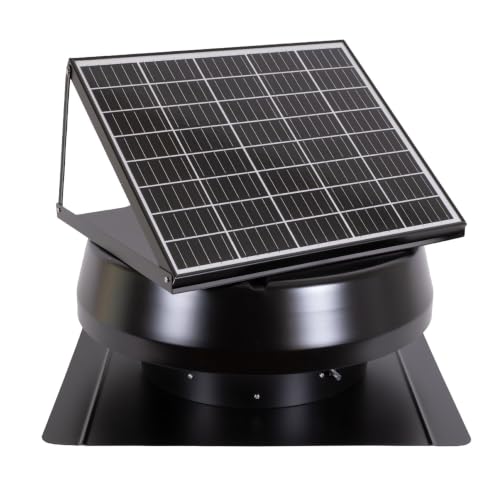
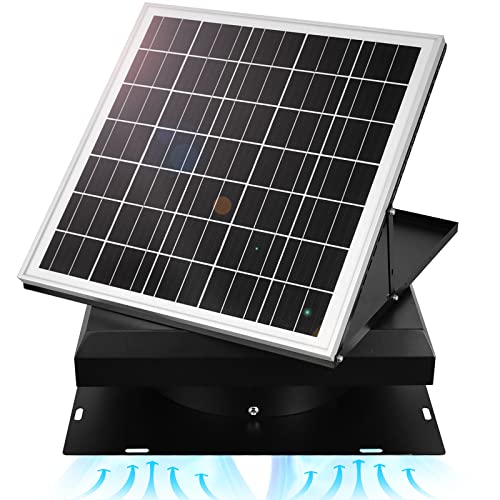
Attic Breeze offers units with the panel on the fan, with a remote panel, and as a wall-mount fan. The AB-3042A has a 30 W adjustable panel and is rated up to 1700 CFM. The AB-3042D uses a 30 W panel mounted separately, and the maker aims it at north-facing or shaded roofs, giving the same 1700 CFM rating. The AB-4042D has a 40 W remote-mounted panel and is rated up to 1875 CFM. The AB-2563 is a 25 W wall-mount unit with a remote panel and a rating up to 1550 CFM.
The AB-3042A is a second-generation model. The maker also lists a newer UltraBreeze line with monocrystalline panels in 25 to 65 W options, and its data sheet gives higher airflow ratings at each panel size. Listings differ between generations and sellers, so compare like with like, within one generation, and use the maker’s own sizing guidance. An optional Breeze Mate system adds temperature and humidity control and pressure sensing, which is useful if you want the fan to run on conditions as well as sun.
Solatube models
Solatube’s solar attic fans come as roof-mounted and interior-mount types, and several flashing options are listed: no-pitch flashing in 2.5 and 6 inch heights, a pitched flashing at 4 inches, and a hurricane-rated no-pitch version. The RM1500 is 16 W and the RM2400 is 33 W, both with a 24 inch fan diameter, a brushless DC motor and five polymeric blades. The IM1500 is an interior-mount 16 W model for use with an existing vent, and the maker says it covers up to 1,500 square feet. The pages retrieved gave no CFM figures, so compare coverage claims rather than airflow numbers.
Natural Light is a separate brand name some buyers search for, but no separate specifications for it are given here, so use the Solatube figures above and the maker’s pages.
Lomanco options
Lomanco lists two solar models, the Omni Solar Vent (OSV40) and the Omni Solar Gable Vent (SGABLE40), both with a 40 W panel. For the gable version the maker states 768 square inches of net free area is required. The maker lists the OSV40 with a 14 inch fan, a 40 W panel and 160 square inches of static net free area, but does not state a CFM rating that could be confirmed, so airflow comparison with the other models is not possible.
Sizing the fan to the attic
Ventilation guidance varies, and rules of thumb for fan airflow per square foot of attic floor differ between sources, so treat any single figure as a rough starting point and use the maker’s own coverage rating and sizing guide. Because solar fan airflow ratings are maximums in full sun, picking a unit whose rated coverage comfortably exceeds your attic floor area is sensible. Larger or darker roofs, poor insulation and hot climates all push toward the bigger panels.
Next, count intake. Soffit vents need to be open, not stuffed with insulation. If intake is limited, adding intake area first often does more than adding a bigger fan. Many makers include an intake calculation in their sizing guide, and a local roofing contractor can tell you the code requirement.
Installation and safety notes
- Roof work. Cutting a hole in the roof deck and flashing a curb is roofing work. A poor flashing job is the main source of leaks. Use a roofer if you are not experienced, and work safely on ladders and slopes.
- Roof pitch and covering. Choose the flashing for your pitch and roof type. Solatube lists different flashing heights for different conditions, and a tile or metal roof needs a matching flashing.
- Panel orientation. A panel on the unit works best facing the sun. If the roof has shade, a remote panel can sit in a better spot.
- Wiring. Most units are plug-in low-voltage connections between panel and fan. If a model uses any mains wiring or a thermostat on mains power, follow the manual and local code and use a licensed electrician.
- Combustion appliances. If a gas furnace or water heater vents in the attic or nearby, ask a qualified professional about backdrafting before adding exhaust ventilation.
- Warranty and wind rating. Solatube lists a hurricane-rated version for no-pitch flashing. In high-wind areas, check the rating the maker states.
Budget tiers
The budget tier is smaller 16 to 25 W units such as the Solatube RM1500 and IM1500 or the Attic Breeze wall mount. The mid-range tier is the 30 W Attic Breeze AB-3042A or D, which covers most average attics. The premium tier is the 40 W and larger panel models, units with a temperature and humidity controller, and hurricane-rated flashing options. Remote-panel designs usually cost more than panel-on-fan designs because of the extra cable and mounting.
Pick X if you
| Pick this | If you |
|---|---|
| Attic Breeze AB-3042A | have a sunny roof slope and want a simple unit with an adjustable panel |
| Attic Breeze AB-3042D or AB-4042D | have a shaded or north-facing fan location and can put the panel elsewhere |
| Attic Breeze AB-2563 | want a gable-wall installation |
| Solatube IM1500 | want to use an existing vent opening from inside the attic |
| Solatube RM2400 | want a larger panel and a 24 inch fan on a roof mount |
| Lomanco SGABLE40 | want a gable vent with a 40 W panel and can provide the required net free area |
Alternatives to consider
Passive ridge and gable vents
Static ridge vents and gable louvres have no moving parts and need no sun, but they rely on wind and convection. In many climates a good ridge and soffit system is the baseline.
Wired thermostat-controlled power vents
Mains-powered roof or gable fans run regardless of sun and can be controlled by thermostat. They add electric cost and need wiring by a licensed electrician.
Whole-house fans and radiant barriers
A whole-house fan is a different appliance for moving air through living spaces. A radiant barrier or more insulation addresses heat gain directly and can pair with ventilation.
Frequently Asked Questions
Does a solar attic fan work on cloudy days or at night?
Output depends on light. In weak sun it runs slower, and with no light it does not run unless the model has a battery or hybrid power option. Maker airflow ratings are for full sun.
How many solar attic fans do I need?
It depends on attic size, roof, climate and intake. Makers publish a rated coverage area for each model, and large attics sometimes need more than one fan. Follow the maker’s sizing guide or ask a local roofing contractor.
Can a solar attic fan cause problems with my gas appliances?
Exhaust fans can affect air pressure in the attic and lower spaces. If a furnace or water heater vents nearby, ask a qualified professional about backdrafting before installing.
Do I need extra intake vents?
Often yes. The fan can only move air that can get in. Blocked soffits are a common cause of poor performance, and makers describe balanced exhaust and intake.
Will it leak?
A properly flashed unit should not, but poor flashing and sealing cause most leaks. Match the flashing to the roof pitch and covering, and use a roofer if you are unsure.
What is the difference between a 30 W and a 40 W model?
A larger panel generally runs the fan faster for a higher rated airflow. Attic Breeze lists up to 1700 CFM for its 30 W models and up to 1875 CFM for the 40 W model.