Key takeaways
- Flush the line. Run water through the tubing before fitting the emitters or end caps, to push out dirt.
- Use the regulator and filter. Place them between tap and tubing. Clean the filter periodically.
- Layout. Lay tubing in the sun for a few minutes so it softens and is easier to shape. Use stakes to hold it in place.
- Backflow. A backflow preventer protects your household water supply. The faucet connection kit includes one; if your kit lacks it, check local requirements.
- Freezing weather. Drain the system and remove battery timers before frost.
- Clogs. If a plant looks dry, check the emitter for a blockage, and replace it if a quick rinse does not help. Occasional defective drippers are reported; check the maker’s warranty.
- Electrical timers. If you use a mains-powered controller, follow the maker’s instructions and use a qualified electrician for any hard-wired installation.
For a vegetable bed, border or row planting, a Rain Bird drip kit such as the Gardener’s Drip Kit (or the larger Landscape and Garden kit) is the safest starting point under $150, a Raindrip kit with a timer suits containers and small plots, and an Orbit micro bubbler kit suits plantings that need bubbler-style watering. Drip systems are cheap relative to the cap, so the real choice is how big your planting area is and whether you want a timer included.
Our top picks


As an Amazon Associate we earn from qualifying purchases at no extra cost to you.
Kit comparison
| Kit | Best for | Stated contents / specs | Limits |
|---|---|---|---|
| Rain Bird Gardener’s Drip Kit (GRDNERKIT) | Vegetable beds and rows | The maker’s page and manual list a 25 PSI hose regulator with filter, a 3/4 in hose thread to 1/2 in drip line adapter, 50 ft of 1/2 in emitter tubing with 0.9 GPH emitters every 18 in, additional 1/2 in tubing, 25 ft of 1/4 in tubing and 5 spot-watering emitters at 1.0 GPH; retail listings differ on piece count (47 or 50) and coverage is stated at about 75 sq ft | No timer in the box |
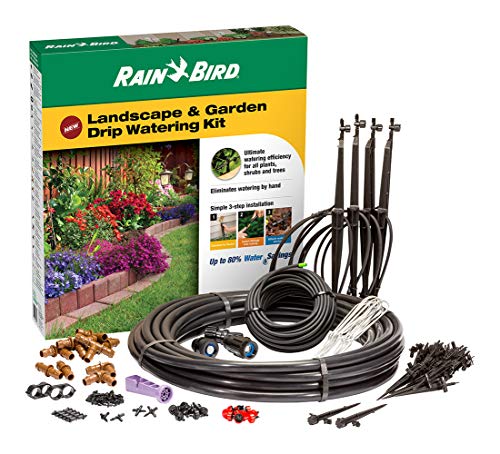
| Rain Bird Landscape and Garden Drip Watering Kit (LNDDRIPKIT) | Mixed beds, larger areas | The maker calls it its most complete starter kit; listings show about 108 to 109 pieces with a pressure regulator and a drip-watering range of plants | Timer sold separately; piece counts differ by seller |
| Rain Bird Spot Watering Kit (SWDMSPKIT) | Pots, shrubs, scattered plants | Listings show 1/4 in tubing, stakes, a 6-port manifold with 30 PSI regulator, a fine mesh filter and 12 watering devices (emitters and bubblers); plant coverage is stated as 15 to 25 depending on the source | Not designed for long straight rows or as a complete starter |
| Rain Bird Faucet Connection Kit (FCKIT) | Starting a system from scratch | Maker lists a backflow preventer, 25 PSI regulator, 150 mesh filter and adapter to 1/2 in or 5/8 in drip tubing | Connection pieces only, you add tubing and emitters |
| Rain Bird Repair and Expansion Kit | Adding to an existing system | Maker lists 100 ft of 1/4 in tubing, stakes, drippers, plugs, tees, couplings and 40 pressure-compensating emitters; no regulator or filter | Not a standalone starter |
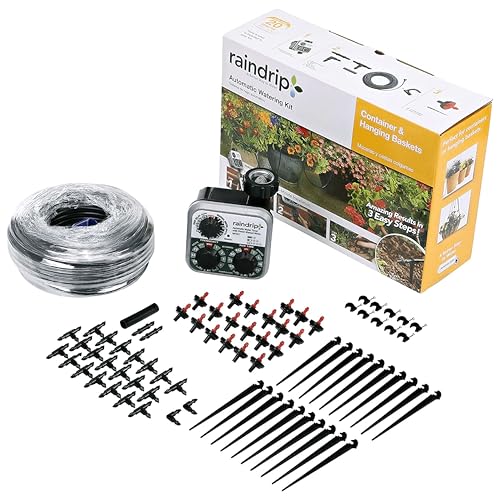
| Raindrip Automatic Watering Kit with Timer (R560DP) | Containers, small gardens | Listings describe a kit with an included timer for up to about 20 potted plants, hanging baskets or planter boxes | Small coverage; reviewers say timer programming options are limited |
| Orbit 69525 Micro Bubbler Kit | Shrubs and planted beds that suit bubbler watering | Listings describe a micro bubbler system with adjustable flow, with coverage stated as about 250 sq ft or about 50 plants depending on the source | Specialised; coverage figures differ between listings |
How to choose a drip irrigation kit
Measure the area before you shop
Sketch your beds and add up the straight-line distance from the tap to the plants plus the length of each row. A kit that includes 50 ft of main tubing covers a small raised bed or short row planting. A garden with several separated beds usually needs a distribution tubing kit with 1/4 in feeder lines, such as the spot-watering kit, or you may need to add an expansion pack.
Pressure regulation and filtration are not optional
Drip emitters work at low pressure. Rain Bird’s faucet connection kit page says drip systems need at least 15 PSI and a maximum of 25 to 30 PSI, which is why its kits come with a 25 or 30 PSI regulator. A filter (mesh sizes of 150 to 200 are listed) protects emitters from clogging. If a kit does not include these, buy them separately.
Emitter type
Inline emitters set at fixed spacing, such as the 18 in spacing on the Gardener’s Drip Kit tubing, are well suited to rows of vegetables. Individually placed spot emitters at 1.0 or 2.0 GPH work for shrubs and pots. Pressure-compensating emitters keep flow even along longer runs and on slopes. Micro bubblers cover a small circular area around a plant rather than a single point.
Timers
Several of the best kits leave the timer out so you can choose one. Timers range from simple single-dial or battery models for one zone to multi-zone controllers for several beds. Battery timers are convenient but need fresh batteries and should be brought in before frost. If a kit includes a timer, as the Raindrip kit does according to its listings, you save a separate purchase.
Tubing size and fittings
A 1/2 in main line carries more water and runs further; 1/4 in feeder lines branch to individual plants. Kits built on one standard keep the fittings compatible. Make sure the faucet adapter matches your tap thread (the Gardener’s Drip Kit lists a 3/4 in hose thread adapter) and the expansion pieces fit the tubing diameter you chose.
Pick-by-need decision table
| Pick this if… | Choose | Why |
|---|---|---|
| You have a vegetable bed with rows | Rain Bird Gardener’s Drip Kit | Inline emitters every 18 in on 50 ft of 1/2 in tubing |
| You have mixed beds and may expand | Rain Bird Landscape and Garden kit | The maker’s most complete starter kit; timer sold separately |
| You mostly water pots and shrubs | Rain Bird Spot Watering Kit | 12 watering devices on 1/4 in tubing; not a complete starter |
| You want an included timer for a few pots | Raindrip kit with timer | Listings say a timer is included |
| You have shrubs or beds that suit bubblers | Orbit 69525 Micro Bubbler Kit | Bubbler-style watering around plants |
| You want to add to an existing system | Rain Bird Repair and Expansion Kit | Extra tubing and 40 emitters, no regulator needed if you already have one |
Budget tiers within the cap
Budget kits are small starter sets with a few dozen feet of tubing and a handful of emitters. Mid-range kits add regulators, filters, more tubing and sometimes a battery timer. At the upper end of the cap you can combine a good kit with a separate programmable timer, which is the usual route to fully automated watering. Because even a large kit plus a timer usually fits within the cap, spending more is only worthwhile if you plan many beds, in which case a basic kit plus an expansion pack is more economical than a single huge kit.
Installation and care notes
- Flush the line. Run water through the tubing before fitting the emitters or end caps, to push out dirt.
- Use the regulator and filter. Place them between tap and tubing. Clean the filter periodically.
- Layout. Lay tubing in the sun for a few minutes so it softens and is easier to shape. Use stakes to hold it in place.
- Backflow. A backflow preventer protects your household water supply. The faucet connection kit includes one; if your kit lacks it, check local requirements.
- Freezing weather. Drain the system and remove battery timers before frost.
- Clogs. If a plant looks dry, check the emitter for a blockage, and replace it if a quick rinse does not help. Occasional defective drippers are reported; check the maker’s warranty.
- Electrical timers. If you use a mains-powered controller, follow the maker’s instructions and use a qualified electrician for any hard-wired installation.
Alternatives
- Soaker hose. Simple and cheap for straight beds, but less even over long runs.
- Self-watering containers. Good for a few pots where a full drip system is overkill.
- Hand watering at the base of plants with a wand. No installation, but it takes time.
A note on sourcing: contents for Rain Bird kits come from the maker’s pages, manuals and retail listings, which differ slightly on piece counts and coverage. Raindrip and Orbit descriptions come from retail listings and reviewers, so treat coverage figures as rough.
Frequently Asked Questions
How much area will a drip kit cover?
It depends on the tubing length and emitter spacing. A kit with 50 ft of 1/2 in tubing, like the Gardener’s Drip Kit, covers a modest vegetable bed or a short row. Listings describe the Raindrip kit as suited to up to about 20 containers and the Orbit micro bubbler kit as covering about 250 square feet, though sources differ.
Do I need a pressure regulator?
Yes, for most faucet-fed systems. The maker says drip systems need at least 15 PSI and no more than 25 to 30 PSI, and household taps often deliver far more. Most kits include a regulator; if yours does not, add one.
Can I add a timer later?
Generally yes. Rain Bird’s kits can be paired with a timer, and timers screw onto the tap before the filter and regulator. Choose a single-dial or battery timer for one zone, or a multi-zone model if you have several beds.
How often should I water with drip irrigation?
It depends on your soil, plants and climate. Many gardeners water for a longer period less often, so water reaches roots. Watch plants and soil moisture and adjust.
Will emitters clog?
They can, especially if the filter is missing or dirty. Rinse the filter regularly and flush the tubing. Pressure-compensating emitters are generally described as more consistent but can still clog with debris or hard water.
Can I use drip irrigation on a slope or in containers?
Yes. Pressure-compensating emitters help keep flow even on slopes, and 1/4 in tubing with spot emitters or container kits are designed for pots. Place emitters near the plant base, not on the leaves.