Our Short List of 3

- Best for: A living room that needs a long cable, an amplifier, and a flat panel that can sit on a window or wall.
- Brand: 1byone
- Maximum range: 200 miles
- Coaxial cable: 17ft
- Impedance: 75 Ohms

- Best for: A small room, apartment, or second television where a compact magnetic-base antenna can sit on a metal stand or shelf.
- Brand: DTB TECH
- Maximum range: 120 miles
- Cable length: 8.2ft
- Reception: 360-degree omni-directional
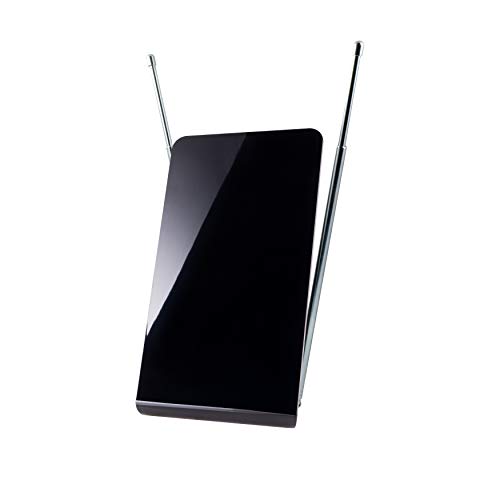
- Best for: A tidy indoor setup where adjustable rabbit ears and a flat panel help with a mixed VHF and UHF channel list.
- Brand: GE
- Model number: 33681
- Coaxial cable: 5ft
- Design: Flat panel with extendable dipole rabbit ears
All 3 Picks at a Glance
| Product | Specs | Action |
|---|---|---|
| 1byone Amplified HD Digital TV Antenna |
| Check price on Amazon |
| DTB TECH Indoor TV Antenna |
| Check price on Amazon |
| GE Flat Panel Indoor HD Digital TV Antenna 33681 |
| Check price on Amazon |
Key takeaways
- Compare four indoor HD digital TV antennas for your home, with amplifier, cable and placement guidance to help you pick local channels with confidence.
Choosing an HD digital TV antenna for your home is really a choice about where your local channels come from and how much effort you want to spend finding them. A flat panel on a window may suit a living room near a tower, while a household farther out may need an amplified model, a longer cable, and a higher mounting point before the channel scan finds anything worth keeping. The wrong pick does not simply give a weaker picture; it gives missing channels and frozen frames on windy evenings.
This guide is for cord cutters who want local news, sport, and network shows without a monthly subscription, for renters who cannot drill or mount an outdoor aerial, and for households adding a second television in a bedroom or kitchen. The four antennas below were chosen from names and specifications shown on their Amazon product pages, with attention to amplifier design, cable length, reception range, mounting style, and the bands each model is built to receive.
Quick Picks
As an Amazon Associate we earn from qualifying purchases
| Product | Best for | Key spec from title |
|---|---|---|
| 1byone Amplified HD Digital TV Antenna | A living room that needs a long cable and a strong amplifier | Support 4K 1080p, 17ft coax cable |
| DTB TECH Indoor TV Antenna | A small room or apartment where a compact magnetic base helps | Magnetic base, 360-degree reception, 8.2ft cable |
| GE Flat Panel Indoor HD Digital TV Antenna 33681 | A tidy setup beside a television with adjustable rabbit ears | Extendable dipole rabbit ears, 5ft coax cable |
| TKTDBX Digital TV Antenna | A household that wants a portable amplified antenna for several rooms | Smart switch amplifier signal booster, 10.5ft coax cable |
How to Choose
Start with distance and direction
Distance from the nearest broadcast towers shapes almost every other decision, because an antenna that works well three miles from a transmitter can struggle at thirty miles when walls, hills, and tall buildings sit in between. Check a local coverage map before ordering, note whether your main stations share one direction or spread around the compass, and treat a very large advertised range as a theoretical maximum rather than a promise for your street. A directional flat panel suits stations grouped in one direction, while a model with wide reception suits stations arriving from several sides.
Decide whether you need an amplifier
An amplifier helps when the signal arriving at your television is weak, when a long cable run loses strength, or when a splitter feeds more than one set. It does not create channels that are absent at your location, and it can make a strong nearby signal worse by overloading the tuner, so a switchable amplifier gives you a useful way to compare both settings. Homes close to a tower often do better with the amplifier off or with a passive model, while homes at the edge of coverage usually benefit from the extra gain.
Measure cable length against placement
Cable length decides where the antenna can actually live, and the best reception point is rarely the shelf directly beside the television. A window, a high wall, or a spot away from a metal cabinet can change the result completely, so measure the route from the television to the highest window in the room before choosing. A short cable forces a compromise between a neat installation and a clear signal path, while a long cable lets you try a window, a wall, and a shelf in turn. Keep the cable away from power leads where possible and leave enough slack to shift the antenna a few inches at a time while you scan.
Match VHF and UHF coverage to your channels
Many households assume every local channel uses the same band, yet a network affiliate may broadcast on VHF while another uses UHF, and an antenna tuned mainly for one band can miss the other entirely. Look up the real broadcast band for each station you want, not just the channel number shown on screen, because virtual channel numbers often hide the physical band underneath. A model that lists both VHF and UHF reception gives broader coverage for a mixed local lineup, while a UHF-only design may suit a household whose wanted stations all sit on UHF.
The 4 Best Options
1byone Amplified HD Digital TV Antenna
- Best for: A living room that needs a long cable, an amplifier, and a flat panel that can sit on a window or wall.
- Brand: 1byone
- Maximum range: 200 miles
- Coaxial cable: 17ft
- Impedance: 75 Ohms
A living room that needs a long cable, an amplifier, and a flat panel that can sit on a window or wall.
The advertised range is a maximum under ideal conditions, so check your local tower distance and expect fewer channels if hills or tall buildings block the path.
This 1byone model suits a main living room where the television sits away from the best window and the household wants a straightforward amplified flat panel. Its long cable gives room to place the panel high on a wall or window, and the amplifier can be used when distant stations need extra help during a scan. The flat white design hides behind a television or blends against a light wall, while adhesive stickers, suction cups, and mounting screws give several ways to fix it in place without a permanent outdoor installation.
DTB TECH Indoor TV Antenna
- Best for: A small room, apartment, or second television where a compact magnetic-base antenna can sit on a metal stand or shelf.
- Brand: DTB TECH
- Maximum range: 120 miles
- Cable length: 8.2ft
- Reception: 360-degree omni-directional
A small room, apartment, or second television where a compact magnetic-base antenna can sit on a metal stand or shelf.
The magnetic base needs a metal surface to hold firmly, so check what your stand or shelf is made from before relying on that mounting method.
This compact DTB TECH antenna suits a bedroom, kitchen, or apartment where space is tight and the television sits on a metal stand or near a metal shelf. Its magnetic base sticks to a metal surface, which makes it easy to lift, shift, and try again without adhesive or screws, and its small size means it can sit on a desk or cabinet without dominating the room. The wide reception pattern helps when local towers sit in different directions, and the short setup routine of placing the antenna, connecting the cable, and scanning keeps the first attempt simple for a second television.
GE Flat Panel Indoor HD Digital TV Antenna 33681
- Best for: A tidy indoor setup where adjustable rabbit ears and a flat panel help with a mixed VHF and UHF channel list.
- Brand: GE
- Model number: 33681
- Coaxial cable: 5ft
- Design: Flat panel with extendable dipole rabbit ears
A tidy indoor setup where adjustable rabbit ears and a flat panel help with a mixed VHF and UHF channel list.
The 5ft cable limits how far the antenna can sit from the television, so measure the distance to your best window or high shelf before ordering.
This GE flat panel model suits a household that wants a simple indoor antenna with adjustable rabbit ears for VHF stations and a flat panel element for UHF. The extendable dipoles can be angled and lengthened while you scan, which gives a practical way to improve a stubborn VHF channel without moving the whole antenna to another wall. Its adjustable stand lets the panel sit upright on a shelf or beside the television, and the compact flat shape fits a tidy media unit where a larger outdoor-style aerial would look out of place.
TKTDBX Digital TV Antenna
This TKTDBX antenna suits a household that wants a portable amplified model to move between rooms or to try in several positions before settling on one spot. Its amplifier signal booster is built around a smart IC chip, and the flat lightweight design can sit behind a television, on a wall, or on a window while the channel scan runs. The cable is long enough for many window placements without stretching across a walkway, and the compact package size makes storage simple when the antenna is not in use.
Specs
- Brand: TKTDBX
- Model number: T808
- Maximum range: 300 miles
- Coaxial cable: 10.5ft
- Reception: 360-degree
- Amplifier: Smart IC chip signal booster
- Package dimensions: 8.54 x 6.54 x 1.14 inches
- Item weight: 2.89 ounces
- Support: 4K and 1080p
- Date first available: May 30, 2025
Best for: A portable amplified antenna for households that want to try several rooms or window positions before choosing a permanent spot.
Watch out for: Treat the advertised range as a theoretical maximum, and scan at more than one height and position before deciding which channels the antenna reliably brings in.
ASIN: B0FBFHC975
Which One Fits Your Situation
You live close to the towers and want a simple setup
Choose the GE Flat Panel Indoor HD Digital TV Antenna 33681, because its adjustable rabbit ears and flat panel cover a mixed VHF and UHF lineup without an amplifier to manage. Place it on its stand near a window, extend the dipoles, scan, and adjust the angle in small steps until the channels you watch most come in clearly. Its short cable keeps the installation tidy beside the television.
You live farther out and need extra signal help
Choose the 1byone Amplified HD Digital TV Antenna, because its amplifier, long 17ft cable, and 28dB gain give you more room to place the panel high and toward the tower. Try the amplifier on, scan, then try it off if nearby channels break up, and keep the setting that holds the most wanted stations through an evening of viewing.
You have a small room or a second television
Choose the DTB TECH Indoor TV Antenna, because its compact size and magnetic base fit a bedroom, kitchen, or apartment without a long cable run or wall mounting. Stick it to a metal stand or shelf, connect the 8.2ft cable, and scan from a higher position first, since a few inches of height often changes the channel list in a small room.
You want to move the antenna between rooms
Choose the TKTDBX Digital TV Antenna, because its lightweight portable design and 10.5ft cable make it easy to carry from the living room to a bedroom and try a different window. Scan in each room, note which position brings in the most wanted channels, and keep the antenna where the signal stays steady rather than where it looks neatest.
Common Mistakes
- Placing the antenna behind a large metal object, a mirror, or a thick wall, then assuming the model is faulty when the scan finds few channels.
- Scanning only once, in one position, instead of rescanning after moving the antenna higher, closer to a window, or a few inches to one side.
- Leaving an amplifier switched on for a strong nearby signal, which can overload the tuner and break up channels that would otherwise come in clearly.
- Choosing a model for its advertised range alone, without checking the real distance, direction, and broadcast band of the stations you actually want.
- Forgetting to check whether the television has a built-in tuner for over-the-air broadcasts, or whether an older set needs a separate digital converter box.
Frequently Asked Questions
Do I need an amplifier for an indoor HD antenna?
An amplifier helps when the signal is weak, the cable run is long, or a splitter feeds more than one television, because it raises the signal before the tuner decodes it. It does not help when the signal is already strong, and it can overload the tuner if a tower sits very close. A switchable amplifier is useful because you can compare a scan with it on and off.
Why does my antenna find different channels after each scan?
Channel results change because signal strength varies with antenna position, height, direction, weather, and nearby interference from electronics or metal objects. A small move can bring in a new station while losing another, especially when towers sit in different directions. Scan from the highest practical spot near a window and rescan after any move.
Can one indoor antenna work for every television in the house?
One antenna can feed more than one television with a splitter, but each split reduces the signal, and each room has a different view toward the towers. A single well-placed antenna may suit two sets in nearby rooms, yet a distant bedroom may need its own compact model. Try the shared setup first and add a second antenna only where the shared signal proves too weak.
What should I check before buying an indoor antenna?
Check the distance and direction of your local towers, the broadcast band for each wanted station, and whether your television has a built-in tuner. Measure the cable route from the television to the best window or high shelf, and decide whether you need an amplifier, a magnetic base, or adjustable rabbit ears.