Key takeaways
- Find the best saws for beginners, from a double-edge pull saw to a simple corded jigsaw, with clear specs and guidance for first home projects.
A first saw should make cutting feel controlled rather than intimidating, and that choice matters more than most beginners expect. A blade that is too aggressive can wander across a pencil line, bind in the cut, or leave a rough edge that needs far more sanding than the project deserves. A saw that is too small for the material, on the other hand, turns a simple shelf or picture frame into a slow and frustrating job. The right first saw matches the thickness of the boards you plan to cut, the shapes you want to make, and the amount of space and patience you have while you learn.


This guide is for people setting up a first home workshop, renters who need a quiet hand tool for small repairs, hobbyists moving from simple craft projects to furniture and shelving, and new homeowners who want to cut trim, plywood, dowels, and boards without buying a full set of power tools at once. Every product below was chosen from the name and specifications shown on its Amazon product page, so you can compare blade length, tooth count, motor size, and included parts before you decide which saw belongs in your toolbox first.
Quick Picks
As an Amazon Associate we earn from qualifying purchases.
| Product | Best for | Key spec from title |
|---|---|---|
| SUIZAN Ryoba Double Edge Saw 9.5″ | Learning clean pull cuts on boards and joinery | 9.5-inch double-edge Japanese pull saw |
| IRWIN Hand Saw, Coarse Cut, ProTouch Handle, 15-Inch | Fast straight cuts in boards for general home repairs | 15-inch coarse-cut hand saw |
| IRWIN Tools ProTouch Coping Saw (2014400) | Cutting curves and coping trim in tight spaces | 6-1/2-inch coping saw |
| BLACK+DECKER Jig Saw, Smart Select, 5.0-Amp (BDEJS600C) | First curved and straight cuts in plywood and trim | 5.0-amp corded jigsaw with Smart Select |
| SKIL 5 Amp Corded Jig Saw – JS313101 | Straight and curved cuts with guided orbital settings | 5-amp corded jigsaw with 4-stage orbital cutting |
How to Choose
Start With the Cuts You Will Make Most Often
Before you compare brands, list the cuts your first projects actually need. A hand saw suits straight cuts across a board, trimming a dowel flush, or shortening a length of trim, while a coping saw is the better tool for the tight curves and inside corners found in moulding and small craft work. A jigsaw covers the widest range for a beginner because it can follow a curve, cut a circle, and still make a useful straight cut in plywood or a shelf board. If your list is mostly straight cuts in softwood, a general hand saw will serve you well. If it includes circles, notches, and cutouts for a sink or a vent, choose a jigsaw first and add a hand saw later when you need quiet, cord-free cutting.
Understand Blade Length, Tooth Count, and Cut Quality
Blade length decides how much material a saw can cross in one stroke, and tooth count decides how smooth the edge will feel. A longer blade, such as a 15-inch hand saw, moves through a board quickly and suits general carpentry, while a shorter blade gives you more control on small pieces and detailed work. Fewer teeth per inch cut faster but leave a rougher surface, which is acceptable for framing and rough shelving. More teeth per inch cut more slowly and leave a cleaner edge, which matters for visible furniture parts, picture frames, and trim. A double-edge pull saw uses this idea in one tool, with one edge for cutting along the grain and another for cutting across it, so check which edge matches the direction of your next cut.
Choose Between Hand Power and Corded Power
A hand saw needs no outlet, makes little noise, and lets you feel exactly how the blade is moving through the wood. That feedback helps a beginner learn to start a cut on the line, keep the blade square, and stop before the wood splinters. A corded jigsaw adds speed and makes curved cuts far easier, but it also needs a stable work surface, a clamp to hold the workpiece, and a clear path for the cord. Beginners who work in a flat or a shared home often prefer a hand saw for the first few projects, then add a corded jigsaw when they have a bench, a set of clamps, and a space where sawdust and noise are less of a concern.
Check Comfort, Control, and Blade Changing Before You Buy
A saw that hurts your hand after ten minutes will stay in a drawer, so look closely at the handle shape and the way the blade is held. A full grip that fills your palm, with a shape that keeps your wrist straight, gives you steadier control than a thin or sharply angled handle. On a coping saw, check that the frame holds the blade firmly and that the pins sit securely in the handle. On a jigsaw, look for a tool-free blade change, a clear view of the cut line, and a shoe that sits flat on the workpiece. Also confirm that replacement blades are easy to find in the size and tooth pattern you need, because a beginner learns faster with a fresh, sharp blade than with a dull one kept in service too long.
The 5 Best Options
SUIZAN Ryoba Double Edge Saw 9.5″
The SUIZAN Ryoba suits a beginner who wants to learn careful woodworking without the noise and setup of a power tool. Its pull-stroke action gives you control from the first stroke, because the blade cuts as you draw it toward you and stays in line more easily than a saw that must be pushed through the wood. The double edge means one saw can handle both rip cuts along the grain and crosscuts across it, which keeps a first toolkit simple. It is a strong first choice for small furniture, boxes, picture frames, and trim work where a clean edge matters more than raw speed.
Specs
- Blade length: 9.5 inches
- Blade material: Japanese steel
- Double-edge blade with 9 teeth per inch on the rip side and 15 teeth per inch on the crosscut side
- Model number: SR-001
- Included components: Blade and blade guard
Best for: A beginner learning clean, controlled pull cuts for furniture, boxes, and trim.
Watch out for: Check the blade guard and the condition of both cutting edges on arrival, and confirm that the rip edge and the crosscut edge are marked clearly before your first cut.
IRWIN Hand Saw, Coarse Cut, ProTouch Handle, 15-Inch
The IRWIN 15-inch hand saw suits a beginner who needs a straightforward tool for everyday cutting around the home. Its coarse teeth and 15-inch blade move through softwood boards, studs, and shelving material at a useful pace, and the ProTouch handle is shaped for a firm grip during longer cuts. This is the saw to reach for when you need to shorten a board, trim a piece of decking, or cut a length of timber to size before assembly. It asks for little setup, works anywhere, and teaches the basic rhythm of marking, starting, and following a line.
Specs
- Blade length: 15 inches
- Cut type: Coarse cut
- Handle: ProTouch handle
- Tooth geometry: M2 advanced tooth geometry with Tri-Ground teeth
- Blade feature: Deep gullets for clearing sawdust from the cut
- Model number: 2011201
Best for: Fast straight cuts in boards, studs, and shelving for general home repairs and first carpentry projects.
Watch out for: Check that the teeth are straight and undamaged along the full blade, and confirm the handle is firmly fixed with no movement before you start cutting.
IRWIN Tools ProTouch Coping Saw (2014400)

The IRWIN ProTouch Coping Saw suits a beginner who needs to cut curves, circles, and the shaped joints used in trim and moulding. Its narrow blade turns easily, so it can follow a pencil line around a curve that a straight hand saw cannot manage, and its compact frame fits into spaces where a larger saw would be awkward. It is also useful for small craft projects, model work, and cutting openings in thin panels. Because the blade is thin and the frame is light, it rewards a gentle touch and a steady pace rather than force, which is a useful habit to build early.
Specs
- Blade length: 6-1/2 inches
- Frame type: Flat-bar frame
- Handle: ProTouch handle
- Pins: DuraSteel pins
- Model number: 2014400
Best for: Cutting curves, coping trim joints, and shaping small pieces where a straight saw cannot turn.
Watch out for: Check that the blade is tensioned evenly and seated on both pins, and confirm the blade teeth point in the direction shown in the product instructions before cutting.
BLACK+DECKER Jig Saw, Smart Select, 5.0-Amp (BDEJS600C)

The BLACK+DECKER BDEJS600C suits a beginner who wants a corded jigsaw that removes some of the guesswork from curved cutting. Its Smart Select dial, also described as CurveControl, lets you match the orbital action to the type of curve you are cutting, so a gentle curve and a tight turn do not need the same setting. The 5.0-amp motor handles plywood, trim, and laminate for common home projects, and the tool-free blade change means you can switch between a wood blade and another blade type without searching for a wrench. It is a practical first power saw for shelves, cutouts, and decorative shapes.
Specs
- Motor: 5.0 amp
- Maximum speed: 3,000 strokes per minute
- Orbital blade: 3/4-inch orbital blade
- Curve settings: 4 curve settings
- Bevel cuts: 45-degree beveled cuts
- Blade change: Tool-free blade change, accepts U and T shank blades
- Power source: Corded
Best for: A first jigsaw for curved cuts, cutouts, and straight cuts in plywood, trim, and laminate.
Watch out for: Check that the shoe sits flat and the bevel adjustment locks firmly, and confirm which shank type your spare blades use before you buy them.
SKIL 5 Amp Corded Jig Saw – JS313101
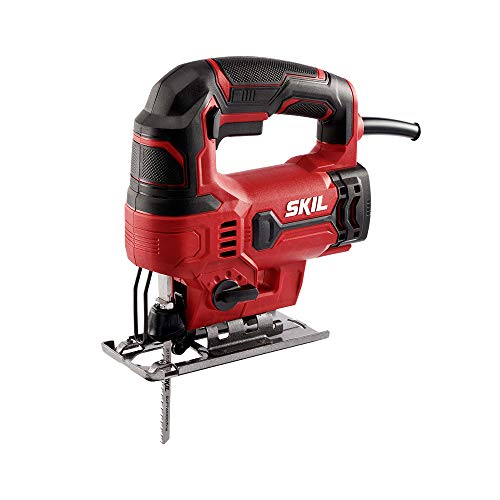
The SKIL JS313101 suits a beginner who wants a simple corded jigsaw with clear, step-by-step cutting controls. Its four-stage orbital system lets you choose a smoother setting for a clean edge or a more aggressive setting for faster progress through plywood, and the variable-speed control helps you slow down for a tight curve or a delicate piece of trim. The corded design means you do not need to manage batteries or charging while you learn, and the saw is well suited to a bench setup with clamps and a marked cut line. It is a solid choice for shelving, craft panels, and home repair cutouts.
Specs
- Motor: 5 amp
- Orbital cutting: 4-stage orbital cutting system
- Speed control: Variable speed control up to 3,000 strokes per minute
- Blade change: Tool-less blade clamp
- Model number: JS313101
- Power source: Corded
Best for: Learning orbital and variable-speed cutting on plywood, shelving, and trim with a straightforward corded jigsaw.
Watch out for: Check that the blade clamp holds the blade without slipping, and confirm the orbital setting and speed are set for your material before the blade touches the wood.
Which One Fits Your Situation
You Want One Quiet Tool for Small Woodworking Projects
Choose the SUIZAN Ryoba Double Edge Saw 9.5″ if your first projects are boxes, frames, small furniture, and trim. Its pull-stroke cutting and double edge give you control and a clean edge without an outlet, a cord, or sawdust blown across a room. It is the best starting point when you want to learn how a blade behaves in wood before you add a power tool to your bench.
You Need to Cut Boards to Length Around the Home
Choose the IRWIN Hand Saw, Coarse Cut, ProTouch Handle, 15-Inch if most of your work is shortening boards, trimming timber, and cutting shelving to size. Its longer blade and coarse teeth move through softwood quickly, and its simple design means you can start work as soon as you have marked the line. Keep the SUIZAN Ryoba for finer work and use this IRWIN saw for the larger, rougher cuts.
You Need Curves, Circles, and Trim Joints
Choose the IRWIN Tools ProTouch Coping Saw (2014400) if your projects involve curved shapes, circular cutouts in thin panels, or the coped joints used where two pieces of moulding meet. Its narrow blade follows a line that a straight saw cannot follow, and its light frame helps you steer through tight turns. For larger curved cuts in plywood, move up to one of the jigsaws below instead.
You Want a First Power Saw for Plywood and Cutouts
Choose the BLACK+DECKER Jig Saw, Smart Select, 5.0-Amp (BDEJS600C) if you want a corded jigsaw that helps you match the orbital setting to the curve. Its dial makes the learning curve shorter, and its tool-free blade change keeps the focus on the cut rather than on setup. Choose the SKIL 5 Amp Corded Jig Saw – JS313101 instead if you prefer a four-stage orbital system and a variable-speed control for a steadier introduction to powered cutting.
Common Mistakes
- Starting a cut without clamping the workpiece, which lets the board move and pulls the blade off the line.
- Pushing a hand saw too hard instead of letting the teeth do the work, which bends the blade and leaves a rough edge.
- Using a coarse blade for a visible furniture edge, where a finer tooth pattern would leave a cleaner finish.
- Forcing a jigsaw around a tight curve at full speed, which can snap the blade or tear the surface of the wood.
- Skipping a practice cut on scrap wood before cutting the real piece, especially when trying a new blade or a new orbital setting.
Frequently Asked Questions
What is the easiest type of saw for a complete beginner?
A hand saw is usually the easiest place to start because it needs no power, makes little noise, and gives you direct feedback on how the blade moves through wood. A general hand saw handles straight cuts in boards and shelving, while a pull saw such as the SUIZAN Ryoba adds control for finer work. A jigsaw is the easiest power saw for a beginner once you have a bench and clamps, because it can cut curves and straight lines with a guided, steady motion.
Should a beginner choose a hand saw or a jigsaw first?
Choose a hand saw first if your projects are mostly straight cuts, small repairs, and work in a shared or quiet space. Choose a jigsaw first if your projects include circles, cutouts, and curved shapes in plywood or trim, because a hand saw cannot follow those lines easily. Many beginners start with a hand saw for general cutting, then add a corded jigsaw when they need curves and faster progress through sheet material.
How do I keep a cut straight when I am learning?
Mark the line clearly, clamp the workpiece so it cannot move, and start with short, light strokes to form a groove on the line before you lengthen each stroke. Keep your wrist straight, watch the blade rather than the handle, and let the teeth cut at their own pace. With a jigsaw, keep the shoe flat on the workpiece, follow the line at a steady speed, and slow down before a corner so the blade does not wander.
When should I replace a saw blade?
Replace a blade when it needs noticeably more force to move through wood, leaves a scorched or torn edge, or wanders away from the line even when your grip and setup have not changed. A dull blade also makes a jigsaw vibrate more and a hand saw bind in the cut. Keep a spare blade in the size and tooth pattern you use most, and check the teeth for damage after the saw has been stored or dropped.