Key takeaways
- Compare the best 135Ah lithium batteries in LiFePO4 form, with 12V and 36V picks for RV, marine, solar and golf cart use, plus BMS, charging and sizing guidance.
As an Amazon Associate we earn from qualifying purchases.
Affiliate Disclosure: This article contains affiliate links. If you buy through a link on this page, we may earn a commission at no extra cost to you.
Introduction
A 135Ah lithium battery sits in an awkward but useful middle ground. It holds noticeably more energy than the very common 100Ah size, yet it usually stays in a single, movable case instead of forcing you into a large rack or a bank of smaller batteries wired together. For an RV house bank, a trolling motor, a small off-grid solar setup or a golf cart conversion, that extra capacity can be the difference between running through the night comfortably and watching the voltage fall earlier than you planned.
There is a catch, and it shapes this entire guide. The keyword is about capacity, not voltage. A 135Ah rating means very different amounts of stored energy depending on whether the battery is a nominal 12.8V, 36V or 48V unit, because energy is capacity multiplied by voltage. A 12V 135Ah battery stores roughly 1.73 kilowatt-hours. A 36V battery with the same amp-hour rating stores about three times that. They are not interchangeable, they do not use the same charger, and they must never be swapped into each other’s systems. So this guide is organised by voltage first and by brand second.
A second, equally important rule applies here. Every pick below is a genuine 135Ah lithium iron phosphate (LiFePO4) battery. We did not fill the list with 100Ah or 200Ah models and call them close enough, because a buyer searching for this exact capacity usually has a battery box, a weight limit, a runtime calculation or a golf cart tray that was measured around it. Where the market is thin — and at exactly 135Ah it is thinner than at 100Ah — we say so openly instead of padding the list.
Quick Picks
- Dakota Lithium 12V 135Ah LiFePO4 Deep Cycle Battery (ASIN: B0CBMZ5GZF) — Best 12V all-rounder, from an established lithium brand, for RV, marine and dual-purpose starting and deep-cycle work.
- KEPWORTH 12V 135Ah LiFePO4 Battery, model KEP12V135Ah332BT (ASIN: B0DJLVSWQJ) — Best 12V value-style pick, a Group 31 format battery with a 100A BMS and Bluetooth monitoring.
- E-LekTech 36V 135Ah LiFePO4 Golf Cart Battery, model GC-BT-36V (ASIN: B0DQSM1WHG) — Best 36V pick, built for 36V golf carts, with a 200A BMS and a charger-included kit format.
Availability note: listings at this exact capacity change seller and stock status frequently. Check the live Amazon US listing for the exact ASIN before ordering, and confirm the voltage in the listing title matches your system.
What 135Ah Actually Gives You
Amp-hours describe how much charge a battery can deliver, not how much energy it holds on its own. Multiply by nominal voltage to get watt-hours. At 12.8V, 135Ah works out to about 1,728 watt-hours. At 36V, the same 135Ah is about 4,860 watt-hours. That is why two batteries with identical amp-hour labels can power completely different vehicles and loads.
In practical 12V terms, a single 135Ah LiFePO4 battery suits a camper or boat house bank running LED lighting, a compressor fridge, phone and laptop charging, a water pump and a small inverter for occasional mains-style loads. LiFePO4 chemistry allows a much deeper usable discharge than lead-acid, so more of that nameplate capacity is genuinely available day to day, and the flat discharge curve means voltage stays steadier for longer instead of sagging steadily from the moment you start drawing power.
For golf carts the maths is different. A 36V or 48V cart needs a battery built and configured for that system voltage, usually replacing a set of series-wired lead-acid batteries with a single lithium pack plus a matching charger. Runtime then depends on the motor, controller, terrain, load and driving style, so treat any range claim as an estimate for a specific cart rather than a promise for yours.
1. Dakota Lithium 12V 135Ah LiFePO4 Deep Cycle Battery
ASIN: B0CBMZ5GZF
Dakota Lithium is one of the better-known names in the 12V lithium market, and its 135Ah deep-cycle battery is the most straightforward answer for a buyer who wants this capacity in a conventional 12V system. It is a LiFePO4 battery aimed at RV and marine house power, off-grid solar storage, trolling motors and, in the maker’s dual-purpose line, engine starting duties as well. Always confirm on the live listing which exact variant the ASIN currently resolves to, because Dakota sells closely related 135Ah models and the dual-purpose version carries different starting specifications from a pure deep-cycle unit.
The appeal of this pick is the support structure behind it. Dakota Lithium publishes full specification sheets, sells matched LiFePO4 chargers, and has a long trading history in this category, which matters for a battery you expect to keep for many seasons. LiFePO4 cells in this class are typically rated for thousands of cycles at deep discharge, far beyond the few hundred cycles expected from a comparable lead-acid battery, and the built-in battery management system (BMS) protects against over-charge, over-discharge, over-current and short circuit events.
For cold-climate users, check whether the specific variant includes an internal heating function for charging below freezing. Charging a LiFePO4 battery in sub-zero conditions without low-temperature protection can damage the cells, and not every 135Ah model handles this the same way. If your battery lives in an unheated RV bay or a boat through winter, that single feature may matter more than any headline specification.
Choose this battery if you want the established-brand route in 12V, you value published documentation and charger matching, and your application is a house bank, trolling motor or dual-purpose installation rather than a golf cart traction pack.
2. KEPWORTH 12V 135Ah LiFePO4 Battery (KEP12V135Ah332BT)
ASIN: B0DJLVSWQJ
The KEPWORTH 12V 135Ah is a Group 31 format LiFePO4 battery built around a 100A BMS, with a stated capacity of 135Ah and total energy of about 1,728 watt-hours at its 12.8V nominal voltage. Group 31 is a familiar footprint in RV, marine and solar installations, so this battery is aimed squarely at buyers replacing a large lead-acid battery in an existing box or tray, rather than at golf cart owners.
The 100A continuous BMS rating is the specification to plan around. At 12V, 100 amps of discharge supports roughly 1,200 watts of continuous load through an inverter, before allowing for inverter losses. That covers a fridge, lights, pumps, device charging and modest inverter use comfortably, but it is not the battery for a large inverter running high-draw appliances continuously. If your load plan includes sustained high wattage, either parallel a second identical battery where the maker allows it, or step to a different capacity class entirely rather than over-drawing this one.
Bluetooth monitoring is the other headline feature on this model, letting you check state of charge, voltage and current from a phone app instead of relying on the rough estimate a simple voltage reading gives with lithium’s flat discharge curve. Treat app readings as a helpful guide rather than a laboratory instrument, and still fit a proper shunt-based monitor if precise state-of-charge tracking matters for a larger solar system.
One clear limit from the maker’s positioning: this style of deep-cycle battery is not intended for engine starting or for golf cart traction use. Respect that boundary. A house battery and a starting or traction battery face very different current demands, and using the wrong type risks BMS shutdowns under load.
Choose the KEPWORTH if you want a Group 31, 12V, 135Ah house battery with app monitoring for an RV, boat or solar setup, and your continuous loads sit comfortably within a 100A discharge ceiling.
3. E-LekTech 36V 135Ah LiFePO4 Golf Cart Battery (GC-BT-36V)
ASIN: B0DQSM1WHG
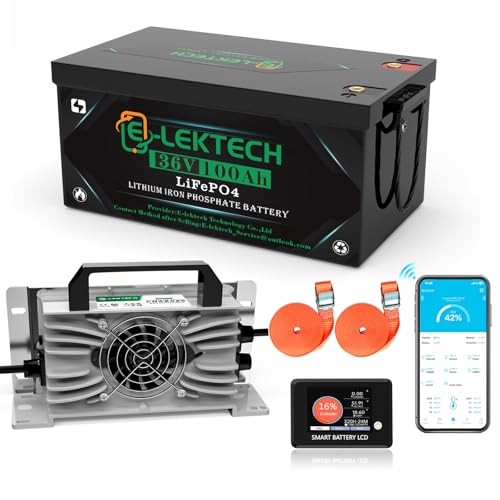
Step up in voltage and the E-LekTech GC-BT-36V is a purpose-built 36V 135Ah LiFePO4 battery for 36V golf carts. At 36V, its 135Ah capacity equals about 4,860 watt-hours of stored energy, and the maker rates the pack for a maximum load power of 7,680 watts with a 200A continuous discharge through its built-in smart BMS. The battery weighs about 96 pounds according to the maker’s published figures — heavy in absolute terms, but substantially lighter than the set of lead-acid batteries a 36V cart would otherwise carry.
The BMS protection list covers the events that actually kill lithium packs or cause nuisance shutdowns: over-charge, over-discharge, over-current and temperature protection. The maker states a cycle life in the region of ten thousand cycles under its test conditions and offers a long warranty period; treat headline cycle numbers across all brands as laboratory-condition figures, since real life — heat, deep discharges, high charge rates — shortens any battery’s working life.
Kit contents matter with golf cart conversions. Listings for this class of E-LekTech battery commonly bundle the battery with a matched charger and, on some variants, a state-of-charge monitor. Confirm exactly what the live listing for this ASIN includes before ordering, because converting a cart from lead-acid also requires a LiFePO4-profile charger matched to 36V — reusing an old lead-acid charger is one of the most common conversion mistakes and can undercharge the pack or trip its protection.
This battery is only for 36V systems. It does not suit a 48V cart, it is not a 12V house battery, and wiring it into the wrong system is not a matter of reduced performance but of incompatibility. Check your cart’s system voltage from its existing battery configuration or controller label before you buy anything.
Choose the E-LekTech if you own a 36V golf cart, want a single-pack lithium conversion at exactly 135Ah, and will install the matched charger the chemistry requires.
Why There Are Only Three Picks
Honesty about this capacity class matters more than a long list. Several other 135Ah listings exist on Amazon US, particularly in 48V golf cart form, but when we checked them the indexed listings showed no featured offer available, which means we could not treat them as reliably buyable and left them out rather than recommend a product you may not be able to order. Listings at this capacity also appear and disappear faster than at 100Ah, and some are sold under short-lived marketplace brand names with limited documentation.
If you cannot find a 135Ah battery in stock from a seller you trust, the sensible alternatives are a well-documented 100Ah model from an established brand, accepting less capacity, or a properly engineered parallel pair — never an unbranded listing chosen only because the number on the case matches. Capacity is one specification; the BMS rating, cell quality, warranty support and charger matching decide how the battery behaves over years of use.
How to Choose a 135Ah Lithium Battery
Match the voltage first. This is non-negotiable. A 12V system needs a 12V battery or a series configuration the maker explicitly approves; a 36V cart needs a 36V pack; a 48V cart needs a 48V pack. No adapter or setting changes a battery’s native voltage.
Check the BMS continuous rating against your loads. Divide your largest continuous wattage by system voltage to estimate the current draw, then compare it with the BMS continuous discharge rating, leaving headroom. A battery whose BMS trips under your normal load is the wrong battery, whatever its capacity says.
Confirm the physical fit. Measure the battery box or tray and compare length, width and height, plus terminal position and type. Group 31 is common at this capacity in 12V, but golf cart packs vary widely in shape, and a battery that does not fit the tray is a return waiting to happen.
Plan the charger at the same time. LiFePO4 needs a charger with a lithium profile and the correct voltage for the pack. Budget for it, check whether a kit includes it, and never assume a lead-acid charger with an equalise mode is suitable — equalisation voltages can damage lithium cells.
Think about temperature. If the battery will be charged below freezing, look for low-temperature charge protection or a heated model. If it will live in a hot compartment, expect faster ageing and keep ventilation in mind.
Read the warranty terms, not just the headline. Warranty length, who provides support, and whether the seller is the manufacturer or a reseller all affect what a warranty is worth in practice.
Charging and Installation Basics
Install the battery with correctly sized cables for the current involved, secure it against movement, and torque terminal connections to the maker’s specification. Loose terminals cause voltage drop, heat and intermittent BMS trips that can look like a faulty battery. For series or parallel configurations, only combine identical batteries of the same age and capacity, and only in arrangements the manufacturer explicitly permits — some 12V LiFePO4 batteries allow limited series connection, others prohibit it entirely.
For solar charging, set the charge controller to a LiFePO4 profile or enter the maker’s recommended charge voltage manually, and disable equalisation. For storage, LiFePO4 batteries are generally happiest stored partially charged rather than full or empty, and they self-discharge slowly, but check the state of charge every few months during long storage rather than forgetting the battery for a year.
Frequently Asked Questions
How long will a 12V 135Ah battery run my fridge? It depends on the fridge’s actual consumption, ambient temperature and how often the door opens. Work it out from watt-hours: the battery holds about 1,728 watt-hours in total, and a typical 12V compressor fridge might use a few hundred watt-hours per day, giving several days of runtime before other loads are counted. Measure your own fridge for a real answer.
Can I replace a 100Ah battery with a 135Ah battery? Usually yes in a 12V house system, provided the physical size fits, the charger profile suits LiFePO4, and your cabling and fusing suit the BMS current rating. The system does not need to be reprogrammed for the larger capacity in most simple installations, though a battery monitor should be told the new capacity to report state of charge accurately.
Can I use a 135Ah lithium battery for engine starting? Only if the specific model is rated for starting or dual-purpose use, with a stated cranking specification. A deep-cycle-only model with a 100A BMS is not a starting battery, however large its capacity sounds.
Are 36V and 48V 135Ah golf cart batteries interchangeable? No. The cart’s motor and controller are built for one system voltage. Fitting the wrong voltage pack can damage components or simply not work. Confirm your cart’s voltage before ordering.
Why do listings for this capacity disappear? The 135Ah class is a niche between the mass-market 100Ah size and larger rack or cart packs, so fewer factories tool for it and marketplace sellers rotate stock. If you find a documented model from a seller you trust, that is usually a better buy than waiting for a perfect listing that may not return.
Conclusion
The best 135ah lithium battery is the one whose voltage matches your system, whose BMS rating covers your loads, and whose maker publishes real documentation. In 12V, the Dakota Lithium 135Ah suits buyers who want an established brand for RV, marine and dual-purpose work, while the KEPWORTH 135Ah offers a Group 31 house battery with Bluetooth monitoring for loads within its 100A ceiling. In 36V, the E-LekTech GC-BT-36V is a purpose-built golf cart pack at exactly this capacity. Whichever you choose, verify the live listing and ASIN before ordering, plan the matched charger alongside the battery, and treat any 135Ah listing without a featured offer or documentation as a reason to keep looking rather than a bargain.