Our Short List of 3

- Best for: Players who want a sharp 120Hz display and a 1TB library in one laptop.
- Display: 16-inch WQXGA, 2560 by 1600, 120Hz, 300 nits brightness
- Processor: Intel Core 7 240H, 10 cores, up to 5.2 GHz with Turbo Boost
- Graphics: NVIDIA GeForce RTX 5050, 8GB GDDR7
- Memory: 16GB DDR5
- Best for: Daily carry and long sessions where durability and a fast panel matter.
- Display: 16-inch FHD+, 1920 by 1200, 165Hz, IPS-level, full sRGB
- Processor: Intel Core i5-13450HX
- Graphics: NVIDIA GeForce RTX 5050, 115W maximum graphics power
- Memory: 16GB DDR5
- Best for: Budget-conscious players who want a fast screen and 1TB of storage.
- Display: 15.6-inch Full HD IPS, 1920 by 1080, 165Hz
- Processor: Intel Core i7-13620H, 10 cores
- Graphics: NVIDIA GeForce RTX 4050 Laptop GPU, 6GB GDDR6
- Memory: 16GB DDR5, expandable to 32GB
All 4 Picks at a Glance
| Product | Specs | Action |
|---|---|---|
| Alienware 16 Aurora |
| Check price on Amazon |
| ASUS TUF Gaming F16 |
| Check price on Amazon |
| Acer Nitro V 15 |
| Check price on Amazon |
 Lenovo LOQ 15 |
| Check price on Amazon |
Key takeaways
- Compare four 120Hz gaming laptops with RTX graphics, high-refresh displays, 16GB of memory and fast SSD storage, and pick the model for your games.
A 120Hz gaming laptop changes the decision from raw frame rates to balance. The panel can show up to 120 frames each second, so fast movement stays readable and aiming feels connected to the screen, but that smoothness only matters when the graphics card, processor, memory and storage can keep up. A quick panel with a weak graphics card will still stutter in demanding scenes, while a strong graphics card with a dim, slow panel wastes much of its output. The real choice is therefore a matched set of parts, not a single headline number.
This guide is for competitive players who want clearer motion in shooters and racing games, for story-driven players who want smooth camera movement without a desktop, and for students and workers who need one laptop for classes, office work and evening play. Every laptop below was chosen from the name and specifications shown on its Amazon product page, with the display refresh rate, graphics card, processor, memory and storage taken from that listing.
Quick Picks
As an Amazon Associate we earn from qualifying purchases
| Product | Best for | Key spec from title |
|---|---|---|
| Alienware 16 Aurora | Sharp 120Hz play at higher resolution | 16-inch 120Hz WQXGA display, RTX 5050 |
| ASUS TUF Gaming F16 | Tough daily gaming with a fast panel | 16-inch FHD+ 165Hz display, RTX 5050 |
| Acer Nitro V 15 | Value gaming with a large game library | 15.6-inch FHD IPS 165Hz display, RTX 4050 |
| Lenovo LOQ 15 | Smooth 144Hz play with tear-free sync | 15.6-inch FHD IPS 144Hz display, RTX 5050 |
How to Choose
Read the refresh rate as a floor, not a target
A 120Hz panel refreshes 120 times each second, twice the motion clarity of a standard 60Hz screen, so fast movement stays readable and aiming feels connected to the screen. Panels rated at 144Hz and 165Hz clear that floor and show even more frames when the graphics card can deliver them. What matters is whether the graphics card can sustain frame rates near the panel speed in the games you play. A competitive shooter at reduced settings may reach those frame rates easily, while a ray-traced open-world title may sit well below them. Resolution matters too, because a 2560 by 1600 panel asks far more of the graphics card than a 1920 by 1080 panel at the same refresh rate.
Match the graphics card to the resolution
The graphics card decides which settings and resolutions stay smooth. An RTX 5050 with 8GB of graphics memory suits 1080p and 1200p play at high settings and can stretch to 1600p in lighter titles, while an RTX 4050 with 6GB of graphics memory is a better fit for 1080p play where texture quality and ray tracing stay moderate. Graphics memory matters because modern games load large textures, and a card that runs out of it will stutter even when its core is fast enough. Look for the exact card in the listing title rather than a family name, and confirm whether the listing states a power limit, since the same card can behave differently at different wattages.
Do not accept 8GB of system memory
Sixteen gigabytes of DDR5 memory is the sensible starting point for a gaming laptop in this class, because games, a browser, voice chat and a launcher can easily fill 8GB before play even begins. DDR5 also moves data faster than older DDR4 in most current designs, which helps when a game streams assets during play. Storage deserves the same attention: a 512GB SSD holds the operating system and a handful of large games, while a 1TB SSD gives room for a library, recordings and updates without constant uninstalling. Check whether the listing states a memory ceiling, because a laptop that can grow from 16GB to 32GB is far easier to keep useful for several years.
Check the panel, keyboard and ports before you commit
Refresh rate is only one part of the display. Brightness near 300 nits keeps the image readable in a bright room, and full sRGB colour coverage makes game worlds and video look richer than a narrow-gamut panel. An IPS panel also holds its colours when viewed from an angle, which matters when the laptop sits on a shared desk. The keyboard should be backlit for evening play, and a numeric keypad helps in strategy games and spreadsheets alike. Ports decide what else the laptop can do: a USB-C port with display output, an HDMI port for a television or monitor, and an Ethernet port for stable online play are all worth confirming on the listing.
The 4 Best Options
Alienware 16 Aurora
- Best for: Players who want a sharp 120Hz display and a 1TB library in one laptop.
- Display: 16-inch WQXGA, 2560 by 1600, 120Hz, 300 nits brightness
- Processor: Intel Core 7 240H, 10 cores, up to 5.2 GHz with Turbo Boost
- Graphics: NVIDIA GeForce RTX 5050, 8GB GDDR7
- Memory: 16GB DDR5
Players who want a sharp 120Hz display and a 1TB library in one laptop.
The higher resolution asks more of the graphics card, so check your settings in demanding titles.
The Alienware 16 Aurora is the only laptop here with a panel rated at exactly 120Hz, and it pairs that panel with the sharpest resolution in the group, so it suits players who want crisp detail as well as smooth motion. Its 16-inch WQXGA display shows 2560 by 1600 pixels, which makes distant enemies and fine textures easier to read, while the RTX 5050 graphics card and 16GB of DDR5 memory keep modern games moving at high settings. The larger screen and the 1TB SSD also make it a comfortable single machine for study or work during the day and play at night.
ASUS TUF Gaming F16
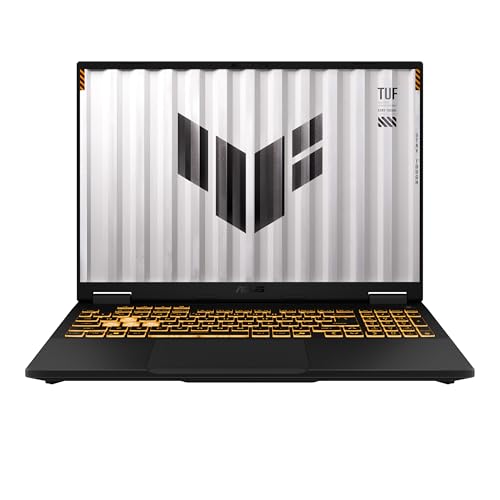
- Best for: Daily carry and long sessions where durability and a fast panel matter.
- Display: 16-inch FHD+, 1920 by 1200, 165Hz, IPS-level, full sRGB
- Processor: Intel Core i5-13450HX
- Graphics: NVIDIA GeForce RTX 5050, 115W maximum graphics power
- Memory: 16GB DDR5
Daily carry and long sessions where durability and a fast panel matter.
The 512GB SSD fills quickly with large games, so plan storage before you install a full library.
The ASUS TUF Gaming F16 is built for players who carry their laptop everywhere and want a durable chassis behind a fast screen. Its 16-inch FHD+ display runs at 165Hz with full sRGB colour coverage, so motion stays smooth well beyond the 120Hz floor and colours stay vivid in both games and video. The Intel Core i5-13450HX processor and RTX 5050 graphics card handle 1200p play confidently, and the listing states a 115W maximum graphics power limit, which helps frame rates stay steady during long sessions rather than fading as the machine warms up.
Acer Nitro V 15
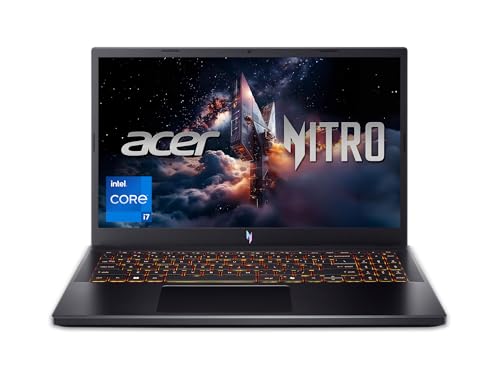
- Best for: Budget-conscious players who want a fast screen and 1TB of storage.
- Display: 15.6-inch Full HD IPS, 1920 by 1080, 165Hz
- Processor: Intel Core i7-13620H, 10 cores
- Graphics: NVIDIA GeForce RTX 4050 Laptop GPU, 6GB GDDR6
- Memory: 16GB DDR5, expandable to 32GB
Budget-conscious players who want a fast screen and 1TB of storage.
The RTX 4050 has 6GB of graphics memory, so keep texture settings moderate in the newest titles.
The Acer Nitro V 15 is the value pick for players who want a fast panel and a large drive without paying for the newest graphics tier. Its 15.6-inch Full HD IPS display runs at 165Hz, which gives competitive games the same smooth motion as the more expensive models here, while the Intel Core i7-13620H processor and RTX 4050 graphics card cover 1080p play at solid settings. Sixteen gigabytes of DDR5 memory can grow to 32GB, and the 1TB Gen 4 SSD holds a proper library, so this laptop stays useful as games grow larger.
Lenovo LOQ 15
- Best for: Players who want tear-free 144Hz play with strong cooling.
- Display: 15.6-inch Full HD IPS, 1920 by 1080, 144Hz, full sRGB, 300 nits, G-Sync
- Processor: Intel Core i7-13650HX
- Graphics: NVIDIA GeForce RTX 5050, 8GB GDDR7
- Memory: 16GB DDR5, expandable to 32GB
Players who want tear-free 144Hz play with strong cooling.
The listing has shown different sellers over time, so confirm the seller and the exact model number before ordering.
The Lenovo LOQ 15 suits players who hate screen tearing and want a calm, steady image in fast games. Its 15.6-inch Full HD IPS display runs at 144Hz with full sRGB colour, 300 nits of brightness and G-Sync support, which synchronises the panel with the graphics card to reduce tearing and stutter. The Intel Core i7-13650HX processor and RTX 5050 graphics card give it more headroom than the RTX 4050 models, and the Hyperchamber cooling design with twin fans and copper heat pipes is built to keep temperatures in check during long matches.
Which One Fits Your Situation
You want the sharpest image at 120Hz
Pick the Alienware 16 Aurora. Its 2560 by 1600 panel shows more detail than any other display here, and its 120Hz refresh rate is exactly the standard this guide is built around. The RTX 5050, 16GB of DDR5 memory and 1TB SSD keep that sharper image moving, so it fits players who notice texture detail and distant targets.
You carry your laptop everywhere
Pick the ASUS TUF Gaming F16. Its durable chassis and 16-inch 165Hz display survive daily travel better than a delicate design, and the 115W graphics power limit keeps frame rates steady in long sessions. The trade-off is the smaller 512GB SSD, so keep your active library lean or add storage later.
You want the most storage for the least spend
Pick the Acer Nitro V 15. It pairs a 165Hz Full HD display with a 1TB Gen 4 SSD and 16GB of DDR5 memory that can grow to 32GB, so a large game library fits without constant uninstalling. The RTX 4050 suits 1080p play, which is the right match for its panel.
You hate tearing and stutter in fast games
Pick the Lenovo LOQ 15. Its 144Hz panel with G-Sync synchronises refresh with the graphics card, and the Hyperchamber cooling helps frame rates stay steady in long matches. The RTX 5050 and 16GB of memory give it room for demanding titles at 1080p, while the 1TB SSD holds a full library without constant uninstalling.
Common Mistakes
- Buying a 120Hz panel with a weak graphics card and expecting every game to reach 120 frames each second.
- Choosing 8GB of memory to save money, then watching games and background apps compete for the same small pool.
- Picking a 512GB SSD for a large library and spending more time uninstalling games than playing them.
- Ignoring brightness and colour coverage, then finding the panel washed out in a bright room.
- Assuming every listing with the same model name has the same graphics card, memory and storage, when sellers vary the configuration.
Frequently Asked Questions
Is 120Hz enough for competitive gaming?
Yes, 120Hz is a clear step up from 60Hz and shows motion smoothly enough for most competitive play, with faster camera movement and steadier tracking. Panels at 144Hz and 165Hz add a little more headroom, but the gain is smaller than the jump from 60Hz to 120Hz, and the graphics card matters more than the extra hertz once you pass 120Hz.
Do I need an RTX 5050, or is an RTX 4050 enough?
An RTX 4050 is enough for 1080p play at solid settings, especially in competitive titles and older games. An RTX 5050 with 8GB of graphics memory gives more room for higher settings, larger textures and higher resolutions such as 1200p and 1600p, so choose it when you play demanding new titles or want the laptop to stay capable for longer.
How much storage should a gaming laptop have?
A 1TB SSD is the safer choice for most players, because modern games often take tens of gigabytes each and updates add more over time. A 512GB SSD works when you play only a few games at a time and uninstall finished titles, but it fills quickly once a library grows, so check for a second drive slot before you buy.
Can a 120Hz gaming laptop also work for school and office tasks?
Yes, all four laptops here run Windows 11 Home with a backlit keyboard and Wi-Fi, so they handle documents, video calls, browsing and study software alongside games. The larger 16-inch models give more screen room for split windows, while the 15.6-inch models travel more easily, so pick the size that fits your bag and desk.