Key takeaways
- Compare five resin printers for prototype studios on build volume, XY resolution and speed, with heated vats and large-format MSLA options from Amazon.
A prototype studio does not buy a resin printer for its headline resolution number. The real decision is which machine keeps client work moving: a plate wide enough for the parts you quote, pixel sizes fine enough that surfaces need little finishing, and heating and monitoring features that stop a cold room or an empty vat from wasting a day of billable time.


This guide is for product design studios, model shops and small engineering teams choosing a workhorse resin machine. Every pick below is an MSLA (masked LCD) resin printer sold on Amazon US, and each specification is taken from that product’s own Amazon listing, including the build volume, screen resolution and speed figures quoted by the manufacturer.
Quick Picks
As an Amazon Associate we earn from qualifying purchases
| Product | Best for | Key spec from title |
|---|---|---|
| Anycubic Photon Mono M7 Pro | Fast daily turnaround on small parts | 14K 10.1-inch mono LCD, up to 170mm/h |
| Elegoo Saturn 4 Ultra 16K | Finest surface detail on prototypes | 16K mono LCD, 14 x 19 µm XY resolution |
| Uniformation GK3 Ultra | Large parts that still need detail | 16K 15120 x 6230 LCD, auto resin heating |
| Anycubic Photon Mono M7 Max | Biggest Anycubic build envelope | 13.6-inch 7K mono LCD, flip-open cover |
| Phrozen Sonic Mega 8K S | Batch runs across a wide plate | 15-inch 8K mono LCD, 330 mm wide plate |
How to Choose
Match the build volume to the parts you actually quote
Prototype work fails at the quoting stage when a part has to be split, printed in pieces and bonded before a client ever sees it. Measure your typical largest part, then leave margin for supports and rafts on every axis. A 10-inch class machine around 220 mm wide handles housings and brackets comfortably, while enclosure panels and full-scale mock-ups push you toward 300 mm class plates. Remember that Z height matters less often than plate width, because tall parts can usually be oriented, but a wide part cannot be shrunk.
Read pixel size, not just the K number
Screen resolution labels mislead when compared across plate sizes. A 16K screen stretched over a 13.5-inch plate produces larger pixels than a 14K screen on a 10.1-inch plate, and pixel size in micrometres is what decides how much sanding a curved surface needs before painting. Listings state XY resolution directly, for example 14 x 19 micrometres on the Elegoo below, so compare that figure first. For cosmetic prototypes that go straight to a client meeting, finer pixels beat a bigger screen almost every time.
Treat headline speed as a system, not a number
The millimetre-per-hour figures on listings assume the manufacturer’s high-speed resin, the matching release film and aggressive lift settings working together. Swap in a standard resin and the same machine slows down sharply. Tilt-release designs peel each layer with less Z travel, which helps on any resin, while heated vats keep viscosity low so exposure times stay short in a cold studio. When you cost a job, use the speed your chosen resin and film combination can sustain, not the number printed in the product title.
Budget for heating, monitoring and post-processing
Resin behaves badly below room temperature, so a heated vat or chamber is not a luxury in an unheated workshop; it is what keeps first layers attached in winter. Cameras and resin-level sensors earn their keep on overnight runs, when a failed print discovered at 9 a.m. costs a full day. Finally, none of these printers washes or cures parts, so a wash and cure station sized to your largest plate belongs in the same purchase decision, along with spare release film and LCD protectors.
The 5 Best Options
Anycubic Photon Mono M7 Pro
For studios turning around small functional prototypes daily, the Photon Mono M7 Pro is built around speed with control. Its 10.1-inch 14K screen keeps pixels fine on detailed parts, while the COB LighTurbo 3.0 light source and dynamic resin heating hold exposure steady when the workshop temperature drops. The plate suits housings, brackets and fit-check parts rather than full assemblies. Note that the headline print speed assumes high-speed resin and the matching fast film, so a studio chasing that pace should stock both from day one.
Specs
- Technology: LCD-based MSLA resin printing
- Screen: 10.1-inch mono LCD, 13312 x 5120 (14K)
- Build volume: 8.77 x 4.96 x 9.05 inches
- Maximum print speed: 170mm/h
- Light source: COB LighTurbo 3.0
- Z-axis accuracy: 0.01 mm
- Features: dynamic resin temperature control
Best for: Small studios that need fast, repeatable runs of palm-sized prototypes.
Watch out for: The 170mm/h figure applies to high-speed mode; standard mode is listed at a lower rate, and the fast ACF film is a consumable you will replace regularly.
ASIN: B0CYSBZX61
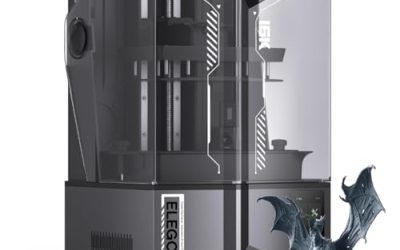
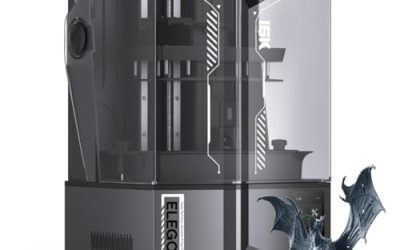
Elegoo Saturn 4 Ultra 16K
Detail-led studios should start here. The Saturn 4 Ultra 16K states an XY resolution of 14 x 19 micrometres, the finest figure in this line-up, which is exactly what cosmetic prototypes and master patterns for moulding need. Its tilt-release vat peels layers by rocking the tank instead of lifting the plate through a long Z move, supporting the listed speed, and the smart tank heater holds resin at a steady temperature. A built-in camera with a light watches the print, and Wi-Fi cluster printing lets a studio run several machines as one small farm.
Specs
- Technology: MSLA stereolithography
- Screen: 10-inch 16K mono LCD, 15120 x 6230 pixels
- XY resolution: 14 x 19 µm
- Build volume: 211.68 x 118.37 x 220 mm
- Layer thickness: 0.01 to 0.2 mm
- Maximum print speed: 150 mm/h
- Light source: COB, 405 nm wavelength
- Features: smart tank heating, AI camera, auto leveling, built-in Wi-Fi
Best for: Studios whose prototypes are judged on surface finish and fine features.
Watch out for: The listing’s featured offer status has fluctuated, so confirm the seller is Elegoo’s official store and that the 16K version, not the 12K, is selected before ordering.
ASIN: B0DT8PV51T
Uniformation GK3 Ultra
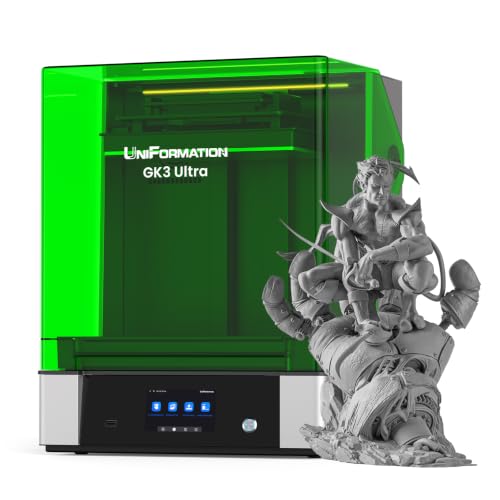
The GK3 Ultra answers the oldest resin-printing compromise: large parts usually mean coarse pixels. Its 16K screen spreads 15120 x 6230 pixels across a 13.5-inch plate, keeping pixel size at 20 x 26 micrometres over a build volume most 10-inch machines cannot approach. A heated chamber, a pressurised resin feed that keeps the vat topped up, and remote monitoring through the app suit a studio that queues big jobs and leaves them running. Ethernet alongside Wi-Fi and USB makes it easy to place on a workshop network.
Specs
- Technology: Masked SLA (MSLA) LCD resin printing
- Screen: 13.5-inch 16K LCD, 15120 x 6230 pixels
- Pixel size: 20 x 26 µm
- Build volume: 300 x 160 x 300 mm
- Connectivity: USB, Wi-Fi, Ethernet
- Features: auto resin heating, pressurised resin feed, remote monitoring
- Control: 5-inch capacitive touchscreen
- Machine weight: 30 kg
Best for: Studios printing large enclosures and full-scale mock-ups that still need presentable surfaces.
Watch out for: At 30 kg with a flip-up lid, this machine needs a permanent bench position with headroom; check your wash and cure station can take parts from a plate this size.
ASIN: B0DDX74P1Q
Anycubic Photon Mono M7 Max
Studios loyal to the Anycubic ecosystem get their biggest envelope here. The M7 Max stretches a 13.6-inch 7K screen over a plate far wider and taller than the M7 Pro’s, so assemblies that would need splitting on a mid-size machine print in one piece. You trade pixel fineness for that area: 7K across 13.6 inches gives noticeably larger pixels than the 16K machines above. Dynamic heating, the COB LighTurbo 3.0 source and a flip-open cover that saves the bench depth a lift-off hood needs round out a practical, production-minded package.
Specs
- Technology: LCD-based MSLA resin printing
- Screen: 13.6-inch mono LCD, 6480 x 3600 (7K)
- Build volume: 11.73 x 6.46 x 11.81 inches
- Maximum print speed: 60mm/h
- Light source: COB LighTurbo 3.0
- Z-axis accuracy: 0.01 mm
- Features: dynamic heating, flip-open cover design
Best for: Anycubic-equipped studios that have outgrown a 10-inch plate.
Watch out for: Anycubic sells this model through more than one listing with differently ordered dimension figures, so confirm the exact build volume on the listing page before quoting a job against it.
ASIN: B0DB8BF7R3
Phrozen Sonic Mega 8K S

Batch production is the Mega 8K S’s whole argument. Its 15-inch screen gives it the widest plate here at 330 mm across, and Phrozen’s listing rates the machine at printing dozens of small models in a single short run, which suits studios producing sets of identical parts, dental-style models or miniature masters. The 43-micrometre pixel size is the coarsest in this group, so individual surfaces need more finishing than the Saturn’s, but for volume work the arithmetic favours the big plate. A lift-up lid reduces the clearance the machine needs overhead.
Specs
- Technology: LCD/MSLA resin printing
- Screen: 15-inch 8K mono LCD
- XY resolution: 43 µm
- Print volume: 33 x 18.5 x 30 cm
- Layer thickness: 0.01 to 0.30 mm
- Average printing speed: 600 layers per hour
- Light source: 405 nm ParaLED Matrix
- Release film: ACF film
- Machine weight: 26 kg
Best for: Studios running batches of small parts across one wide plate.
Watch out for: The wide plate drinks resin, and the matching wash and cure capacity for 330 mm parts is a significant second purchase; confirm Phrozen’s large stations fit your bench.
ASIN: B0CF24PTPD
Which One Fits Your Situation
Your prototypes are judged on surface detail
Choose the Elegoo Saturn 4 Ultra 16K. Its 14 x 19 micrometre XY resolution is the finest stated here, and cosmetic parts, textured housings and mould masters come off the plate needing the least sanding before they are shown to a client or sent for casting.
You print large parts in one piece
Choose the Uniformation GK3 Ultra if detail still matters at size, since it holds 20 x 26 micrometre pixels across a 300 mm plate. Studios already running Anycubic machines and resin should take the Photon Mono M7 Max instead and accept coarser pixels for the familiar workflow.
You sell batches of identical small parts
Choose the Phrozen Sonic Mega 8K S. The 330 mm wide plate lets you nest far more small models per run than any 10-inch machine, and its stated layers-per-hour rate is aimed squarely at throughput rather than single showpiece prints.
Your studio is small and every job is urgent
Choose the Anycubic Photon Mono M7 Pro. It is the fastest-listed machine here for everyday part sizes, its heated resin handling suits an unheated room, and its footprint leaves bench space for the wash and cure station you will use just as often.
Common Mistakes
- Comparing K numbers across different screen sizes instead of the pixel size in micrometres stated on the listing.
- Quoting a client job from the headline print speed, then printing it in standard resin at half that pace.
- Buying a 300 mm class printer while owning a wash and cure station sized for a 10-inch plate.
- Ignoring vat heating in a cold workshop, then blaming the resin for first-layer failures all winter.
- Forgetting that release film and LCD screens are consumables, and leaving no budget or spares for either.
Frequently Asked Questions
Are these printers really SLA, or a different technology?
All five are MSLA machines: an LCD screen masks a UV light source to cure each resin layer, which is why the listings describe them as LCD or MSLA printers. Buyers search for them as SLA printers because the workflow and results are equivalent for prototyping, but no laser is involved in any machine listed here.
Do any of these printers wash and cure the finished parts?
No. Every pick in this guide is a printer only, and resin parts still need washing and a final UV cure before handling or delivery. Each manufacturer sells matching wash and cure stations, and the station must be sized to the printer’s plate, which matters most with the 300 mm class machines.
Which layer thickness should a studio use for prototypes?
The listings here support layers from 0.01 mm upward, but most prototype work runs at 0.05 mm, where surface quality and print time balance well. Drop to thinner layers only for the visible faces of cosmetic models, because halving layer height roughly doubles the layer count and the time a job occupies the machine.
Does a heated vat really change print reliability?
Yes, according to the way these listings present it: Elegoo, Anycubic and Uniformation all build heating into these models to hold resin near a set temperature. Cold resin flows poorly and cures less predictably, so in an unheated studio the heater is the difference between a routine overnight run and a plate of failed first layers.