Key takeaways
- Compare the best plunge saws for splinter-free track cuts, with corded and cordless picks covering depth, bevel range, dust extraction and guide rails.
Disclosure: As an Amazon Associate, we may earn from qualifying purchases made through links on this page, at no additional cost to you.


A plunge saw, also sold as a track saw, solves the problem that makes sheet goods so frustrating: getting a long, dead-straight, splinter-free cut in plywood, MDF or melamine without wrestling a full sheet across a table saw. The saw rides on an aluminium guide rail, the blade starts retracted inside the housing, and you plunge it into the work exactly where the cut begins. That lets you start a cut in the middle of a panel for a sink cut-out, trim a door in place, or break down a full sheet on sawhorses with a finish edge.
The trade-offs sit elsewhere: depth of cut is limited by the 6-1/2 inch blade class, rails and batteries are sometimes sold separately, and each brand locks you into its own track system.
This guide compares five plunge saws covering the main ways people buy into the category: a complete corded kit with the rail in the box, professional cordless options from the big battery platforms, and a corded value pick. Every model below is a genuine plunge/track saw, not a standard circular saw with a guide accessory.
Quick Picks
- Best complete corded kit: Makita SP6000J1 — 12 amp corded saw with the 55 inch guide rail and a stackable case included.
- Best cordless for Makita users: Makita XPS01PTJ — 36V (18V X2) brushless kit with two 5.0Ah batteries and a rapid charger.
- Best cordless for DEWALT users: DEWALT DCS520B — 60V MAX TrackSaw with continuous anti-kickback and a riving knife; bare tool.
- Best cordless for Milwaukee users: Milwaukee 2831-20 M18 FUEL — 6,300 RPM brushless plunge track saw with micro-adjust depth control; bare tool.
- Best value corded pick: WEN CT1065 — 10 amp plunge cut saw with a scoring setting and 2-1/3 inch capacity; track sold separately.
Makita SP6000J1 6-1/2″ Plunge Circular Saw Kit with 55″ Guide Rail (ASIN: B00CHN6L74)
See the Makita SP6000J1 on Amazon
The SP6000J1 is the kit most people picture when they decide to buy a track saw: a 12 amp corded saw, a 55 inch guide rail and a stackable tool case in one box. The motor uses a variable speed dial running from 2,000 to 5,200 RPM, with electronic speed control that holds blade speed steady under load and a soft start that keeps the saw from jerking when you pull the trigger. Cutting capacity is 2-3/16 inches at 90 degrees — enough for two layers of 3/4 inch sheet goods or a solid core door — and the bevel range runs from -1 to 48 degrees with positive stops at 22.5 and 45 degrees. The -1 degree setting is an undercut for scribing and cleaning up the back edge of a cut.
Makita builds the saw body with magnesium components to keep weight down, and adds details that matter on a rail: a lock-lever physically attaches the saw to the rail so it cannot tip off during bevel cuts, and an electric brake stops the blade quickly between cuts. The guide rail is included in this kit.
Highlights
– Complete kit: saw, 55 inch guide rail, 48-tooth blade and stackable case included
– 12 amp motor, variable speed (2,000–5,200 RPM), electronic constant-speed control
– 2-3/16 inch depth at 90 degrees; bevel -1° to 48° with positive stops
– Lock-lever keeps the saw attached to the rail during bevel cuts
Considerations
– Corded only, so you are tethered to an outlet or extension lead
– At 16.5 pounds in kit form it is the heaviest option here
– Long rips need a longer rail or a rail joiner beyond the included 55 inch rail
Makita XPS01PTJ 18V X2 LXT (36V) Brushless Cordless 6-1/2″ Plunge Circular Saw Kit (ASIN: B01IVTAO8Y)
See the Makita XPS01PTJ on Amazon
The XPS01PTJ takes Makita’s plunge saw cordless by running two 18V LXT batteries in series for 36V of output. The brushless motor reaches 6,300 RPM, and a variable speed dial lets you slow it to 2,500 RPM for plastics, aluminium or delicate veneers. Cutting capacity matches the corded Makita at 2-3/16 inches at 90 degrees, with the same -1 to 48 degree bevel range and positive stops at 22.5 and 45 degrees.
The kit is complete on the power side: two 18V LXT 5.0Ah batteries, a dual-port rapid charger that refills a battery in about 45 minutes, a 48-tooth blade, a hex wrench and a case. What is not in the box is the guide rail — the rail is sold separately, so budget for at least a 55 inch rail if you do not already own one.
Highlights
– 36V (18V X2) brushless motor with 2,500–6,300 RPM variable speed dial
– Kit includes two 5.0Ah batteries and a rapid charger
– Same 2-3/16 inch depth and -1° to 48° bevel range as the corded Makita
– Automatic Speed Change adjusts torque and speed during the cut
Considerations
– Guide rail is sold separately, adding to the real cost of getting started
– Runs on pairs of 18V batteries, so spares rotate in twos
– Heavier in hand than a single-battery saw once both packs are fitted
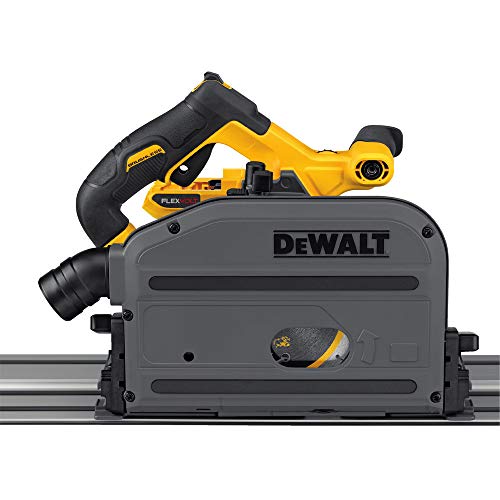
DEWALT DCS520B 60V MAX 6-1/2″ Cordless TrackSaw, Tool Only (ASIN: B0713M31RC)
See the DEWALT DCS520B on Amazon
DEWALT’s DCS520B runs on the 60V MAX FLEXVOLT platform and is built around its zero clearance TrackSaw cutting system: the saw runs on dual-edged tracks, so the splinter guard edge works cutting in either direction. The brushless motor turns the 6-1/2 inch blade at 1,750 to 4,000 RPM; capacity is 2-1/8 inches at 90 degrees and 1-5/8 inches at 45 degrees, with a bevel capacity of 47 degrees. The depth scale is calibrated for track thickness, removing a common source of error when setting plunge depth.
Safety hardware is where this saw makes its case. A continuous anti-kickback mechanism works with a riving knife to stop the saw climbing out of the cut if the blade binds, and the plunge action is a straight, vertical movement. The enclosed, low-profile blade guard gives the saw a stated 90 percent dust extraction capability with a vacuum connected. This listing is the bare tool: battery, charger and track are all sold separately, so it suits tradespeople already running FLEXVOLT batteries on site.
Highlights
– Continuous anti-kickback mechanism plus a riving knife
– Zero clearance dual-edged track system for splinter-free cuts in both directions
– Enclosed low-profile guard with a stated 90% dust extraction capability
– Depth scale calibrated for track thickness
Considerations
– Bare tool only — battery, charger and track are separate purchases
– Lower top speed (4,000 RPM) than the Makita and Milwaukee cordless saws
– DEWALT tracks are their own system; other brands’ rails do not fit
Milwaukee 2831-20 M18 FUEL 6-1/2″ Cordless Plunge Track Saw, Bare Tool (ASIN: B0F3NZ7H52)

See the Milwaukee 2831-20 on Amazon
Milwaukee’s entry runs on the M18 platform, for the many trades already carrying M18 batteries. The POWERSTATE brushless motor is listed at 6,300 RPM — the joint-fastest here — with a variable speed dial for sheet materials that chip or melt at full speed. A micro-adjust depth knob is the standout control: instead of relying only on the depth scale, you can nudge plunge depth in fine increments, exactly what you want for veneer-faced board or a groove stopped at a precise depth.
Kickback control comes from a riving knife that keeps the kerf open behind the blade, and bevel stops are set at 22.5, 45 and 48 degrees. Dust management is a strength: a vacuum port sized for 1-7/8 inch hoses plus a dust bag, with a stated collection efficiency above 90 percent with a vacuum connected. At 11.7 pounds it is one of the lighter cordless options. This is a bare tool — battery, charger and guide rail are sold separately.
Highlights
– 6,300 RPM POWERSTATE brushless motor on the M18 platform
– Micro-adjust depth knob for precise plunge depth control
– Riving knife, plus bevel stops at 22.5°, 45° and 48°
– Vacuum port and dust bag with a stated collection efficiency above 90%
Considerations
– Bare tool only — battery, charger and rail are separate purchases
– Milwaukee rails are a separate ecosystem from Makita and DEWALT tracks
WEN CT1065 10-Amp 6.5-Inch Plunge Cut Sidewinder Circular Track Saw (ASIN: B07VFXFTVP)
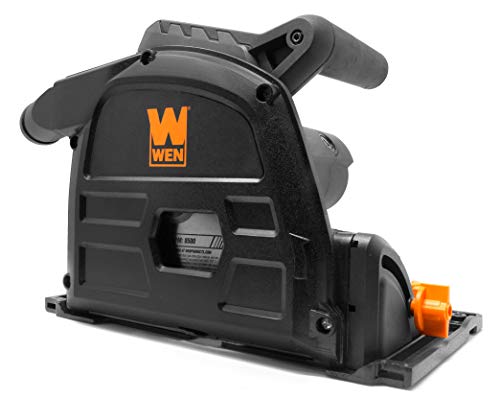
The CT1065 is the entry point into plunge cutting: a 10 amp corded saw in a sidewinder layout, with the blade on the left of the motor. That motor spins the included 6.5 inch, 24-tooth carbide-tipped blade at up to 5,500 RPM. Depth capacity is the surprise of the group — the saw rips boards up to 2-1/3 inches thick, slightly more than the professional saws above, and bevels to 45 degrees in stock up to 1-5/8 inches thick.
WEN gives the blade three working positions: a scoring setting that cuts about 1/8 inch deep to protect a veneered face from tear-out, a full plunge setting, and a blade-change position. The grooved base rides on WEN’s track system, and the saw can also be used off the track for internal cut-outs. Note the buying detail that matters most: the track is not included — the compatible WEN CT9502 100-inch track and clamps are separate purchases. A two-year warranty backs the saw.
Highlights
– 2-1/3 inch maximum depth of cut, the deepest in this guide
– Three blade settings, including a shallow scoring mode for veneered faces
– Included 24-tooth carbide blade with a 20 mm arbor
– Works on the track or standalone for internal cut-outs
Considerations
– Guide track sold separately (WEN CT9502); the saw alone cannot make guided cuts
– The 10 amp motor works harder in thick, dense hardwood than the 12 amp Makita
– The stock 24-tooth blade is a general-purpose grind; fine finishes need a higher-tooth blade
How to Choose
Start with power. Corded saws like the Makita SP6000J1 and WEN CT1065 deliver constant power for long ripping sessions and never stop for a battery swap, which suits a fixed workshop. Cordless models trade a little of that relentlessness for the freedom to break down sheet goods wherever they are stacked — and make the most sense when you already own batteries on that platform, because the bare-tool saws here need a battery, a charger and a rail before they cut anything.
Next, check what is in the box. The guided, splinter-free cutting that defines this category happens on the track, and only the SP6000J1 includes one (55 inch). Every other pick needs a rail purchase, so compare total system cost, not saw cost.
Depth and bevel come after that. Most 6-1/2 inch plunge saws cut a little over 2 inches at 90 degrees — enough for 2x material and doubled sheet goods — and bevel to about 45 to 48 degrees. If you scribe cabinets, a -1 degree undercut setting, offered by both Makitas, is worth having. Finally, dust: an enclosed guard and vacuum port make these saws usable indoors on a remodel.
Key Specifications Explained
Depth of cut. Measured at 90 degrees, and slightly less on the rail, because track thickness sits between blade and work. Check whether a maker’s headline figure is on-track or off-track before comparing saws.
Plunge mechanism. The blade retracts fully into the housing and is pushed down into the work by the operator. A straight plunge action, as on the DEWALT, moves the blade vertically; other designs pivot. Either way, it is what allows cuts that start in the middle of a panel.
Riving knife and anti-kickback. A riving knife is a thin plate behind the blade that keeps the kerf from closing and pinching the blade, the main cause of kickback in sheet goods. Some saws add an anti-kickback mechanism that brakes or locks the saw on the rail if it starts to climb.
Splinter guard and scoring. The rail’s replaceable splinter guard supports the wood fibres right at the cut line. A scoring pass — a shallow first cut, a dedicated setting on the WEN — severs those fibres before the full-depth cut for the cleanest result on melamine and veneer.
Dust extraction. An enclosed blade guard with a vacuum port captures dust at the source. Quoted figures assume a vacuum is connected; a dust bag alone collects noticeably less.
Track compatibility. Rails are not universal. Each brand uses its own profile, and a saw generally only runs on its own brand’s rails, so your first rail purchase commits you to that system.
Setup and Use Tips
Set up on a flat, supported surface. Sheet goods should be fully supported on a foam insulation board or a grid of battens on sawhorses, so the offcut cannot sag and pinch the blade as the cut finishes. Lay the rail on your marks with the splinter guard edge exactly on the cut line, and clamp the rail for any cut you cannot afford to have wander.
For a finish cut, set depth so the blade clears the bottom of the material by only a few millimetres; this reduces tear-out. Let the saw reach full speed before you plunge, and feed at a steady pace — a falling motor note means you are pushing too hard.
After the first cut on a new rail, the splinter guard is trimmed to your saw and blade, and from then on it shows the exact cut line. Keep that rail and blade paired, and replace the guard strip when it gets chewed up. A higher-tooth-count blade is the biggest single upgrade for finish work.
Common Mistakes to Avoid
- Buying the saw and forgetting the rail. Three of the five picks here are sold without a track. Without one you have a plunge saw but none of the guided accuracy the category exists for.
- Cutting unsupported sheet goods. A panel that sags mid-cut pinches the blade, which is how kickback and ragged cuts happen. Support the whole sheet, on both sides of the cut line.
- Skipping the scoring pass on faced materials. Melamine and veneer chip on the top face at full depth. The shallow scoring cut prevents it.
- Setting depth from the wrong reference. Depth scales may read off the base or account for the track. Too shallow leaves the panel joined at the bottom; too deep chews the support board.
- Mixing rail brands. A saw that almost fits another maker’s rail will rock in the track and cut inaccurately. Stay inside one rail system.
- Forcing the feed rate. Pushing faster than the motor can clear chips burns edges, deflects the blade and overheats the motor.
FAQ
What is the difference between a plunge saw and a regular circular saw?
A plunge saw’s blade retracts fully into an enclosed housing and is plunged into the work by the operator, and the saw is designed to ride on a guide rail. That allows cuts that start in the middle of a panel, dead-straight guided cuts with a splinter guard, and far better dust extraction than a standard circular saw offers.
Can a plunge saw replace a table saw?
For breaking down sheet goods and making long straight cuts, largely yes — that is the job these saws are built for. A table saw is still faster for repeated narrow rips and small parts, so most workshops treat the plunge saw as a complement, not a replacement.
Do I need the guide rail, or can I use the saw on its own?
You can plunge-cut freehand with saws like the WEN, which is useful for internal cut-outs, but the rail is what delivers straight, splinter-free edges. Every saw here is designed around its rail system, and for most buyers the rail is not an optional extra.
How deep can a plunge saw cut?
The 6-1/2 inch class covered here cuts roughly 2-1/8 to 2-1/3 inches at 90 degrees, depending on the model, and around 1-5/8 inches at a 45 degree bevel. That covers sheet goods, doors and most 2x lumber in a single pass.
Are track saw rails interchangeable between brands?
Generally no. Makita, DEWALT, Milwaukee and WEN rails use different profiles, and each saw is machined to fit its own system. The safe assumption when budgeting is that saw and rails must come from the same system.
Final Verdict
For most buyers, the Makita SP6000J1 is the easiest plunge saw to recommend: it is the only pick here that arrives with its guide rail in the box, its 12 amp motor holds speed under load, and its cut quality on sheet goods is the benchmark for the category. If you already own batteries, match the saw to your platform instead — the XPS01PTJ for Makita LXT users, the DEWALT DCS520B for FLEXVOLT users who value its anti-kickback hardware, and the Milwaukee 2831-20 for M18 users who will appreciate the micro-adjust depth control. The WEN CT1065 earns its place for occasional sheet work, provided you add the WEN track to the order. Whichever you choose, choose it as a system: saw, rail and a fine-tooth blade together produce the clean, straight cuts this category promises.