Key takeaways
- Four drills that handle hole saws well: high torque, low speed and the right chuck, compared for framing, doors, cabinets and tight joist bays.
A hole saw turns a drill into a circle cutter, and the drill decides whether the cut goes well or goes wrong. A large saw needs steady torque at low speed, a chuck that grips the arbor shank, and a body you can hold square when the teeth bite. A light drill built for pilot holes will stall, wobble and overheat on a two-inch cup, and a saw that binds can twist the drill out of your hands. Choosing the drill first, then the saw, saves both.


This guide is for electricians and plumbers boring studs and joists, remodelers cutting lockset and vent holes, and DIYers fitting doors, sinks and light cans. Every drill below was chosen from the name and specifications on its Amazon product page, with the hole-saw job in mind: torque at low speed, chuck size, and control when a saw catches.
Quick Picks
As an Amazon Associate we earn from qualifying purchases
| Product | Best for | Key spec from title |
|---|---|---|
| Milwaukee M18 FUEL Hole Hawg 2807-20 | Large holes between studs and joists | 1/2 in keyed chuck, right-angle head, 18V brushless |
| DEWALT 20V MAX XR Hammer Drill DCD1007B | The strongest straight drill for big saws | 2,100 in-lbs max torque, 3-speed, 1/2 in chuck |
| DEWALT 20V MAX ATOMIC Hammer Drill DCD799B | A light 1/2 in drill for medium saws | 552 UWO, up to 1,650 RPM, 2.53 lb, 1/2 in chuck |
| DEWALT 20V MAX Right Angle Drill DCD740B | Hole saws in tight bays and cabinets | 3/8 in chuck, dual speed 0-650/0-2,000 RPM, 4.0 in body |
How to Choose
Torque at low speed matters more than top speed
A hole saw cuts with a wide ring of teeth, so it needs turning force, not revolutions. A drill that lists a high top speed but little torque will bog down the moment the cup meets hardwood or doubled framing, and the motor heats up while the cut stalls. Look for a torque figure in inch-pounds or a power figure in unit watts out, then check the low gear: a drill with a 0-450 or 0-650 RPM low range lets the saw cut steadily without burning the teeth. Single-speed drills near 1,500 RPM can still work, but you must feather the trigger and let the pilot bit lead.
Match the chuck to the arbor shank
The arbor is the part that connects saw to drill, and its shank decides the chuck size you need. Small arbors carry a 3/8-inch shank that fits almost any drill, while large arbors for saws above two inches commonly carry a 1/2-inch shank that will not fit a 3/8-inch chuck at all. Check the arbor that comes with your saw kit before ordering a drill: a 1/2-inch chuck takes both shank sizes and covers the full range, while a 3/8-inch chuck limits you to smaller saws. A keyed chuck grips an arbor shank more firmly than a keyless chuck when a large cup binds.
Control when the saw binds
A hole saw can catch without warning, especially when it breaks through the far side of a stud or hits a knot. That catch sends a sharp twist back through the drill, so control features are not luxuries. A side handle gives a second grip and leverage against the twist; a mechanical clutch slips before the torque reaches your wrist; an anti-rotation system cuts power when it senses a sudden spin. Hold the drill with both hands on large saws, brace your body, and keep the trigger finger ready to release. If a drill has none of these features, keep the saw small.
Corded or cordless, and which battery you already own
Cordless drills dominate this job because hole saws travel: stud bays, attics, crawl spaces and half-built rooms rarely have an outlet nearby. The catch is that every cordless pick here is a bare tool, so the battery platform decides the real outlay. If you already own DEWALT 20V MAX or Milwaukee M18 batteries, the matching drill is the sensible buy; starting a new platform for one drill is hard to justify. Corded right-angle drills still suit a fixed workshop bench, where endless runtime beats portability and the cord never runs flat mid-cut.
The 4 Best Options
Milwaukee M18 FUEL Hole Hawg 2807-20
The Hole Hawg is the drill built for this exact job: a right-angle body that slides between studs and joists, a 1/2-inch keyed chuck that takes large arbors, and an 18V brushless motor that keeps turning through framing lumber. Milwaukee rates it for holes up to 2-9/16 inches, which covers locksets, plumbing and conduit pass-throughs in one tool. The long 15.6-inch body reaches across wide bays, and the keyed chuck holds the arbor shank firmly when a big cup bites. It is the pick when the work is boring holes all day in framing.
Specs
- 18V M18 FUEL brushless motor
- 1/2 in keyed chuck
- Up to 1,550 RPM, single speed
- Right-angle head for joist and stud bays
- Drills holes up to 2-9/16 in
- 7.7 lb, 15.6 in long body
- Tool only; battery and charger sold separately
Best for: Electricians and framing crews boring large holes between studs and joists all day.
Watch out for: Tool only, so an M18 battery is needed before the first hole. At 7.7 lb it is the heaviest drill here, and overhead work will tire an arm quickly. One listing copy states the top speed as 1,500 RPM rather than 1,550 RPM; confirm the figure on the product page if it matters to you.
DEWALT 20V MAX XR Hammer Drill DCD1007B
The DCD1007B is the strongest straight drill in this guide, and the one to reach for when the saw is large and the material is unforgiving. Its 2,100 inch-pounds of maximum torque and three-speed all-metal transmission give a low gear that keeps a big cup turning through doubled framing and hardwood without stalling. The anti-rotation system is the feature that matters most here: when a saw binds, it shuts the drill down before the twist reaches your wrist. The 1/2-inch ratcheting chuck has carbide inserts that grip the arbor shank, and the pivoting LED lights the cut in dark bays.
Specs
- 20V MAX XR brushless motor
- 2,100 in-lbs maximum torque
- 3-speed all-metal transmission
- 1/2 in ratcheting nitro-carburized metal chuck with carbide inserts
- ANTI-ROTATION system
- Pivoting LED work light
- 4.96 lb; tool only, battery and charger sold separately
- 3 year limited warranty
Best for: Buyers who want the strongest straight drill for large hole saws in hardwood and doubled framing.
Watch out for: Tool only, so a 20V MAX battery is needed. At 4.96 lb it is the heaviest straight drill here. Recent Amazon checks show third-party sellers on this listing, so confirm who sells and ships the drill before ordering.
DEWALT 20V MAX ATOMIC Hammer Drill DCD799B
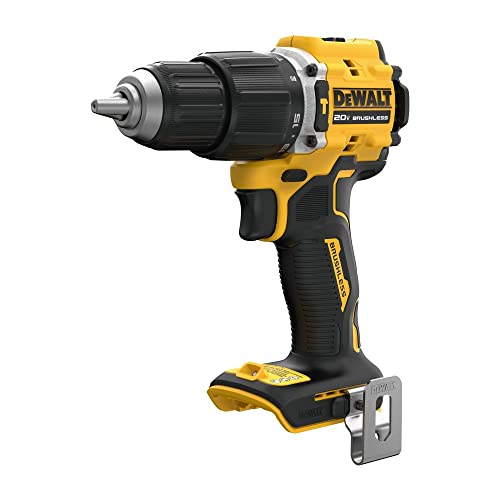
The DCD799B is the light option that still carries a full 1/2-inch chuck, which is the combination that suits most household hole-saw work. At 2.53 pounds with a 6.49-inch head it is easy to hold square overhead and in cabinets, and its 552 unit watts out with a top speed of 1,650 RPM handles medium saws in wood, drywall and composites without complaint. The compact head reaches into corners where a long drill cannot sit straight, and the LED work light marks the cut line. It is the right size when the saws stay under two inches and the jobs vary.
Specs
- 20V MAX ATOMIC brushless motor
- 1/2 in ratcheting chuck
- Up to 1,650 RPM
- 552 UWO
- Up to 28,050 BPM
- 6.49 in head length, 2.53 lb
- LED work light
- Tool only; battery and charger sold separately
Best for: DIYers and remodelers who want a light 1/2 in drill for medium hole saws around the house.
Watch out for: A compact motor has less reserve than the DCD1007B, so for repeated large-diameter holes in hardwood, step up to the bigger drill. Hammer mode must stay off when cutting wood with a hole saw; the hammer action belongs to masonry bits only.
DEWALT 20V MAX Right Angle Drill DCD740B

The DCD740B is the tight-space specialist: a right-angle head in a 4.0-inch body that fits between joists and inside cabinets where no straight drill can sit square. Its dual speed ranges give a low range of 0-650 RPM for hole saws and a high range of 0-2,000 RPM for fastening and small bits, and the multi-grip trigger can be worked from either side of the body. The 3/8-inch ratcheting chuck takes small arbors, and the belt hook keeps the drill on your hip between cuts. It is the drill for the holes that are awkward to reach, not the holes that are biggest.
Specs
- 20V MAX battery platform
- 3/8 in ratcheting chuck
- Dual speed ranges: 0-650 / 0-2,000 RPM
- 4.0 in front-to-back length
- Multi-grip trigger
- Belt hook; 3.25 lb
- Tool only; battery and charger sold separately
- 3 year limited warranty
Best for: Drilling hole saws in joist bays, cabinets and corners where a straight drill cannot fit.
Watch out for: The 3/8 in chuck limits arbor size, so check the arbor shank fits before ordering; large-diameter saws need a 1/2 in chuck drill. Use the low 0-650 RPM range for hole saws, not the 2,000 RPM top end, or the teeth will overheat and dull.
Which One Fits Your Situation
Boring studs and joists for wiring and pipe
Pick the Milwaukee Hole Hawg 2807-20. Its right-angle head slides into the bay, the 1/2-inch keyed chuck takes the large arbors that framing work needs, and the long body spans wide joist spacing. The single-speed motor is geared for this work, and the weight is manageable when the drill rests against the framing. Keep a charged M18 battery nearby, because a dead battery mid-bay means climbing out to swap it.
Cutting large holes in doors and countertops
Pick the DEWALT DCD1007B. Doors and countertops punish a weak drill: the saw is wide, the material is dense, and a stall leaves a scorched ring. The 2,100 inch-pounds of torque and the low gear keep the cup turning, and the anti-rotation system protects your wrist if the saw catches on a knot or a screw. Clamp the workpiece, mark the centre, and let the pilot bit start the cut before leaning in.
A first hole-saw drill for general household jobs
Pick the DEWALT DCD799B. Most household holes are locksets, vent covers, cable pass-throughs and light cans, all inside the range of a medium saw, and a light drill you can hold square beats a heavy one you fight. The 1/2-inch chuck covers the common arbor sizes, the compact head fits cabinets, and the weight suits overhead work. Add the bigger DEWALT later only if large hardwood holes become routine.
Holes in tight bays and inside cabinets
Pick the DEWALT DCD740B. When the gap is a joist bay or the inside of a cabinet, a straight drill cannot sit square and the saw will cut at an angle. The right-angle head and 4.0-inch body solve that, and the low 0-650 RPM range keeps the saw cool. Stay with smaller saws that fit the 3/8-inch chuck, and use the multi-grip trigger from whichever side your hand lands on.
Common Mistakes
- Running a hole saw at full speed: high RPM burns the teeth and scorches wood; use the low gear and let the saw cut.
- Fitting a 1/2-inch arbor shank into a 3/8-inch chuck: it will not fit, and forcing it damages the chuck jaws.
- Leaving hammer mode on while cutting wood: the hammer action shatters the saw teeth and tears the workpiece; hammer mode is for masonry bits only.
- Drilling a large saw one-handed: when the cup binds, the twist goes straight to your wrist; use both hands and a side handle or clutch where the drill has one.
- Skipping the pilot bit: without it the cup wanders across the surface and the hole lands off-centre; drill the pilot first and keep the saw square.
Frequently Asked Questions
What size drill do I need for hole saws?
A 1/2-inch chuck is the safe choice, because it takes both 3/8-inch and 1/2-inch arbor shanks and covers saws up to the largest common sizes. A 3/8-inch chuck works only with smaller arbors, so check the shank on your arbor before ordering. Torque matters more than voltage alone: look for a high inch-pound figure and a low speed range.
Can a regular drill drive a hole saw?
Yes, if it has enough torque and the right chuck. A compact 12V drill will stall on a two-inch cup in hardwood, while an 18V or 20V drill with a 1/2-inch chuck handles it. Cordless drills need a charged battery of the same platform, and the drill must be a bare tool or a kit with the battery included.
Should I use low or high speed with a hole saw?
Low speed. Hole saws cut best around a few hundred RPM, where the teeth bite without overheating. High speed generates friction, dulls the teeth and scorches wood, and makes a binding saw twist harder. Use the lowest gear, feather the trigger, and clear the waste plug often so the cup does not pack full.
Do I need a side handle for hole saws?
For large saws, yes. A side handle gives a second grip and leverage against the sudden twist when a saw binds, which is the main injury risk in this job. Smaller saws in soft material are manageable with two hands on the drill body, but a clutch or anti-rotation system is a good substitute when no side handle is fitted.