Key takeaways
- Find the best horse arena sprinklers for dust control and even watering, from traveling sprinklers to gear-drive rotors for permanent arena systems.
Introduction
A dry horse arena is a dusty horse arena. When footing dries out, every hoofbeat kicks up a cloud that hangs in the air, irritates horses and riders, and leaves the surface loose, deep, and uneven. Watering is the simplest way to keep arena footing consistent, and the right sprinkler turns a daily chore into a short, predictable routine.


The best horse arena sprinklers share a few traits. They cover a wide area so a large ring does not need a dozen separate setups. They lay water down evenly, without puddles in one corner and dry patches in another. They stand up to outdoor use, sun, and the occasional bump from equipment.
This guide covers four sprinkler styles that work for horse arenas: a traveling sprinkler that follows a hose path across the footing, two gear-drive rotors built for permanent installation around an arena, and a tripod-mounted oscillating sprinkler for flexible, portable watering. Each one suits a different arena size, water supply, and budget of effort, and the sections below explain which setup fits which situation.
At a Glance
| Sprinkler | Best For | Coverage | Setup Style |
|---|---|---|---|
| Nelson Rain Train Traveling Sprinkler | Large outdoor arenas watered without a permanent system | Up to 13,500 sq. ft. along a hose path | Portable, self-propelled |
| Rain Bird 5000 Series Rotor 5004 PC | Permanent multi-head arena systems | 25 to 50 ft throw per head | In-ground pop-up rotor |
| Hunter PGP Ultra 6-Inch Rotor | Permanent arena perimeter systems | 17 to 46 ft throw per head | In-ground pop-up rotor |
| Melnor MiniMax Turbo Oscillating Sprinkler on Tripod | Small to mid-size arenas and portable watering | Up to 4,000 sq. ft. | Portable tripod |
1. Nelson Rain Train Traveling Sprinkler
The Nelson Rain Train is a self-propelled traveling sprinkler, and it is one of the simplest ways to water a large arena without installing anything permanent. You lay a garden hose along the path you want watered, set the sprinkler on the hose, and turn on the water. The sprinkler uses water pressure to drive itself slowly along the hose, spraying as it goes, and shuts itself off automatically when it reaches the end of the run.
For a horse arena, that self-propelled design solves a real problem. A standard rectangular arena is far too large for a single stationary sprinkler, and dragging a hose and sprinkler around by hand takes time and leaves uneven coverage. The Rain Train covers up to 13,500 square feet in a single run, which is enough for many full-size outdoor arenas, and its adjustable spray arms let you change the width of the spray pattern to match the width of your ring.
Listing features:
- Self-propelled traveling design follows a hose path and shuts off automatically at the end of the run
- Covers up to 13,500 square feet per run
- Adjustable spray arms change the spray diameter from 15 feet to 50 feet
- Cast iron body built for outdoor use
- High-traction wheels grip footing and gentle slopes
- Rotary spray pattern for even water distribution
Considerations:
- This is a portable, above-ground unit, so it needs to be set up and put away for each watering session, and it must be kept clear of horses while it runs.
- It needs a long, straight hose run and a clear path, so arenas with jumps, poles, or other equipment left in the ring will need a clear lane first.
- Because it moves slowly, a full watering pass takes time; plan sessions around riding schedules rather than trying to squeeze one in between rides.
2. Rain Bird 5000 Series Rotor Sprinkler Head 5004 PC
The Rain Bird 5000 Series is a gear-drive rotor, the workhorse of permanent irrigation systems, and the 5004 PC model is a 4-inch pop-up rotor with an adjustable arc from 40 to 360 degrees. Installed around the perimeter of an arena and connected to a buried supply line, a set of these heads waters the whole ring from fixed positions, with no setup and no equipment in the riding area.
Each head throws water 25 to 50 feet, so a typical arena needs several heads spaced around the edges, with their arcs adjusted so the spray patterns overlap slightly. That overlap is what keeps coverage even: each section of footing gets water from more than one head, which smooths out dry spots. The Rain Curtain nozzle design produces larger droplets that resist wind drift, which matters in open outdoor arenas where a breeze can push a fine mist off target.
This listing is a 20-pack case, which suits an arena project better than it might first appear. A single arena system commonly uses six or more heads, and having spares on hand means a damaged head can be swapped quickly without waiting on a new shipment.
Listing features:
- Gear-drive rotor with adjustable arc from 40 to 360 degrees
- 25 to 50 feet of throw per head
- 4-inch pop-up design sits flush with the surface when not in use
- Rain Curtain nozzle technology for uniform coverage with larger droplets
- Top-adjust arc and radius adjustment without digging up the head
- 20-pack case for multi-head arena installations and spares
Considerations:
- This is a permanent-installation product. It requires buried pipe, a water supply with enough flow and pressure for several heads, and usually a valve and timer setup.
- Pop-up heads must be installed level with the footing surface and protected from hoof traffic and arena drags, so placement along the rail line or just outside the riding area works best.
- The 20-pack case is more heads than a small arena needs, so measure your layout and count heads before ordering.
3. Hunter PGP Ultra 6-Inch Rotor Sprinkler Head
The Hunter PGP Ultra is another gear-drive rotor built for permanent systems, and the 6-inch pop-up model is a strong match for arenas because the taller pop-up clears deeper footing and low vegetation around the ring edge. Its arc adjusts from 50 to 360 degrees, and the installed 3.0 nozzle throws water 17 to 46 feet, which fits the spacing of heads around a standard arena perimeter.
What sets the PGP Ultra apart for arena use is its serviceability. The arc, radius, and nozzle can all be adjusted from the top of the head, and the head can be serviced without digging it out of the ground. In an arena, where footing shifts and heads occasionally take a knock from equipment, that easy access keeps maintenance short. The 3/4-inch inlet fits standard irrigation pipe, and the head includes an adjustment tool and nozzle rack in the listing.
Listing features:
- Gear-drive rotor with adjustable arc from 50 to 360 degrees
- 6-inch pop-up height clears deeper footing at the arena edge
- 17 to 46 feet of throw with the installed 3.0 nozzle
- 3/4-inch inlet for standard irrigation pipe
- Top-adjust arc, radius, and nozzle changes without digging
- Includes adjustment tool and nozzle rack
Considerations:
- Like the Rain Bird rotor, this head belongs in a permanent buried system with adequate water flow and pressure, plus valves and a controller.
- A single head waters only its own arc, so plan the number and placement of heads so spray patterns overlap across the full arena surface.
- The 6-inch pop-up is taller than a standard 4-inch head, which helps in deep footing but also means the head needs a firm, level setting so it retracts fully when the water is off.
- Confirm your supply line size and pressure against the head requirements before laying pipe, since undersized pipe is the most common cause of weak throw in multi-head systems.
4. Melnor MiniMax Turbo Oscillating Sprinkler on Tripod

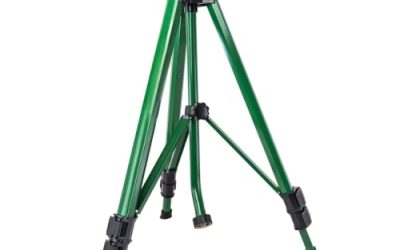
Not every arena needs a permanent system, and not every arena is large enough to justify one. The Melnor MiniMax Turbo on a tripod is a portable oscillating sprinkler that covers up to 4,000 square feet from a raised position, which makes it a practical choice for smaller arenas, round pens, and schooling areas, or as a supplement for dry corners in a larger ring.
The tripod is the key feature here. Raising the sprinkler head above the footing gives the spray a clear path over low rails and uneven ground, and the oscillating motion sweeps water back and forth in a rectangular pattern that matches the shape of most arenas better than a circular pattern does. Four-way adjustment lets you set the width and range of the sweep, and the QuickConnect fittings make hose hookup fast.
Listing features:
- Oscillating sprinkler on an adjustable tripod for raised, clear spray
- Covers up to 4,000 square feet
- Four-way adjustable spray width and range
- QuickConnect bundle for fast hose attachment
- Step-spike and tripod base options for stable placement on soft ground
Considerations:
- Coverage of up to 4,000 square feet suits a round pen or a small arena, but a full-size arena will need the sprinkler moved to several positions for complete coverage.
- A tripod standing in or beside the arena must be removed before horses work in the ring, so this is a water-then-ride tool, not a set-and-forget system.
- Oscillating sprinklers produce a finer spray than gear-drive rotors, so they are more affected by wind; water early in the morning or in calm conditions for the most even result.
- The tripod legs need firm, level ground to stay stable, so avoid setting it on freshly dragged, very loose footing.
How to Choose
Start with the size of your arena and how often you water. A small round pen or schooling area can be handled by a single portable sprinkler moved between two or three positions. A full-size outdoor arena, roughly 100 by 200 feet or larger, needs either a traveling sprinkler that walks the ring or a permanent rotor system with several heads.
Next, look at your water supply. Traveling and tripod sprinklers run from a standard garden hose and a household spigot, which keeps setup simple. Permanent rotor systems need a buried supply line and enough flow to run several heads at once, which may mean a dedicated line, a larger pump, or a zoned layout where heads run in groups. If your water pressure is low, a portable sprinkler will give better results than a rotor system starved of flow.
Think about who waters and when. If one person handles arena care and rides daily, a permanent system on a timer removes the chore entirely. If watering happens a few times a week and someone is on site anyway, a traveling sprinkler is a low-cost way to get even coverage without digging. If the arena is used for lessons with tight turnarounds, a permanent system keeps equipment out of the ring and avoids setup time between sessions.
Dust control is a separate goal from deep watering, and it changes the choice. For dust control, short, frequent watering that keeps the top layer of footing damp matters more than soaking the base. A system that can run briefly and often — a timer-controlled rotor system, or a traveling sprinkler on a regular schedule — will control dust better than an occasional heavy soak. For footing that has dried out completely, a slow, deep watering that penetrates the full depth of the surface is the better first step, followed by lighter maintenance watering.
Finally, match the sprinkler to your footing. Sand footing drains fast and needs more frequent watering than a sand and fiber mix, which holds moisture longer. Clay-based footing holds water well but can turn slick if overwatered, so even, moderate coverage matters more than volume.
Fit and Installation Considerations
For permanent rotor systems, layout comes before purchase. Measure the arena, mark head positions around the perimeter, and check that the throw of each head overlaps the next by a comfortable margin. Heads belong along the rail line or just outside the riding surface, where hooves and drags will not strike them, and pop-up heads must sit flush with the finished footing level so they retract fully and do not create a trip hazard.
Pipe sizing deserves attention. A rotor system with several heads running at once moves a large volume of water, and pipe that is too small will starve the farthest heads and leave dry patches at the far end of the arena. A main line that is larger than the branch lines, and zones that group heads by area, will keep pressure even across the system. A filter on the supply line protects nozzles from grit, which is especially important when the water source is a well or a pond.
For portable sprinklers, fit is about the hose path and the water source. A traveling sprinkler needs a clear, straight hose run and enough hose to cover the full length of the arena. Lay the hose before watering, walk the path to check for kinks and snags, and keep the hose clear of jumps and poles. A tripod sprinkler needs level ground and a hose long enough to reach the far corner without pulling the tripod over.
Drainage and winter care matter for every type. In freezing climates, drain portable sprinklers and store them under cover, and winterize buried systems by blowing out the lines before the first hard freeze. Check pop-up heads after dragging the arena, since a drag can shift footing over a head and block it from popping up. Inspect nozzles at the start of each season for clogs, and flush the system briefly before the first watering of the year.
Watering timing affects results as much as equipment. Early morning watering loses the least to evaporation and gives footing time to settle before riding.
Frequently Asked Questions
How often should a horse arena be watered?
That depends on footing type, climate, and use. In dry, warm weather, many arenas need watering every day or every other day to keep dust down and footing consistent. Watch the surface: if hoofprints kick up visible dust, or the footing feels loose and deep underfoot, it is time to water.
How many sprinklers does a full-size arena need?
A permanent rotor system for a standard arena commonly uses six to ten heads spaced around the perimeter, depending on each head’s throw and the arena dimensions. The right number is the one that gives overlapping coverage across the whole surface with no dry gaps, so measure your arena and map head positions on paper before buying. A traveling sprinkler can cover the same area with a single unit, but it needs a hose path that reaches the full length of the ring.
Can a traveling sprinkler water an arena with jumps set up?
It can, but the hose path must be clear. A traveling sprinkler follows the hose, so jumps, poles, and standards in its path will block it or snag the hose. Clear a lane down the center or along one side before starting a run, or water before setting jumps for the day. For arenas where jumps stay up permanently, a rotor system with heads around the perimeter is usually the better fit.
Is a permanent sprinkler system worth it for a private arena?
For a private arena watered several times a week, a permanent system saves a large amount of time over a season and gives the most even coverage, since heads run on a timer and no equipment sits in the riding area. The trade-off is the upfront work of trenching pipe and installing valves. If the arena is small, or watering is only an occasional job, a traveling or tripod sprinkler delivers good results with far less installation.
Conclusion
The best horse arena sprinklers are the ones that match your arena size, your water supply, and the way you work. A traveling sprinkler like the Nelson Rain Train waters a large ring with no permanent installation and shuts itself off when the run is done. Gear-drive rotors like the Rain Bird 5000 Series and the Hunter PGP Ultra give a permanent, timer-controlled system that keeps equipment out of the riding area and delivers even coverage day after day. A tripod oscillating sprinkler like the Melnor MiniMax is the flexible choice for smaller arenas, round pens, and spot watering.
A well-watered arena is safer, kinder to horses and riders, and far more pleasant to work in — and the right sprinkler makes keeping it that way a routine instead of a chore.
As an Amazon Associate, we earn from qualifying purchases.