Key takeaways
- Cut crown molding cleanly with a miter saw built for trim work. Compare five saws judged on precise bevel stops, fence height, and crown capacity.
Crown molding shows every small error. A joint that is off by half a degree opens a visible gap at the corner, and a cut that wanders across the face of the molding leaves a line you cannot sand away. The miter saw you use for crown work therefore matters more than the saw you use for framing, and the features that matter are not the ones on the front of the box. What decides whether your corners close is the bevel range and its detents, the height of the fence, the way the saw holds the molding while you cut, and the blade that ships with the tool.


This article picks five miter saws for crown molding and judges each one on crown work first. Every pick is a compound saw with the bevel and miter control needed for nested and flat crown cuts, and every pick is a 10-inch slider or a non-sliding compound model. The site already covers 12-inch sliding compound saws in a separate roundup, so this article stays away from that class and looks instead at the saws trim carpenters actually reach for when the job is molding. If you cut mostly wide boards and only occasionally touch crown, the 12-inch sliding roundup is the better place to look.
Disclosure: As an Amazon Associate, we earn from qualifying purchases.
Quick Picks
Our Short List of 3
- Specs: 12-inch blade; 15-amp motor, 3,800 RPM; double bevel 0 to 48 degrees left and right with positive stops at 0, 22.5, 33.9, and 45 degrees; miter 0 to 50 degrees left and right; 14 positive miter stops on a stainless-steel detent plate; tall sliding fences support 6-5/8-inch nested crown and 6-1/2-inch vertical base molding; XPS cutline LED shadow-line system; 49 pounds; includes dust bag, vertical clamp, and blade wrench.
- Best for: Dedicated crown work in a shop or on a jobsite where the saw stays set up for trim. The double bevel, the 33.9-degree bevel stop, and the 6-5/8-inch nested crown capacity cover the largest crown in this article, and the XPS shadow line shows the cut before the blade drops.
- Watch out for: At 49 pounds it is heavy to carry between rooms, and it is not a sliding saw, so wide boards need a different tool. The listing shows two different no-load speeds in different places; the product overview lists 3,800 RPM. Confirm the listing is the bare saw before ordering, since bundled versions with a stand or extra accessories appear under nearby listings.
- https://www.amazon.com/dp/B07SHJTPMY
- Specs: 10-inch blade, 60-tooth carbide; 15-amp motor, 4,800 RPM; dual bevel 0 to 47 degrees left and right with detents at 0, 33.9, and 45 degrees; miter detents at 0, 15, 22.5, 31.6, 45, and 60 degrees; Axial-Glide articulating arm system; 12-inch horizontal cut capacity; 5-1/2-inch vertical baseboard and 6-inch nested crown capacity; tall sliding 4-1/4-inch fences; 64 pounds; 1-year warranty; includes work clamp, dust bag, and vacuum adapter.
- Best for: Small shops and benches against a wall. The glide arm gives sliding-saw reach without rails sticking out the back, so the saw sits close to the wall, and the 31.6-degree miter detent and 33.9-degree bevel detent are the exact settings for flat-cutting 38-degree spring crown.
- Watch out for: At 64 pounds it is the heaviest saw here, so it suits a fixed bench more than a carry-around kit. One tool roundup reported the Amazon listing as unavailable in a recent check, while other current sources list it in stock; confirm a live offer before ordering.
- https://www.amazon.com/dp/B00G5R4E9A
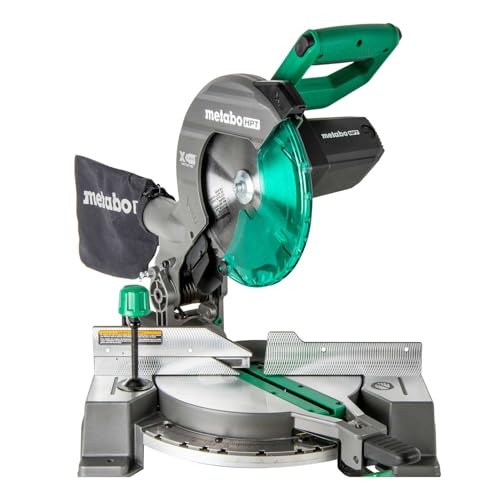
- Specs: 10-inch blade, 40-tooth carbide; 15-amp motor, 5,000 RPM; single bevel 0 to 45 degrees left; miter 0 to 52 degrees left and right; Xact Cut shadow-line system; large 10-inch table; 24.2 pounds; 5-year warranty; includes dust bag, vise assembly, and hex bar wrench.
- Best for: Light trim work and portability. At just over 24 pounds it is the lightest saw in this article by a wide margin, and the shadow line keeps the cut on the mark for small crown and casing. It is a sensible pick when the saw travels from room to room and the crown is modest in size.
- Watch out for: Single bevel only, so matching left and right crown pieces means flipping the workpiece. The fence is lower than the tall fences on the DEWALT saws, so large crown needs extra support. One older listing crawl showed no featured offers alongside a note that hundreds had sold in the past week; confirm a live offer before ordering.
- https://www.amazon.com/dp/B0FBPB1MJ8
All 5 Picks at a Glance
| Product | Specs | Action |
|---|---|---|
| DEWALT DWS716XPS 12-Inch Double-Bevel Compound Miter Saw |
| Check price on Amazon |
| Bosch CM10GD 10-Inch Dual-Bevel Glide Miter Saw |
| Check price on Amazon |
| Metabo HPT C10FCG2 10-Inch Single-Bevel Compound Miter Saw |
| Check price on Amazon |
 DEWALT DWS713 10-Inch Single-Bevel Compound Miter Saw |
| Check price on Amazon |
 DEWALT DWS715 12-Inch Single-Bevel Compound Miter Saw |
| Check price on Amazon |
How to Choose
Bevel type: double bevel saves the flip
Crown molding is cut either nested against the fence, with the molding held upside down at its spring angle, or lying flat on the table with a compound miter and bevel setting. Nested cutting is the simpler method for most rooms, and it works best on a double-bevel saw. A double-bevel head tilts both left and right, so you can cut the matching left and right pieces of a corner without turning the molding around. A single-bevel saw tilts one way only, so you flip the workpiece for the matching cut, and every flip is a chance to lose the angle. If you cut crown often, pay for the double bevel. If you cut crown once a year, a single-bevel saw with tall fences still does the job, just more slowly.
Bevel detents at the crown angles
Crown molding has a spring angle, usually 38 degrees or 45 degrees, which is the angle between the back of the molding and the wall. When you cut crown lying flat, the miter and bevel settings come from that spring angle: for 38-degree spring crown the standard settings are a 31.6-degree miter and a 33.9-degree bevel, and for 45-degree spring crown they are 35.3 degrees and 30 degrees. A saw that locks positively at 33.9 degrees bevel and 31.6 degrees miter lets you set those angles by feel instead of by eye. Check the detent list before you buy, and favor saws with detents at 0, 22.5, 33.9, and 45 degrees on the bevel scale.
Miter detents and repeatability
Crown corners are cut at 45-degree miters, inside and outside, and the same angle repeats dozens of times across a room. A stainless-steel detent plate with positive stops at the common angles keeps every cut at the same setting, while a saw that relies on a scale and a thumb screw drifts a little with each adjustment. Look for 14 positive miter stops or more, a cam-lock miter handle, and a detent override for the odd angle that falls between stops.
Fence height and crown stops
The fence holds the molding while the blade drops, and a tall fence holds tall crown steady. Sliding fences that move out of the way of the blade let you support wide molding without the fence blocking the cut. Crown stops, small blocks that clamp to the fence and hold the molding at its spring angle, are the accessory that makes nested cutting repeatable, so check whether the saw accepts them. The nested crown capacity in the comparison table tells you the largest crown each saw holds against its fence; match it to the crown in your rooms before you buy.
Blade and cutline
A fine-tooth blade leaves a cleaner edge on painted molding than the coarse blade that ships with most saws. A 60-tooth carbide blade is a good middle ground for trim, and an 80-tooth blade leaves an even smoother face on hardwood crown. A laser line or an LED shadow line shows where the blade will land before you pull the trigger, which matters when the cut has to land exactly on a pencil mark at the end of a long run of molding. Neither system replaces a careful setup, but both cut down on wasted pieces.
Weight and bench space
A 12-inch compound saw weighs around 43 to 49 pounds, and a 10-inch saw weighs around 24 to 31 pounds. If the saw lives on a bench, weight barely matters. If you carry it from room to room or up a flight of stairs, it matters a lot. Sliding saws need clearance behind the bench for the rails; glide-arm saws such as the Bosch in this article need less depth against a wall. Measure your bench before you choose.
Best Miter Saws for Crown Molding
DEWALT DWS716XPS 12-Inch Double-Bevel Compound Miter Saw
- Specs: 12-inch blade; 15-amp motor, 3,800 RPM; double bevel 0 to 48 degrees left and right with positive stops at 0, 22.5, 33.9, and 45 degrees; miter 0 to 50 degrees left and right; 14 positive miter stops on a stainless-steel detent plate; tall sliding fences support 6-5/8-inch nested crown and 6-1/2-inch vertical base molding; XPS cutline LED shadow-line system; 49 pounds; includes dust bag, vertical clamp, and blade wrench.
- Best for: Dedicated crown work in a shop or on a jobsite where the saw stays set up for trim. The double bevel, the 33.9-degree bevel stop, and the 6-5/8-inch nested crown capacity cover the largest crown in this article, and the XPS shadow line shows the cut before the blade drops.
- Watch out for: At 49 pounds it is heavy to carry between rooms, and it is not a sliding saw, so wide boards need a different tool. The listing shows two different no-load speeds in different places; the product overview lists 3,800 RPM. Confirm the listing is the bare saw before ordering, since bundled versions with a stand or extra accessories appear under nearby listings.
- https://www.amazon.com/dp/B07SHJTPMY
Bosch CM10GD 10-Inch Dual-Bevel Glide Miter Saw
- Specs: 10-inch blade, 60-tooth carbide; 15-amp motor, 4,800 RPM; dual bevel 0 to 47 degrees left and right with detents at 0, 33.9, and 45 degrees; miter detents at 0, 15, 22.5, 31.6, 45, and 60 degrees; Axial-Glide articulating arm system; 12-inch horizontal cut capacity; 5-1/2-inch vertical baseboard and 6-inch nested crown capacity; tall sliding 4-1/4-inch fences; 64 pounds; 1-year warranty; includes work clamp, dust bag, and vacuum adapter.
- Best for: Small shops and benches against a wall. The glide arm gives sliding-saw reach without rails sticking out the back, so the saw sits close to the wall, and the 31.6-degree miter detent and 33.9-degree bevel detent are the exact settings for flat-cutting 38-degree spring crown.
- Watch out for: At 64 pounds it is the heaviest saw here, so it suits a fixed bench more than a carry-around kit. One tool roundup reported the Amazon listing as unavailable in a recent check, while other current sources list it in stock; confirm a live offer before ordering.
- https://www.amazon.com/dp/B00G5R4E9A
Metabo HPT C10FCG2 10-Inch Single-Bevel Compound Miter Saw
- Specs: 10-inch blade, 40-tooth carbide; 15-amp motor, 5,000 RPM; single bevel 0 to 45 degrees left; miter 0 to 52 degrees left and right; Xact Cut shadow-line system; large 10-inch table; 24.2 pounds; 5-year warranty; includes dust bag, vise assembly, and hex bar wrench.
- Best for: Light trim work and portability. At just over 24 pounds it is the lightest saw in this article by a wide margin, and the shadow line keeps the cut on the mark for small crown and casing. It is a sensible pick when the saw travels from room to room and the crown is modest in size.
- Watch out for: Single bevel only, so matching left and right crown pieces means flipping the workpiece. The fence is lower than the tall fences on the DEWALT saws, so large crown needs extra support. One older listing crawl showed no featured offers alongside a note that hundreds had sold in the past week; confirm a live offer before ordering.
- https://www.amazon.com/dp/B0FBPB1MJ8
DEWALT DWS713 10-Inch Single-Bevel Compound Miter Saw
- Specs: 10-inch blade, 80-tooth carbide; 15-amp motor, 5,000 RPM; single bevel 0 to 48 degrees left and 0 to 3 degrees right; miter 0 to 50 degrees left and right; 14 positive miter stops on a stainless-steel detent plate; tall sliding fences support 4-1/4-inch crown nested; 31 pounds; includes dust bag and vertical clamp.
- Best for: A compact 10-inch trim saw for smaller rooms and lighter crown. The 80-tooth blade leaves a smooth face on painted trim, the 31-pound weight is easy to carry, and the 14-stop detent plate keeps the common miter angles repeatable.
- Watch out for: Single bevel, so matching cuts need the workpiece flipped, and the 4-1/4-inch nested crown capacity is the smallest here, so it does not suit tall crown. The listing carries a 20-volt label in one field by mistake; this is a corded 15-amp saw.
- https://www.amazon.com/dp/B07P7LX9DF
DEWALT DWS715 12-Inch Single-Bevel Compound Miter Saw
- Specs: 12-inch blade, 80-tooth carbide; 15-amp motor, 4,000 RPM; single bevel 0 to 48 degrees left and 0 to 3 degrees right; miter 0 to 50 degrees left and right; 14 positive miter stops on a stainless-steel detent plate; tall sliding fences support 5-1/2-inch base molding vertically and 5-1/2-inch crown molding nested; crosscut capacity 2-by-8 at 90 degrees and 2-by-6 at 45 degrees; 42.8 pounds; includes dust bag, vertical clamp, and blade wrench.
- Best for: Value 12-inch single-bevel work. It holds 5-1/2-inch crown nested, which covers most rooms, and the 80-tooth blade and 14-stop detent plate give the same repeatability as the more expensive double-bevel models for a lower outlay.
- Watch out for: Single bevel only, so the matching side of each corner needs the molding flipped. At 42.8 pounds it is heavier than the 10-inch saws here, and it has no laser or shadow-line system, so cut placement depends on the blade and your pencil mark.
- https://www.amazon.com/dp/B07P8QTFRC
Which One Fits
If crown molding is the main job, the DEWALT DWS716XPS is the pick: double bevel, the 33.9-degree bevel stop, and the largest nested crown capacity in this article. If your bench sits against a wall and space is tight, the Bosch CM10GD gives you sliding reach without rails behind the saw, and its detents include the exact 31.6-degree miter and 33.9-degree bevel settings for flat crown cuts. If you carry the saw from room to room, the Metabo HPT C10FCG2 at 24.2 pounds is the easy one to move, and the DEWALT DWS713 at 31 pounds is the compact 10-inch choice for smaller crown. If you want a 12-inch saw for the lowest outlay and can live with a single bevel, the DEWALT DWS715 holds 5-1/2-inch crown nested and covers most rooms.
Match the saw to the crown first and the shop second. Measure the crown in your rooms, check the nested capacity in the table, and then decide whether you need the double bevel. A saw that cannot hold your crown against its fence is the wrong saw no matter how good its motor is.
Common Mistakes
Cutting crown flat without checking the spring angle. Crown cut lying flat needs the miter and bevel settings for its spring angle, 31.6 and 33.9 degrees for 38-degree spring crown, 35.3 and 30 degrees for 45-degree spring crown. Using the wrong pair leaves a joint that looks square until you hold the pieces together. Check the spring angle on the molding before the first cut, and test the settings on a scrap piece.
Cutting crown nested but upside down the wrong way. Nested crown sits against the fence upside down, with the edge that touches the ceiling resting on the table. Flip it the other way and the angles come out mirrored, which shows up only when you try to fit the corner. Mark the ceiling edge on the back of the molding before you cut.
Trusting the scale instead of the detent. Miter scales drift, and a scale read by eye is rarely exact. Use the positive stops for 45-degree corners and the detent override only for the odd angle. Cut a test corner and check it with a square before running the full room.
Using the blade that came with a framing saw. A coarse blade tears the face of painted molding and leaves a ragged edge at the joint. A 60-tooth or 80-tooth carbide blade is the right tool for trim, and it is worth fitting one before the first crown cut rather than after the first bad joint.
Forgetting the fence height. Tall crown needs a tall fence, or the molding rocks while the blade drops. If your crown is taller than the fence, support it with a sacrificial fence or a crown stop rather than holding it by hand.
FAQ
What miter and bevel settings cut crown molding lying flat?
For 38-degree spring crown, set the miter to 31.6 degrees and the bevel to 33.9 degrees. For 45-degree spring crown, set the miter to 35.3 degrees and the bevel to 30 degrees. These settings assume the molding lies flat on the table with its back facing up, and the left and right pieces use mirrored miter settings. Test both settings on scrap before cutting the real pieces.
Is a double-bevel miter saw necessary for crown molding?
No, but it makes the work faster and more accurate. A double-bevel saw cuts both sides of a corner without flipping the molding, so the angle stays the same for both pieces. A single-bevel saw cuts crown well too, but you flip the workpiece for the matching cut, and each flip is a chance to lose the setup. If you cut crown more than a few times a year, the double bevel earns its keep.
What size crown molding can a 10-inch miter saw cut?
It depends on the saw and on how the crown is held. The 10-inch saws in this article hold between 4-1/4 inches and 6 inches of crown nested against the fence, while the 12-inch saws hold between 5-1/2 and 6-5/8 inches. Measure the crown in your rooms and compare it with the nested capacity in the comparison table before you buy, since a saw that cannot hold your crown is the wrong saw for the job.
Do I need crown stops for my miter saw?
Crown stops are not required, but they make nested cutting repeatable. They clamp to the fence and hold the molding at its spring angle, so every piece sits in the same place. Without them you hold the molding by hand and judge the angle by eye, which works for a single corner but drifts across a whole room. If your saw accepts crown stops, they are worth fitting before a large job.
Conclusion
Crown molding rewards a saw chosen for trim work rather than for raw capacity. The bevel detents at the crown angles, the fence height, and the nested crown capacity decide whether your corners close, and those numbers matter more than motor size or crosscut width. The DEWALT DWS716XPS leads this article on crown capacity and bevel control, the Bosch CM10GD suits a tight bench, and the Metabo HPT C10FCG2, DEWALT DWS713, and DEWALT DWS715 cover the lighter and lower-cost ends of the job. Measure your crown, check the spring angle, test the settings on scrap, and the joints will close.