Key takeaways
- Compare true cabinet saws by motor, voltage, fence system and rip capacity, with four enclosed-cabinet Amazon listings for permanent workshop setups.
Buying a cabinet saw is really a decision about permanence. You are choosing a heavy, enclosed machine that will live in one place, on one circuit, for years, and whose fence and trunnion arrangement will shape every rip and crosscut you make in that shop. That is why the honest first questions are electrical and spatial: does the shop have, or can it get, a 230-volt circuit, and will a 36-inch fence system fit with room to feed a full sheet? A lighter 1.75-horsepower model on a household circuit answers a different brief from a 3-horsepower machine.
This guide is for woodworkers stepping up from a jobsite or benchtop saw to a fixed station, for small shops that rip hardwood and sheet goods weekly, and for buyers who specifically want a true cabinet design rather than a hybrid. All four options are enclosed cabinet saws with the motor inside the cabinet, selected from their Amazon titles and listing details for motor rating, voltage, fence system and rip capacity.
Quick Picks
As an Amazon Associate we earn from qualifying purchases
| Product | Best for | Key spec from title |
|---|---|---|
| SAWSTOP 10-Inch Professional Cabinet Saw PCS175-TGP236 | A serious home shop on a standard circuit wanting a 36-inch fence | 1.75-HP, 36-Inch T-Glide Fence |
| SAWSTOP 10-Inch Professional Cabinet Saw PCS31230-TGP236 | A shop with 230-volt power ripping thick hardwood regularly | 3-HP, 36-Inch T-Glide Fence |
| Powermatic 10-Inch Table Saw PM1000 | A buyer wanting the widest rip capacity in this group | 52-Inch Rip, 1-3/4 HP |
| SAWSTOP 10-Inch Professional Cabinet Saw PCS175-PFA30 | A tighter shop that still wants a full cabinet saw | 1.75-HP, 30-Inch Premium Fence |
How to Choose
Confirm it is a cabinet saw, not a hybrid in a cabinet-shaped base
A true cabinet saw carries its trunnion on the cabinet and encloses the motor inside that cabinet, which is what gives the design its mass, its dust containment and its stable blade alignment. Several saws that look similar in a thumbnail are hybrids, with lighter internals and table-mounted components, and they behave differently under a heavy rip fence load. In this guide every pick is listed as a cabinet or professional cabinet saw. Before buying any model elsewhere, find the words cabinet saw in the title, then check the motor and fence details on the same listing rather than trusting a photograph of an enclosed base.
Let your circuit decide between 1.75 and 3 horsepower
This is the fork that removes half the field. A 1.75-horsepower cabinet saw such as the PCS175 configurations is the practical route for a shop that cannot easily add a higher-voltage circuit, while the 3-horsepower PCS31230-TGP236 is listed for 230-volt, 13-amp service. Neither answer is wrong; the mistake is ordering the stronger machine and discovering during delivery week that the panel is full or the run is impractical. Ask an electrician about capacity and distance first, because a long run to a detached garage changes the conversation, and write the answer down before you compare fences.
Size the fence to the material you actually feed
Fence capacity is not a bragging number, it is the width of sheet you can rip without a second setup. A 30-inch premium fence handles most solid-wood parts and narrower sheet breakdown, a 36-inch T-Glide system covers the common cabinet-side and shelving widths, and the 52-inch rip on the Powermatic PM1000 listing suits a shop that breaks down full sheets on the saw as a routine step. Longer rails also demand more wall and floor: measure from the blade to the end of the rail, then add the space you need to stand and feed, rather than measuring the cabinet alone.
Plan delivery, weight and dust collection as part of the purchase
Cabinet saws in this class are listed at several hundred pounds, and the SawStop 1.75-horsepower configuration is described at around 470 pounds in listing-derived data. That weight arrives on a pallet, needs a route from the kerb to the shop that does not involve a narrow stair turn, and then stays where you put it. Think about the dust port and collector position at the same time, because an enclosed cabinet is designed to be connected, and a saw pushed tight into a corner with no room for a hose wastes one of the main reasons for choosing this format.
The 4 Best Options
SAWSTOP 10-Inch Professional Cabinet Saw, 1.75-HP, 36-Inch Professional T-Glide Fence System (PCS175-TGP236)
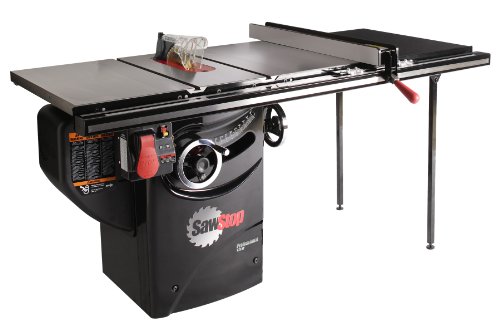
For many serious home shops this is the balanced configuration: full cabinet construction, a 36-inch professional T-Glide fence, and a 1.75-horsepower motor that avoids making a new circuit the first project. It fits the woodworker who rips hardwood for furniture, breaks down sheet goods for cabinets, and wants one permanent station rather than a saw that gets wheeled out and put away. The listing-derived details also describe heavy trunnion and arbor construction aimed at stability, which is the quality you feel when a long rip stays on the line.
Specs
- Brand: SawStop
- Model: PCS175-TGP236
- Blade size listed: 10-Inch
- Motor listed: 1.75-HP
- Fence listed: 36-Inch Professional T-Glide Fence System
- Type listed: Professional Cabinet Saw
- Included in title: fence system, rails and extension table assembly
Best for: A permanent home shop that wants a 36-inch fence and cabinet construction without moving to a 3-horsepower circuit first.
Watch out for: Confirm the assembled footprint with the 36-inch rails in your shop, and verify the exact voltage configuration on the listing before ordering.
ASIN: B009C7NF0Y
SAWSTOP 10-Inch Professional Cabinet Saw, 3-HP, 36-Inch Professional T-Glide Fence System (PCS31230-TGP236)
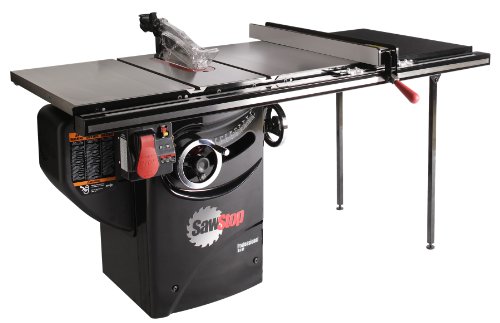
Choose the 3-horsepower version when the work itself demands it: thick hardwood ripping, frequent dado work and long sessions where a smaller motor would slow the feed. Its listing details give a maximum depth of cut of 3-1/8 inches at 90 degrees and 2-1/4 inches at 45 degrees, with a 40-tooth 10-inch blade included and an enclosed cabinet base. The safety system described on the listing stops the blade on skin contact in less than 5 milliseconds. This is a machine for a shop that already has, or is committed to installing, the 230-volt supply it requires.
Specs
- Brand: SawStop
- Model: PCS31230-TGP236
- Blade size listed: 10 inches
- Motor listed: 3 horsepower, 230 volt, 13 amp
- Fence listed: 36-inch Professional T-Glide fence system
- Depth of cut listed: 3-1/8 inches at 90 degrees and 2-1/4 inches at 45 degrees
- Blade included listed: 40-tooth, 10-inch blade
- Safety system listed: blade-contact detection that stops the blade in less than 5 milliseconds
- Base listed: enclosed cabinet base
Best for: A shop with 230-volt power that rips thick hardwood and runs dado work as a regular part of the week.
Watch out for: Confirm your circuit, receptacle type and delivery route before ordering, and check how the listing describes operation with conductive or very wet material.
ASIN: B009C7NGTE
Powermatic 10-Inch Table Saw, 52-Inch Rip, 1-3/4 HP, 115/230V 1Ph (Model PM1000)

The PM1000 earns its place here on width. A 52-inch rip capacity changes how a small shop handles sheet goods, letting you take a full panel down to cabinet parts on the saw instead of pre-cutting elsewhere and then trimming. It pairs that capacity with a 1-3/4 horsepower motor listed for 115/230V single-phase power, so it can suit a shop whose electrical options are still evolving. The trade-off is floor space: a 52-inch system is a wide station, and it needs clear infeed and outfeed room to be worth its footprint.
Specs
- Brand: Powermatic
- Model: PM1000
- Blade size listed: 10-Inch
- Motor listed: 1-3/4 HP
- Power listed: 115/230V, 1Ph
- Rip capacity in title: 52-Inch Rip
- Type: cabinet table saw, as listed
Best for: A shop that breaks down full sheet goods on the saw and wants the widest rip capacity in this group.
Watch out for: Measure the full rail width plus standing room, and confirm which fence configuration the listing is selling before you plan the layout around it.
ASIN: B00E8N4UXS
SAWSTOP 10-Inch Professional Cabinet Saw, 1.75-HP, 30-Inch Premium Fence Assembly (PCS175-PFA30)

Not every cabinet saw buyer has room for long rails. This 30-inch premium fence configuration keeps the enclosed cabinet format and the 1.75-horsepower motor while trimming the station width, which makes it the sensible SawStop route for a one-car garage shop or a basement room where a 36-inch or 52-inch system would crowd out assembly space. It suits solid-wood furniture work and narrower sheet parts better than a routine full-sheet workflow. If your projects regularly start with wide panels, the wider configurations above will serve you better than saving the floor space.
Specs
- Brand: SawStop
- Model: PCS175-PFA30
- Blade size listed: 10-Inch
- Motor listed: 1.75-HP
- Fence listed: 30-Inch Premium Fence Assembly
- Type listed: Professional Cabinet Saw
- Model number listed: PCS175PFA30
Best for: A compact permanent shop that wants true cabinet construction and can work within a 30-inch fence.
Watch out for: Check that 30 inches of fence covers your widest regular rip, and confirm the listing configuration matches the fence assembly named in the title.
ASIN: B005HPWDYO
Which One Fits Your Situation
Your shop has no higher-voltage circuit and no plan to add one
Start with one of the 1.75-horsepower configurations. Between them, choose the PCS175-TGP236 if you have room for the 36-inch T-Glide system and you break down sheet goods often, or the PCS175-PFA30 if the room is tight and most of your work is solid wood. Either way, confirm the exact electrical requirement shown on the listing for the configuration you select, because a cabinet saw is not a purchase you want to re-box over a receptacle.
You rip thick hardwood every week and already have 230-volt power
Take the PCS31230-TGP236. The 3-horsepower motor, the listed cutting depths and the 36-inch T-Glide fence are aimed at sustained work rather than occasional projects, and the enclosed cabinet base supports the dust setup a busy shop needs. This is also the choice for a two-person shop where the saw is in use most days and downtime for a swap would cost more than choosing the stronger machine now.
Your work begins with full sheets, not boards
Take the Powermatic PM1000 with the 52-inch rip. Width is the whole point of your workflow, and no amount of motor discussion changes the fact that a 30-inch fence cannot rip what it cannot reach. Lay out the station on the floor with tape first, including where a full sheet overhangs on infeed, and only then commit, because a wide saw in a room that cannot feed it becomes an expensive obstacle.
You have one small room and the saw shares it with assembly
Take the PCS175-PFA30. A 30-inch fence keeps the station compact enough to leave bench and assembly space usable, and the cabinet format still gives you a fixed, aligned station instead of a portable saw on a stand. Be honest about panel work: if a project needs a wider rip, plan to break the sheet down another way first rather than forcing an unsafe workaround at the fence limit.
Common Mistakes
- Calling any saw with an enclosed base a cabinet saw, without checking that the listing describes a cabinet design with the motor inside the cabinet.
- Ordering a 3-horsepower saw before confirming the circuit, panel capacity and receptacle the listing configuration actually requires.
- Choosing fence capacity from the cabinet width in a photo, then discovering the rails leave no room to stand and feed material.
- Ignoring delivery: several hundred pounds on a pallet will not turn a tight stair corner or fit through every workshop door.
- Planning no dust connection for an enclosed cabinet, then losing the cleanliness and visibility benefit the format is built to provide.
Frequently Asked Questions
What makes a cabinet saw different from a jobsite saw?
Construction and intent. A cabinet saw is a heavy, stationary machine with an enclosed cabinet, the motor mounted inside it and a large fence system, designed to stay in one place and hold alignment over years of work. A jobsite saw is built to be carried, stored and set up again. If you move house or rearrange the shop often, that difference matters as much as motor size, because a cabinet saw rewards a permanent, level, powered position.
Do I need 3 horsepower, or is 1.75 enough?
For furniture work, cabinet parts and sheet goods in a home shop, a 1.75-horsepower cabinet saw covers a great deal of real work. Step up to the 3-horsepower configuration when you rip thick hardwood frequently, run wide dado stacks or share the saw across a busy shop. Let the material and the volume decide, and let your electrical supply confirm the choice, rather than buying the larger motor as a general insurance policy you cannot plug in.
Which fence size should a first cabinet saw have?
Match it to your widest routine rip. Thirty inches suits solid-wood parts and narrower panels in a small room, 36 inches covers most cabinet and shelving work, and 52 inches is for breaking down full sheets on the saw as a normal step. Measure the room with the rails fitted, not the cabinet alone, and leave yourself standing and feeding space on both the infeed and outfeed sides before you settle on a size.
Can a cabinet saw go in a garage shop?
Yes, provided the floor is level, the circuit matches the configuration, and you have a delivery route that can take the weight and width. Garages add two extra checks: moisture, which argues for keeping the cast surfaces protected, and shared use, which argues for the more compact fence configuration if a car still needs to fit. Confirm door width and turning space with the listing dimensions before the delivery day, not during it.