Key takeaways
- Heavy-duty hoses that survive barn aisles, wash racks and trough duty: commercial rubber, reinforced hybrid polymer and long-reach picks compared by listing specs.
A barn hose fails differently from a garden hose. It gets dragged across concrete aisles, stepped on by shod hooves, left pressurized at the wash rack, and pulled around stall corners every single day. The real buying decision is not about watering flowers; it is about wall thickness, reinforcement and fittings that survive abrasion, kinking and cold mornings when a stiff hose fights you at every trough. A lightweight patio hose that kinks at the first corner will cost you more in replacements than one properly built hose.
This guide is for barn managers, small stable owners and anyone who fills troughs, rinses horses and washes down aisles daily. Every pick below was chosen from the product name and specifications stated on its own Amazon listing, favoring commercial-grade rubber, reinforced construction and lengths that reach from a single hydrant to the far end of an aisle.
Quick Picks
As an Amazon Associate we earn from qualifying purchases.
| Product | Best for | Key spec from title |
|---|---|---|
| Gilmour Pro Commercial Hose | Wash racks and aisles that punish hoses daily | 3/4 in. x 75 ft heavy duty water hose |
| Briggs & Stratton 8BS75 Premium Rubber Hose | Cold barns and hot-water washdowns | 75-foot premium heavy-duty rubber garden hose |
| Flexzilla Garden Hose | Long runs from one hydrant to distant troughs | 3/4 in. x 100 ft, lightweight all-weather water hose |
| Giraffe Tools Garden Hose | Handlers who coil and carry the hose all day | 75ft x 5/8 in., heavy duty flexible hybrid hose |
How to Choose
Construction and reinforcement come first
Barn floors are abrasive, and a hose lives on them. Look for construction language on the listing such as double-reinforced rubber and vinyl, multiple plies, or a rugged cover, because those words describe a wall built to be dragged rather than carried. A six-ply commercial hose shrugs off being pulled around a wash-rack post in a way a thin two-ply hose simply cannot. Reinforcement also decides burst strength: a listing that states a high burst rating is telling you the wall can hold pressure when a horse steps on a charged line, which happens in every busy barn sooner or later. Rubber-heavy builds add crush tolerance at the cost of weight, while reinforced hybrid builds trade some of that toughness for easier handling, so construction choice is also a handling choice.
Diameter decides how fast troughs fill
A 3/4-inch hose moves noticeably more water per minute than a 5/8-inch hose at the same hydrant pressure, and that gap matters when you are filling a 100-gallon trough rather than a flower pot. If your barn routine is mostly troughs, wash racks and aisle rinsing, the wider bore shortens every job. Choose 5/8 inch when the hose is mainly for filling buckets, bathing with a spray nozzle, or frequent coiling and carrying, because the smaller line is lighter per foot. Match the diameter to the task you repeat most, not the task you do once a season.
Length should reach without coupling two hoses
Measure from your hydrant to the farthest point the hose must serve, then add slack for routing around stalls and posts rather than cutting corners across walkways. A single 100-foot hose beats two coupled 50-foot hoses in a barn, because every coupling is a leak point, a snag point and something for a hoof to catch. Longer is not automatically better, though: extra length you never use becomes extra weight to coil and extra line to trip over. Buy the shortest length that reaches your farthest trough with a little to spare.
Fittings and cold-weather behavior
In a barn, hoses are connected and disconnected with wet, gloved hands, often in freezing weather. Solid brass couplings tolerate being dropped on concrete and cross-threaded less readily than thin stamped fittings, and they can usually be replaced if damaged. Cold flexibility matters just as much: a hose whose listing says it stays flexible in extreme cold can be coiled on a January morning without cracking or fighting back, while a stiff hose gets left in a tangled pile that kinks at the same spots every day until the wall gives out there.
The 4 Best Options
Gilmour Pro Commercial Hose, 3/4 in. x 75 ft
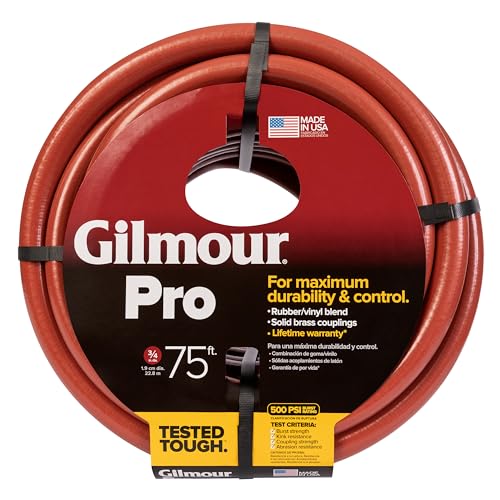
This is the pick for barns where the hose is treated as equipment rather than an accessory. The listing describes a double-reinforced, commercial grade rubber and vinyl build with a rugged, abrasion-resistant red cover, which is exactly the construction that survives being dragged across wash-rack concrete and gravel. Six-ply construction and a stated 500 psi burst strength suit a line that stays pressurized and gets stepped on. The 3/4-inch bore fills troughs quickly, and the commercial positioning makes it the natural choice for the busiest aisle in the barn.
Specs
- Length: 75 feet
- Diameter: 3/4 inch
- Material: double-reinforced commercial grade rubber and vinyl
- Construction: 6 ply
- Burst strength: 500 psi (as stated on the listing)
- Cover: rugged, abrasion-resistant red cover
Best for: Wash racks and main aisles where the hose is dragged, stepped on and left under pressure daily.
Watch out for: The commercial build is heavier to coil than hybrid hoses, and the red cover is chosen for toughness rather than looks.
ASIN: B000KL6QYI
Briggs & Stratton 8BS75 Premium Heavy-Duty Rubber Hose, 75 ft

Rubber remains the traditional barn material for good reason, and this listing leans into it: a premium heavy-duty rubber hose with brass fittings that resists kinking and stays flexible in extreme cold. That cold-weather flexibility is the deciding factor for unheated barns, where a hose that turns rigid overnight becomes a daily wrestling match. The listing also states the hose can be used with hot water, which suits wash racks where horses are bathed with warm water through the colder months. At 75 feet it covers most single-aisle layouts from one hydrant.
Specs
- Length: 75 feet
- Material: rubber
- Fittings: brass
- Model number: 8BS75
- Behavior: resists kinking and stays flexible in extreme cold, per the listing
- Use: can be used with hot water, per the listing
Best for: Unheated barns and wash racks that run warm water for bathing in winter.
Watch out for: Full rubber construction is the heaviest option here to drag and coil, especially at full length.
ASIN: B007R0UHF4
Flexzilla Garden Hose, 3/4 in. x 100 ft
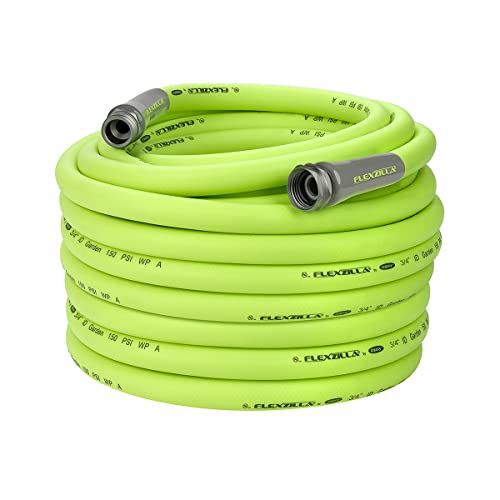
When one hydrant has to serve troughs at both ends of a long barn, reach becomes the whole decision, and this hose answers with 100 feet of 3/4-inch line. The listing describes a lightweight all-weather water hose with durable, flexible construction and leak-free connections, and the hybrid polymer design keeps a hose this long manageable to pull out and coil back. The wider bore keeps flow strong at the far end of the run, so the last trough fills at a useful rate instead of a trickle. It suits properties where moving the water source is not an option.
Specs
- Length: 100 feet
- Diameter: 3/4 inch
- Maximum pressure: 150 pound per square inch, per the listing
- Item weight: 19 pounds
- Model number: HFZG6100YW-E
- Connections: leak-free connections, per the listing title
Best for: Long barns and paddock troughs served from a single distant hydrant.
Watch out for: A 100-foot hose is a lot to coil neatly; without a reel or a wall hook routine it tends to live in a pile.
ASIN: B0781Z3J6B
Giraffe Tools Garden Hose, 75 ft x 5/8 in.

Some barn work is less about raw flow and more about how often the hose gets moved: bathing, bucket filling, rinsing a trailer, spot-cleaning stalls. This listing describes a heavy duty, lightweight, flexible hybrid hose built from a three-layer hybrid polymer that lies flat under pressure and resists kinks, which makes it the easiest of these four to coil, carry and store between jobs. The 5/8-inch diameter keeps the weight down for handlers who move the hose several times a day, and the male-to-female fittings connect directly to standard barn hydrants and nozzles.
Specs
- Length: 75 feet
- Diameter: 5/8 inch
- Material: 3-layer hybrid polymer
- Fittings: male to female fittings
- Behavior: lies flat under pressure and eliminates kinks, per the listing
- Positioning: heavy duty and lightweight, per the listing title
Best for: Daily bathing, bucket work and barns where the hose is coiled and carried often.
Watch out for: The 5/8-inch bore fills large troughs more slowly than the 3/4-inch picks above.
ASIN: B0CN6C896P
Which One Fits Your Situation
Your hose lives at the wash rack
Choose the Gilmour Pro Commercial. A wash-rack hose is dragged over wet concrete, pinned underfoot and left pressurized between horses, so the double-reinforced six-ply build and abrasion-resistant cover answer the exact abuse that kills ordinary hoses in that spot. The 3/4-inch bore also keeps rinsing fast when several horses are waiting their turn.
Your barn is unheated and winters are hard
Choose the Briggs & Stratton 8BS75. The listing’s promise of flexibility in extreme cold matters every single morning, and hot-water capability means the same hose can run a warm bath in February. Accept the extra weight as the trade for a hose that still coils when the aisle is freezing.
One hydrant serves the whole property
Choose the Flexzilla 3/4-inch x 100 ft. Distance is your problem, and a single long line removes couplings from the system entirely. The lightweight all-weather build keeps a 100-foot pull manageable, and the wide bore protects flow at the far trough where pressure would otherwise fade.
You move the hose more than you leave it
Choose the Giraffe Tools hybrid hose. If the hose is coiled after every use and carried between stalls, the trailer and the wash area, its lighter hybrid build and flat-lying behavior save effort on every single handling, which adds up across a working week.
Common Mistakes
- Buying a lightweight garden hose for barn duty: thin walls abrade through on concrete and fail at the first kink point, so the saving disappears into replacements.
- Choosing length by guesswork: a hose that comes up ten feet short gets stretched tight across walkways, where it becomes a trip hazard and a hoof trap.
- Ignoring diameter: filling troughs through a narrow hose wastes working time every day, while an oversized hose for bucket work is needless weight to haul.
- Leaving any hose pressurized in freezing weather: trapped water expands as it freezes and splits walls and fittings, whatever the construction, so drain the line when temperatures drop.
- Storing the hose in a tangled pile: repeated kinks at the same fold weaken the wall there until it bursts under normal pressure, usually mid-job and always at the worst moment; routing the line where wheelbarrows and vehicles do not cross it daily prevents the same kind of fatigue.
Frequently Asked Questions
Is a 3/4-inch or 5/8-inch hose better for a horse barn?
It depends on the job you repeat most. A 3/4-inch hose fills troughs and serves wash racks faster, which suits barns moving a lot of water from one hydrant. A 5/8-inch hose is lighter to coil and carry, suiting bathing, buckets and frequent handling. Many barns end up with one of each, assigned to different work.
Can a barn hose be left outside through winter?
Only if it is drained. Any hose left full of water can split when that water freezes, regardless of how heavily it is built. Cold-flexible rubber or hybrid hoses can stay outdoors and still coil on freezing mornings, but draining after use and storing the line out of traffic remain the habits that protect it.
How long should a barn hose be?
Long enough to reach the farthest trough or wash point from the hydrant with a little slack for routing around stalls, and no longer. Extra length adds weight, coiling effort and trip hazards without benefit. Measure the actual route the hose will travel, including corners, rather than the straight-line distance across the barn.
Why do barn hoses fail at the fittings so often?
Because fittings take the abuse: they are dropped on concrete, stepped on, dragged by the hose and wrenched by gloved hands. Solid brass couplings tolerate that treatment better than thin fittings, and storing the hose without tension on the connection helps. A hose protector or spring guard at the faucet end also reduces the sharp bending that starts leaks.