Our Short List of 3

- Best for: First-time home baristas who want precise espresso steps without a steep learning curve.
- 40 grind settings, with settings 1-20 in the espresso micro range
- 40 mm conical steel burrs, manufactured in Europe
- Hopper capacity of 300 g (10.6 oz)
- Grounds bin capacity of 120 g (4.2 oz)

- Best for: Daily espresso drinkers who want quiet, repeatable timed dosing and stepless fine-tuning.
- 55 mm flat steel burrs with stepless adjustment
- Programmable touchscreen dosing for single, double and continuous modes
- Sound-insulated case with anti-vibration mounts
- Bean hopper capacity of 12 oz

- Best for: Households that split one grinder between espresso and filter brewing.
- 41+ grind settings for espresso, pour-over, French press and cold brew
- 40 mm stainless steel conical burrs
- Volumetric dosing lid measures beans for up to 12 cups
- Direct drop-down grind path for reduced retention
All 4 Picks at a Glance
| Product | Specs | Action |
|---|---|---|
| Baratza Encore ESP |
| Check price on Amazon |
| Eureka Mignon Specialita |
| Check price on Amazon |
| Fellow Opus |
| Check price on Amazon |
 Breville Smart Grinder Pro |
| Check price on Amazon |
Key takeaways
- Compare four precision hopper espresso grinders by burr size, grind steps, hopper capacity and dosing, so you can dial in espresso at home.
A hopper espresso grinder decides whether your shots taste sweet and balanced or sour and muddy, because grind size is the one variable you adjust every single morning. A grinder with coarse steps forces you to choose between a shot that runs too fast and one that chokes the machine, while a precision grinder lets you move in tiny increments until the flow, the crema and the flavour all land where you want them.
This guide is for home baristas pulling shots on a pump machine, for pour-over drinkers who also want espresso capability, and for anyone upgrading from a blade grinder or a basic burr grinder. Every pick below is compared using the burr type, grind settings and hopper capacity stated on its Amazon product page, so you can match the grinder to your machine and your routine.
Quick Picks
As an Amazon Associate we earn from qualifying purchases.
| Product | Best for | Key spec from title |
|---|---|---|
| Baratza Encore ESP | First espresso grinder on a budget | 40 grind settings with a dedicated micro range |
| Eureka Mignon Specialita | Quiet, timed dosing every morning | 55 mm flat steel burrs with stepless adjustment |
| Fellow Opus | One grinder for espresso and filter coffee | 41+ grind settings with a 40 mm conical burr set |
| Breville Smart Grinder Pro | Push-button dosing for a busy kitchen | 60 grind settings with a precision electronic timer |
How to Choose
Burr Size and Burr Shape
Burrs do the actual cutting, and their size and shape set the ceiling on grind quality. Larger flat burrs, such as the 55 mm set in the Eureka, tend to produce a more uniform particle spread at espresso fineness, which helps shots extract evenly. Smaller conical burrs, such as the 40 mm sets in the Baratza and Fellow, are forgiving and produce a familiar, full-bodied cup. Neither shape is automatically better, but a grinder with a named burr diameter and material on its listing gives you a real basis for comparison, while a listing that hides burr details should make you pause before buying.
How Fine the Steps Go
Espresso needs adjustments far smaller than filter coffee, because a change of a fraction of a millimetre can move a shot from twenty seconds to thirty-five. Stepless grinders let you turn the dial to any point in between, which is ideal once you learn to dial in by taste. Stepped grinders with a dedicated micro range, such as the Baratza with twenty fine steps and the Breville with sixty settings, get close enough for most home machines. Count the settings in the fine end of the range, not the total, since coarse steps for cold brew do nothing for your morning shot.
Hopper Size and Bean Freshness
A hopper holds the beans you grind from, and its size shapes how you store coffee. A large hopper suits households that brew several drinks a day and refill often, while a smaller hopper suits a single drinker who buys fresh beans in small bags and wants nothing sitting stale. Some grinders include a dosing cup or a grounds bin as well, which changes how you move grounds into the portafilter. Check whether the hopper locks, twists off easily for cleaning, and holds the amount you actually grind in a week, rather than assuming bigger is always better.
Dosing, Noise and Counter Space
The last decision is practical: how the grinder fits your kitchen and your mornings. Timed dosing and a touchscreen, like the Eureka offers, repeat the same dose without weighing every shot. A pulse button and an on-off switch, like the Baratza uses, give you manual control with fewer parts to fail. Noise matters if you brew before the household wakes, and footprint matters if your counter already holds a machine, a kettle and a scale. Measure the height under your cabinets too, since a tall hopper can be awkward to fill.
The 4 Best Options
Baratza Encore ESP
- Best for: First-time home baristas who want precise espresso steps without a steep learning curve.
- 40 grind settings, with settings 1-20 in the espresso micro range
- 40 mm conical steel burrs, manufactured in Europe
- Hopper capacity of 300 g (10.6 oz)
- Grounds bin capacity of 120 g (4.2 oz)
First-time home baristas who want precise espresso steps without a steep learning curve.
The hopper holds a full bag of beans, so store only what you will use within a week or two to keep the coffee fresh.
The Encore ESP is the natural first precision grinder for someone moving from pre-ground coffee or a basic burr grinder to real espresso. Its dual-range system gives you twenty finely spaced steps for espresso and twenty wider steps for filter and cold brew, so one grinder covers the whole morning routine without a second purchase. The included dosing cup fits both 54 mm and 58 mm portafilters, and the twist of the hopper changes the grind setting with one hand. It is light, simple to clean, and backed by a company known for stocking replacement parts for years.
Watch out for: The hopper holds a full bag of beans, so store only what you will use within a week or two to keep the coffee fresh.
Eureka Mignon Specialita
- Best for: Daily espresso drinkers who want quiet, repeatable timed dosing and stepless fine-tuning.
- 55 mm flat steel burrs with stepless adjustment
- Programmable touchscreen dosing for single, double and continuous modes
- Sound-insulated case with anti-vibration mounts
- Bean hopper capacity of 12 oz
Daily espresso drinkers who want quiet, repeatable timed dosing and stepless fine-tuning.
At over 14 pounds it is a permanent countertop resident, so check your available space and cabinet clearance before ordering.
The Specialita is built for the home barista who pulls the same drink every morning and wants it to taste the same each time. Its 55 mm flat steel burrs adjust steplessly, so you can creep the grind finer by a hair when a new bag of beans runs fast, and the touchscreen stores timed doses for a single, a double and a continuous grind. A sound-insulated case with rubber mounts keeps the grinding noticeably quieter than most grinders in this class, which matters for early mornings. The wide chute and anti-clumping system help the grounds land fluffy and even in the basket.
Watch out for: At over 14 pounds it is a permanent countertop resident, so check your available space and cabinet clearance before ordering.
Fellow Opus
- Best for: Households that split one grinder between espresso and filter brewing.
- 41+ grind settings for espresso, pour-over, French press and cold brew
- 40 mm stainless steel conical burrs
- Volumetric dosing lid measures beans for up to 12 cups
- Direct drop-down grind path for reduced retention
Households that split one grinder between espresso and filter brewing.
The all-purpose design means the finest settings need careful dialling in, so expect a few test shots when you switch to a new bean.
The Opus suits a household where one person pulls espresso and another brews pour-over, because it covers the full range from fine to coarse with 41 easily adjustable settings. Its 40 mm stainless steel conical burr set runs on a motor rated at 6 Nm of torque, and the volumetric dosing lid measures beans for up to 12 cups of brewed coffee. A direct drop-down path from the load bin to the catch keeps retention low, and the anti-static design plus a spouted catch cut down on chaff and stray grounds. The inner ring allows precision adjustments, and calibration needs no tools.
Watch out for: The all-purpose design means the finest settings need careful dialling in, so expect a few test shots when you switch to a new bean.
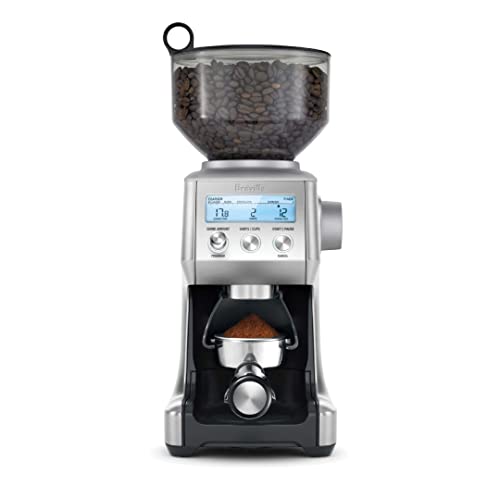
Breville Smart Grinder Pro
- Best for: Busy households that want repeatable, timed dosing and a clear display.
- 60 grind settings from finest espresso to coarsest French press
- Stainless steel conical burrs
- Precision electronic timer adjustable in 0.2-second increments
- 18-ounce coffee bean capacity with a locking hopper system
Busy households that want repeatable, timed dosing and a clear display.
The timer doses by time, not weight, so a change in bean density can shift the dose and a scale check now and then keeps shots consistent.
The Smart Grinder Pro is the pick for a busy kitchen where the grinder must deliver a consistent dose with almost no fuss. Its precision electronic timer adjusts grind time in 0.2-second increments, so once you find the dose you like, you can repeat it at the touch of a button. Sixty grind settings run from the finest espresso to the coarsest French press, and the 18-ounce bean hopper locks in place for easy removal and storage. The portafilter cradles fit both small 50 to 54 mm baskets and large 58 mm baskets, and the LCD display keeps the setting visible at a glance.
Watch out for: The timer doses by time, not weight, so a change in bean density can shift the dose and a scale check now and then keeps shots consistent.
Which One Fits Your Situation
You Are Buying Your First Espresso Grinder
Start with the Baratza Encore ESP. Its micro range gives you the fine steps espresso demands, the dosing cup keeps the workflow simple, and the grinder still handles filter coffee when friends visit. You get a genuine precision tool without paying for a touchscreen or a timed doser you may not yet need.
You Pull the Same Shot Every Morning
Choose the Eureka Mignon Specialita. The stepless adjustment lets you chase small changes as beans age, the timed touchscreen repeats your dose without weighing, and the quiet case keeps early brewing polite. It is the most set-and-forget option here, provided you have the counter space for it. The heavier build also stays put on the counter while you lock in the portafilter, which keeps the morning routine calm and steady.
One Grinder Must Serve the Whole Household
Pick the Fellow Opus. Its wide range covers espresso, pour-over, French press and cold brew, the dosing lid measures beans for a full pot, and the low-retention path means switching methods does not leave stale grounds behind. It is the most versatile grinder in this roundup. Keep a note of your espresso setting on the fridge, so returning from pour-over to espresso takes seconds rather than a fresh round of test shots.
You Want Push-Button Dosing in a Busy Kitchen
Go with the Breville Smart Grinder Pro. The timer in 0.2-second steps repeats your dose reliably, the locking hopper lifts off for storage, and the cradles accept both small and large portafilters, so whoever is brewing gets a consistent result with little practice. The clear display means anyone in the house can see the setting at a glance, and the locking hopper lifts off for easy cleaning between bean changes.
Common Mistakes
- Buying a grinder with only coarse steps, then finding no setting that pulls a balanced shot.
- Filling a large hopper with a whole bag and letting the beans go stale over three weeks.
- Grinding into the portafilter without checking the dose on a scale when switching beans.
- Ignoring height and footprint, then discovering the grinder does not fit under the cabinets.
- Skipping cleaning, so old grounds and oils build up and dull the flavour of fresh beans.
Frequently Asked Questions
What makes a hopper grinder a precision grinder for espresso?
A precision hopper grinder offers very small steps, or no steps at all, in the fine end of its range, so you can adjust the grind by tiny amounts until the shot flows correctly. It also uses burrs built to cut evenly at espresso fineness, rather than crushing the beans. That combination is what separates an espresso-capable grinder from a general-purpose one.
Do I need a stepless grinder to make good espresso?
No, you do not. Stepless adjustment gives the finest control, and experienced baristas value it, but a stepped grinder with a dedicated micro range, such as the Baratza or Breville here, offers enough fine settings for most home machines. Choose stepless if you enjoy dialling in by taste; choose stepped if you prefer repeatable clicks.
How much coffee should I keep in the hopper?
Keep only what you will grind within one to two weeks, and store the rest of the bag sealed in a cool, dark place. Beans lose aroma once the bag is open, and a hopper is not airtight, so a full hopper that sits for a month will taste flat even if the grinder is excellent.
Can one grinder handle both espresso and pour-over?
Yes, if it has a wide grind range and a way to return to your settings reliably. The Fellow Opus and the Baratza Encore ESP both cover espresso through cold brew. Note your espresso setting before moving the dial coarser, so you can return to it without starting the dial-in process from scratch.