Key takeaways
- Compare four crosscut hand saws for clean cuts across the grain, from rough framing work to fine joinery, with specs taken from their Amazon listings.
A crosscut saw earns its keep the moment you need a clean edge across the grain, and the real decision is not which saw looks toughest on the shelf. It is matching tooth count, tooth shape, and blade length to the boards you cut most often, because a coarse framing saw and a fine joinery saw solve opposite problems. Pick the wrong one and you either fight through every stroke or end up with a ragged edge that needs extra sanding and trimming before the piece fits.
This guide is for DIYers trimming studs and deck boards, homeowners cutting shelving and panels to length, and woodworkers who want tidy crosscuts for joinery and trim. It covers four hand saws sold on Amazon, chosen from the names and specifications shown on their product pages, so you can see exactly what each saw offers before you decide which one belongs in your toolbox.
Quick Picks
As an Amazon Associate we earn from qualifying purchases.
| Product | Best for | Key spec from title |
|---|---|---|
| IRWIN Hand Saw, Coarse Cut, ProTouch Handle, 15-Inch (2011201) | Fast crosscuts in framing lumber | 15-inch coarse-cut blade |
| WilFiks 16″ Pro Hand Saw | General DIY cuts around the house | 16-inch blade, 9 TPI |
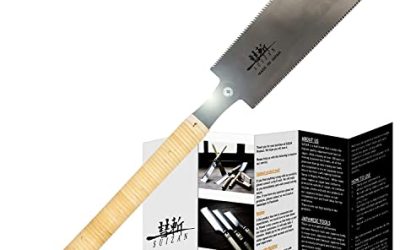
| SUIZAN Ryoba Double Edge Saw 7″ | Fine crosscuts in joinery and trim | 7-inch blade, 19 TPI crosscut edge |
| CRAFTSMAN Hand Saw, 15-Inch (CMHT20880) | Everyday household crosscuts | 15-inch universal-cut blade |
How to Choose
Match tooth count to the finish you need
Tooth count decides the trade between cutting speed and edge quality, so it deserves your attention before anything else. A coarse saw with around 9 teeth per inch removes wood quickly and suits framing lumber, deck boards, and rough cuts where the edge will stay hidden inside a joint or behind trim. A fine saw with around 19 teeth per inch moves more slowly but leaves a smoother edge on visible work such as shelving, trim, and joinery. If most of your cuts disappear into a build, coarse teeth save effort. If the cut edge stays visible, finer teeth save cleanup later.
Pick a blade length that fits your boards
Blade length sets how much board you can cross in one stroke and how the saw feels in use. A 15-inch or 16-inch blade covers standard framing lumber and shelving boards in a few strokes, which makes it the practical choice for general DIY and framing work. A short 7-inch blade cannot cross a wide board in one pass, but it turns easily in tight spaces and gives fine control on small pieces. Measure the widest board you cut regularly, then choose a blade comfortably longer than that width so the full tooth line works through the cut.
Check tooth shape and blade thickness
Crosscut teeth work differently from rip teeth, and the difference shows in the edge they leave. Crosscut teeth are shaped to sever wood fibers across the grain, almost like a row of small knives, while rip teeth act more like chisels along the grain. A saw built for crosscutting therefore leaves a cleaner edge on cross-grain cuts than a general rip-pattern blade. Blade thickness matters too: a thin blade near 0.5 mm removes less wood and leaves a narrow kerf, which suits precise joinery, while a thicker blade resists bending and flexing during heavier cuts.
Choose a handle and stroke you can control
A saw only cuts straight when your hand stays comfortable and steady through the stroke, so handle shape is a real decision criterion rather than a cosmetic one. Look for a handle with a full grip opening that fits your hand, with room to spare if you work in gloves, and a shape that keeps your wrist neutral during push strokes. Japanese pull saws reverse the habit: they cut on the pull stroke, which suits a thin blade and rewards a light touch, but the motion takes practice if you learned on Western push saws. Hold the style in mind before you buy.
The 4 Best Options
IRWIN Hand Saw, Coarse Cut, ProTouch Handle, 15-Inch (2011201)

The IRWIN 2011201 is the saw to reach for when framing lumber and rough crosscuts fill your day, because its coarse tooth pattern is built for speed through softwood and standard boards. Its 15-inch blade is long enough to cross a stud or deck board in a few strokes, while the ProTouch handle gives a secure grip through repeated cuts. Deep gullets clear sawdust from the cut so the blade keeps moving, and the M2 tooth geometry with Tri-Ground teeth is designed for fast, efficient cutting. This is a workhorse saw for builders and DIYers who cut a lot of lumber and care more about pace than a polished edge.
Specs
- 15-inch blade
- 9 points per inch, coarse cut
- M2 advanced tooth geometry with Tri-Ground teeth
- Deep gullets for clearing sawdust
- ProTouch handle
Best for: Fast crosscuts in framing lumber, deck boards, and rough carpentry.
Watch out for: The coarse 9-point tooth pattern leaves a rougher edge, so it is not the right pick for visible trim or fine joinery where the cut edge stays on show.
WilFiks 16″ Pro Hand Saw
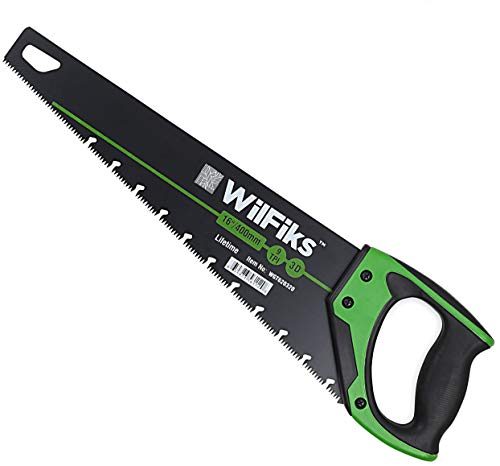
The WilFiks 16-inch Pro Hand Saw suits the household toolbox that handles a bit of everything, from trimming boards to cutting drywall and plastic pipe. Its 16-inch high-carbon steel blade gives a long stroke for framing-size cuts, while the 9 TPI tooth pattern keeps the pace up on softwood and general-purpose work. The ergonomic non-slip handle stays comfortable during longer jobs, and the rigid blade body helps the saw track straight through a cut. If you want one saw that covers most cutting jobs around the home without switching tools, this is a practical and straightforward choice.
Specs
- 16-inch blade
- 9 TPI high-carbon steel blade
- Ergonomic non-slip handle
- Cuts wood, drywall, and plastic pipes
Best for: General DIY crosscuts around the house, including boards, drywall, and plastic pipe.
Watch out for: The 16-inch blade needs clear space to swing, so it feels awkward inside cabinets or other tight spots, and the coarse 9 TPI pattern leaves a rougher edge on visible cuts.
SUIZAN Ryoba Double Edge Saw 7″
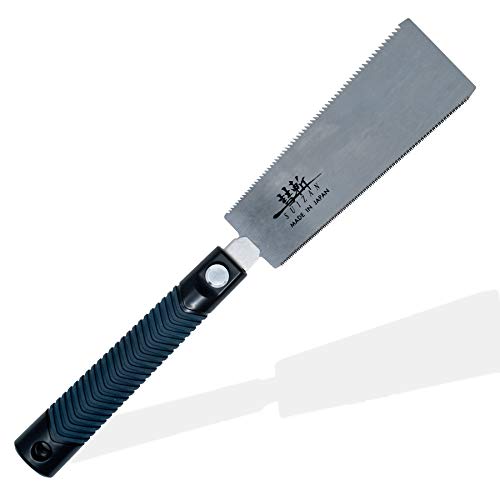
The SUIZAN Ryoba 7-inch saw is the precision pick in this group, built for woodworkers who cut joinery, trim, and molding to length and want the edge to need little cleanup. Its fine crosscut edge runs at 19 TPI, and the thin 0.5 mm Japanese steel blade leaves a narrow 0.8 mm kerf, so it removes little wood and follows a marked line closely. The blade cuts on the pull stroke, which reduces flex and gives fine control, and the elastomer handle grips securely while you work. When the blade eventually dulls, a replacement blade fits the same handle, so the saw stays useful for years.
Specs
- 7-inch (7.09 in / 180 mm) blade
- Crosscut edge at 19 TPI; rip edge at 7-11 TPI
- 0.5 mm blade thickness with a 0.8 mm kerf
- Japanese steel blade, replaceable
- Elastomer non-slip handle
Best for: Fine crosscuts in joinery, trim, molding, and small woodworking projects.
Watch out for: The short 7-inch blade cannot cross a wide board in one pass, the thin blade can flex if forced, and the other edge is a rip edge, so check which edge faces your cut before starting.
CRAFTSMAN Hand Saw, 15-Inch (CMHT20880)

The CRAFTSMAN 15-inch hand saw is a plain, dependable choice for everyday crosscuts around the house, from shortening a shelf board to trimming a stud. Its universal-cut tooth pattern handles wood in either direction well enough for general work, and the 15-inch steel blade is long enough for standard boards while staying easy to control. The red and black ergonomic handle gives a comfortable grip for occasional use, and the saw is light enough to carry in a basic toolbox. It does nothing fancy, which is exactly the point for a household saw that gets used a few times a month.
Specs
- 15-inch steel blade
- Universal-cut tooth pattern
- Red and black ergonomic handle
Best for: Everyday household crosscuts such as shelving, studs, and general DIY boards.
Watch out for: The universal-cut pattern is a compromise, so it cuts neither as fast as a coarse framing saw nor as smoothly as a fine joinery saw, and the listing describes it as universal cut rather than a dedicated crosscut pattern.
Which One Fits Your Situation
Framing, decking, and rough carpentry
Choose the IRWIN 2011201 when your work is mostly framing lumber, deck boards, and rough cuts that stay hidden in the build. Its coarse 9-point teeth and deep gullets move through softwood quickly, and the 15-inch blade crosses standard boards in a few strokes. The rougher edge it leaves does not matter when the cut disappears inside a joint or behind trim.
One saw for the whole house
Choose the WilFiks 16-inch Pro Hand Saw when you want a single saw that handles boards, drywall, and plastic pipe without swapping tools. Its long blade and 9 TPI pattern keep general cutting quick, and the ergonomic handle stays comfortable through a full afternoon of jobs. Keep a finer saw in mind for visible trim, since this one favors speed over finish.
Fine woodworking, trim, and joinery
Choose the SUIZAN Ryoba 7-inch saw when the cut edge stays visible and the fit has to be exact. Its 19 TPI crosscut edge and narrow 0.8 mm kerf leave a smooth edge on joinery, trim, and molding, and the pull stroke gives the control that small pieces demand. Just remember its short blade suits small stock, not wide boards.
Occasional cuts and a first hand saw
Choose the CRAFTSMAN 15-inch hand saw when you need a simple first saw for occasional household jobs. Its universal-cut pattern and manageable 15-inch blade handle shelving, studs, and general boards without a learning curve, and the ergonomic handle suits short sessions. It is the easiest starting point if you only cut wood a few times a month.
Common Mistakes
- Using a rip-pattern edge for crosscuts, or the wrong edge of a double-edge saw, which tears fibers instead of severing them cleanly.
- Choosing tooth count for speed alone, then finding the edge too rough for visible trim or shelving.
- Forcing a thin-bladed saw through a cut, which bends the blade and sends the line off course.
- Cutting a board without supporting both sides, so the offcut drops, pinches the blade, and splinters the edge.
- Storing a hand saw loose with other tools, where the teeth knock against metal and dull before the next job.
Frequently Asked Questions
What is the difference between a crosscut saw and a rip saw?
A crosscut saw has teeth shaped to sever wood fibers across the grain, leaving a cleaner edge on cuts that run across a board. A rip saw has chisel-like teeth shaped to cut along the grain, which suits splitting boards lengthwise. Using a rip saw for crosscuts tears fibers and leaves a rough edge, so matching the tooth pattern to the cut direction matters more than brand.
What tooth count should I choose for crosscutting?
Choose around 9 teeth per inch for fast rough work such as framing lumber and deck boards, where speed matters and the edge stays hidden. Choose around 15 to 19 teeth per inch for visible work such as trim, shelving, and joinery, where a smoother edge saves sanding. A universal-cut saw sits between the two and suits general household cutting when you only want one saw.
Can a general-purpose hand saw cut across the grain?
Yes, a hand saw with a universal-cut tooth pattern can crosscut boards well enough for DIY work, and saws such as the CRAFTSMAN 15-inch and the WilFiks 16-inch Pro are built for that use. The edge will not be as smooth as a crosscut saw leaves, so for visible trim or joinery, switch to a finer saw such as the SUIZAN Ryoba with its 19 TPI crosscut edge.
How do I keep crosscuts straight and clean?
Mark the line, start with a pull stroke to set the kerf, and let the saw do the work with long, steady strokes rather than short, forced ones. Support the board on both sides of the cut so the offcut cannot drop and pinch the blade, and keep your eye on the line rather than the teeth. A fine-tooth blade and a calm rhythm matter more than pressing hard.