Key takeaways
- Compare four jobsite table saws for a home shop by rip capacity, blade size, fence type and stand, from a wide-ripping DEWALT to a compact bench model.
A home shop table saw has to earn its floor space. The real decision is not raw power, since nearly every saw in this class runs a similar motor, but how much of your garage the machine claims, how wide it can rip a sheet of plywood, and whether it folds or rolls away when the car needs to come back inside. A saw that is awkward to store tends to stay buried, and a buried saw rarely gets used.
This guide is for garage woodworkers building cabinets and furniture, weekend renovators ripping flooring and trim, and beginners setting up a first dedicated cutting station. Each pick was chosen from the names and specifications on its Amazon product page, covering wide-ripping, folding, wheeled and compact designs so the differences that matter stay easy to compare.
Quick Picks
As an Amazon Associate we earn from qualifying purchases
| Product | Best for | Key spec |
|---|---|---|
| DEWALT DWE7491RS 10-Inch Table Saw with Rolling Stand | Ripping full plywood sheets in a garage shop | 32-1/2 inch rip capacity |
| SKIL TS6307-00 10-Inch Jobsite Table Saw with Folding Stand | First-time owners who need the saw stored flat | 25-1/2 inch rip capacity to the right |
| BOSCH 4100XC-10 10-Inch Worksite Table Saw with Gravity-Rise Stand | Frequent setup and teardown on uneven floors | 30 inch rip capacity |
| DEWALT DWE7485 8-1/4 Inch Compact Jobsite Table Saw | Bench-top use in the tightest workspaces | 24-1/2 inch rip capacity |
How to Choose
Rip Capacity and Sheet Goods
Rip capacity decides whether a plywood sheet gets cut in one confident pass or in two awkward stages. A figure around twenty four inches handles a half sheet, which covers most cabinet sides, drawer parts and shelving. Step up toward thirty inches or beyond and wider panels, bookcase sides and tabletop blanks pass the blade without support gymnastics. Measure the widest panel on your current project list, then leave a small margin. Buying far more capacity than your work needs usually means accepting a larger footprint every single day you park beside the saw.
Blade Size and Depth of Cut
A ten inch blade is the common choice here, and its deeper cut suits thick leg blanks, laminated tops and resawing tasks split across two passes. The smaller eight and a quarter inch blade on a compact saw gives up some depth, which matters only when stock grows genuinely thick. Check the stated depth at ninety degrees and again at forty five degrees, because bevelled edges on chunky material expose the gap quickly. For typical furniture parts, plywood and two-by lumber, either size keeps pace comfortably.
Fence Design and Repeat Accuracy
Cabinet doors and drawer boxes punish a fence that drifts. Rack and pinion systems move both ends of the fence together, so the measurement you dial in stays parallel to the blade along the whole rail. Clamp style fences can work well too, provided the locking action feels positive and the rail spans enough of the table. Whichever design you choose, plan to verify fence alignment against a miter slot during setup. Repeat cuts for a set of shelves should match without nudging the fence between boards.
Stand Type and Storage Reality
The stand shapes daily life with the saw more than most specifications do. A rolling stand lets one person wheel the machine to the driveway for dusty work and back again afterwards. Folding legs store flatter against a wall, which suits shops sharing space with bikes and storage boxes. A benchtop model needs a sturdy, level surface of its own, plus somewhere safe to sit between projects. Picture your actual storage corner, measure it honestly, and pick the arrangement that leaves the saw ready rather than dismantled.
The 4 Best Options
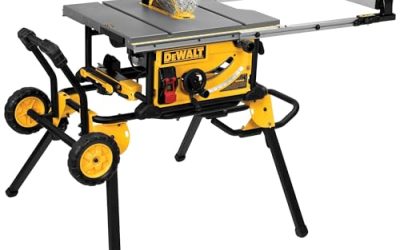
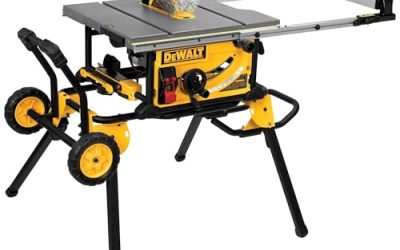
DEWALT DWE7491RS 10-Inch Table Saw with Rolling Stand
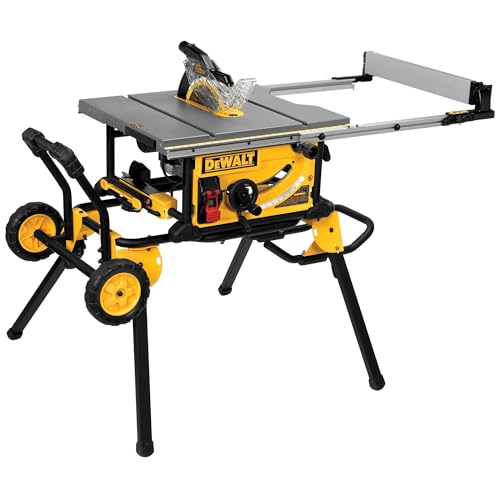
Home woodworkers whose projects start with full sheets of plywood will appreciate this saw most. Its rip capacity is the widest in this group, so cabinet carcasses and long shelving boards pass through without a preliminary breakdown cut elsewhere. The rack and pinion fence adjusts along telescoping rails, helping wide settings stay parallel, while the rolling stand folds for storage and rolls the saw out when a project takes over the garage. Onboard storage keeps the guard, fence and push stick travelling with the machine instead of scattering across benches.
Specs
- Blade size: 10 inches
- Motor: 15 amp
- Blade speed: 4,800 RPM
- Rip capacity: 32-1/2 inches to the right of the blade
- Depth of cut: 3-1/8 inches at 90 degrees, 2-1/4 inches at 45 degrees
- Fence: Rack and pinion telescoping fence rails
- Stand: Foldable rolling stand included
- Dust port: 2-1/2 inch dust collection port
Best for: Garage shops that regularly break down full plywood sheets
Watch out for: Measure your storage bay before ordering, since the rolling stand needs more room than a folding-leg design.
ASIN: B00F2CGXGG
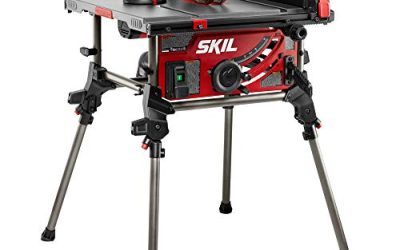
SKIL TS6307-00 10-Inch Jobsite Table Saw with Folding Stand
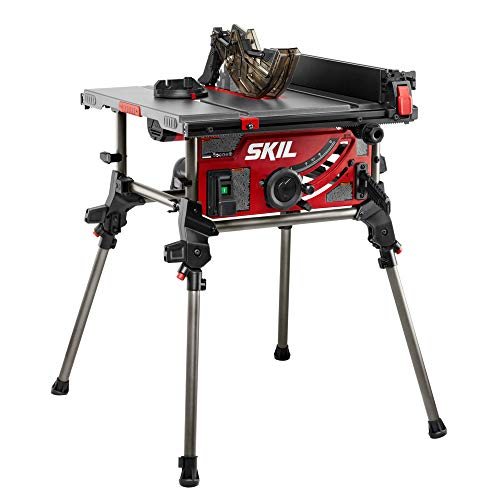
This SKIL suits a first-time table saw owner who wants full ten inch blade capability without giving the machine a permanent address. The integrated stand folds with the saw, so the whole unit leans against a wall between weekend projects. Rack and pinion fence rails support straight rips, and a parallel blade alignment feature lets you correct the blade relative to the fence and miter slot. Its depth of cut handles a four by four at ninety degrees, which covers pergola parts, bed posts and other chunky outdoor builds alongside ordinary furniture stock.
Specs
- Blade size: 10 inches
- Motor: 15 amp
- Blade speed: 4,600 RPM
- Rip capacity: 25-1/2 inches to the right, 14 inches to the left
- Depth of cut: 3-1/2 inches at 90 degrees, 2-1/2 inches at 45 degrees
- Bevel capacity: -2 degrees to 47 degrees
- Fence: Rack and pinion fence rails
- Stand: Integrated folding stand
Best for: Beginners and weekend builders who store the saw flat after each project
Watch out for: Dado work needs a separate dado insert plate, so confirm what the box includes if grooves are on your list.
ASIN: B08F9RFJ2K
BOSCH 4100XC-10 10-Inch Worksite Table Saw with Gravity-Rise Stand
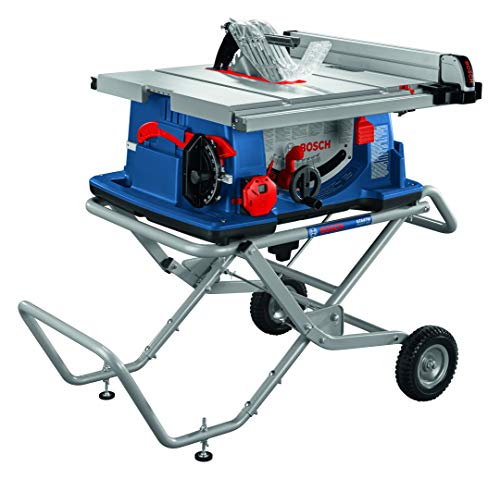
Renovators who set up in a driveway one day and a basement the next are the natural audience for this Bosch. Its Gravity-Rise wheeled stand is built around a single-action setup, so raising or collapsing the saw stays a one-person job even on rough ground. Soft-start circuitry brings the motor up gradually, and Constant Response circuitry works to hold speed under load, while restart protection guards against an unexpected start after a power interruption. The SquareLock rip fence is designed to stay true, and an auxiliary fence helps when narrow workpieces need support close to the blade.
Specs
- Blade size: 10 inches
- Motor: 15 amp, 4.0 maximum horsepower
- Blade speed: 3,650 RPM
- Rip capacity: 30 inches to the right, 8-1/2 inches to the left
- Depth of cut: 3-1/8 inches at 90 degrees
- Tabletop: 30 inches by 22-1/2 inches
- Fence: SquareLock rip fence with auxiliary fence for narrow workpieces
- Stand: GTA47W Gravity-Rise wheeled stand
- Electronics: Soft-start circuitry, Constant Response circuitry, restart protection
Best for: Owners who move the saw often and set up on uneven surfaces
Watch out for: This is the heaviest arrangement in the group, so plan a clear rolling path rather than expecting to carry it.
ASIN: B0851KL858
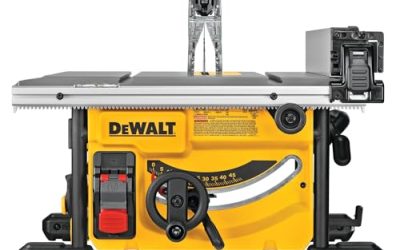
DEWALT DWE7485 8-1/4 Inch Compact Jobsite Table Saw

Apartment workshops, single-car garages and shared sheds call for the smallest footprint that still behaves like a proper table saw, and that is the brief this compact DEWALT fills. It sits on a bench or sturdy surface rather than a stand, then stores on a shelf when floor space runs out. Despite the smaller blade, the rack and pinion fence and a rip capacity beyond twenty four inches let it size plywood panels for cabinets and built-ins. A metal roll cage base suits being moved often, and onboard storage keeps the guarding components, fence and wrenches with the saw.
Specs
- Blade size: 8-1/4 inches
- Motor: 15 amp
- Blade speed: 5,800 RPM
- Rip capacity: 24-1/2 inches
- Depth of cut: 2-9/16 inches at 90 degrees, 1-7/8 inches at 45 degrees
- Fence: Rack and pinion telescoping fence rails
- Base: Metal roll cage base
- Safety: Power-loss reset feature, modular guard system, riving knife and anti-kickback pawls
- Dust port: 2-1/2 inch dust collection port
Best for: Very small shops where the saw lives on a bench or shelf
Watch out for: No stand is included, and the smaller blade cuts shallower than the ten inch models, so check thick-stock plans first.
ASIN: B0842QDW95
Which One Fits Your Situation
Your Shop Is One Bay of a Shared Garage
Choose between the SKIL and the compact DEWALT according to how you store things. The SKIL folds its legs and leans away as one unit, while the DEWALT leaves the floor entirely and sits on a bench or shelf. Both rip a half sheet comfortably. Pick the storage motion you will actually repeat every week, because a saw that takes ten minutes to free from clutter quietly stops being used for small jobs.
Cabinet and Furniture Projects Dominate Your List
The DEWALT DWE7491RS fits this workload best. Its wider rip capacity swallows full sheet breakdowns, and the telescoping rack and pinion fence supports the repeatable settings that fitted doors and drawer fronts demand. The Bosch is the alternative when the same projects happen in different locations, since its wheeled stand and thirty inch capacity travel well. Either machine covers typical furniture thickness without approaching its depth limit.
You Work Wherever the Project Happens to Be
Renovating room by room means the saw follows you, so the Bosch Gravity-Rise design earns its place. One setup motion, large wheels and electronics that manage startup behaviour suit houses with older wiring and uneven driveways. If the work is mostly trim and flooring in finished rooms, the compact DEWALT is easier to carry upstairs and kinder to tight hallways, provided a solid bench or surface waits at the destination.
Thick Stock and Outdoor Builds Are the Priority
Depth of cut becomes the deciding figure here. The SKIL offers the deepest cut at ninety degrees in this group and is specified for four by four material in a single pass, which suits garden structures and heavy bench legs. The ten inch DEWALT and Bosch models follow closely for laminated blanks. Whichever you choose, support long, heavy boards on both sides of the table so the cut stays steady.
Common Mistakes
- Choosing by motor rating alone, when rip capacity and fence design shape everyday results far more.
- Forgetting to measure the storage corner, then discovering the stand fits only when the car stays outside.
- Skipping the setup checks for blade and fence alignment because the saw arrived assembled in its box.
- Feeding full plywood sheets without infeed and outfeed support, which lets the panel tip and wander mid-cut.
- Planning dado grooves without confirming the saw accepts a dado stack and which insert plate it requires.
Frequently Asked Questions
Can a jobsite saw really serve as the only saw in a home shop?
For most home projects, yes. The models above rip sheet goods, size furniture parts and cut joinery with the right blade and setup. Limits appear with very thick stock, production runs and wide panels beyond the stated rip capacity. Within those boundaries, a jobsite saw handles cabinets, shelving, trim and outdoor builds without needing a stationary machine beside it.
How much rip capacity does a typical home shop need?
Around twenty four inches covers a half sheet of plywood, which matches most cabinet and shelving parts. Wider capacity helps when you break down full sheets alone or build broad tabletops and bookcase sides. Rather than chasing the largest number, match capacity to the widest panel on your usual project list and keep the smaller footprint if your work stays modest.
Is an 8-1/4 inch saw a false economy compared with a 10 inch model?
Not for shops built around plywood, trim and two-by material, where its depth of cut rarely becomes the limit. The trade shows up with thick leg blanks, deep bevels and some dado work. If your project list leans toward chunky hardwood furniture, a ten inch model leaves more headroom. For compact storage and ordinary stock, the smaller saw remains a sensible, capable choice.
What should be checked before the first cut on a new saw?
Confirm the blade sits parallel to the miter slots, set the fence to match, and verify the ninety degree stop with a reliable square. Fit the guard, riving knife and anti-kickback pawls, then check that the fence locks without shifting. A few quiet minutes on these steps makes the first project cuts predictable instead of experimental.