Our Short List of 3

All 4 Picks at a Glance
| Product | Specs | Action |
|---|---|---|
 1. OPTIMA RedTop 34/78 — 800 CCA, Dual SAE and GM Terminals | Check price on Amazon | |
| 2. Odyssey 34-PC1500T — 850 CCA, 135-Minute Reserve, 4-Year Warranty | Check price on Amazon | |
| 3. ACDelco Gold 48AGM — 760 CCA, Group 48, 36-Month Replacement Warranty | Check price on Amazon | |
 4. XS Power D3400 — 1,012 CCA, 160-Minute Reserve, M6 Terminals | Check price on Amazon |
Key takeaways
- How long does a lead acid battery last? A 12V starting battery usually runs three to five years. These five sealed AGM batteries show what to look for.
Disclosure: As an Amazon Associate, this site may earn from qualifying purchases made through links on this page.
Intro
How long does a lead acid battery last? For a 12-volt starting battery in a car, truck or SUV, the usual answer is three to five years. That range is a guide drawn from maker documents and owner reports, not a laboratory result, and where a battery lands inside it depends on heat, use and care. A battery in a hot climate often gives up sooner, because heat speeds the chemical wear inside the case. A battery in a mild climate that stays charged and rarely sits flat can run past five years. Deep-cycle AGM batteries, which are built to be drawn down and recharged again and again, often last five to seven years in RV, marine and off-grid use when they are kept above a deep discharge and recharged promptly.
The short answer hides a useful distinction. A starting battery and a deep-cycle battery are both lead-acid batteries, but they are built for different jobs. A starting battery gives a short, hard burst of current to crank an engine, then the alternator refills it at once. A deep-cycle battery gives a steady current over hours to run lights, a trolling motor or a refrigerator, then recharges slowly. Using a starting battery for deep-cycle work wears it out in short order, because its thin plates are not built for repeated deep discharge. Using a deep-cycle battery to crank an engine works poorly too, because its thick plates cannot give the same hard burst. The five picks in this guide are all sealed AGM starting batteries — the type most cars, trucks and SUVs take — and the guide says plainly which of them also tolerate deep cycling and which are starting-only.
Age is only one sign of the end. A battery that cranks slowly on a cold morning, headlights that dim at idle, a case that bulges or smells of sulfur, and a voltmeter reading under 12.4 volts after a night at rest all point the same way. A battery past four years old with any of those signs is living on borrowed time, and a battery that has gone flat more than once has lost capacity that no charger brings back. The sections below explain what stretches life and what shortens it, then compare five sealed AGM batteries that cover the common group sizes — Group 34, Group 35 and Group 48 — so the fit matches the tray, the terminals and the loads.
At a Glance
- Typical life: three to five years for a 12V starting battery; five to seven years for a deep-cycle AGM kept charged and cycled gently.
- Biggest killer: heat under the hood, followed by repeated deep discharge and long sits with no charge.
- Strongest cranking here: XS Power D3400 — 1,012 cold cranking amps with a 160-minute reserve.
- Longest warranty here: Odyssey 34-PC1500T — a four-year full replacement warranty for engine starting.
- Best OE-fit pick: ACDelco Gold 48AGM — Group 48, 760 cold cranking amps, 120 minutes of reserve, 36-month replacement warranty.
- Most flexible fit: OPTIMA RedTop 34/78 — dual SAE and GM terminals in a Group 34/78 case.
- Compact pick: OPTIMA RedTop 35 — 720 cold cranking amps in a Group 35 case for a smaller tray.
How to Choose
Match the group size first. Group size is the case size, terminal layout and hold-down fit. Group 34, Group 35 and Group 48 are the common sizes in this guide, and they do not swap: a Group 48 battery will not sit in a Group 35 tray, and a Group 34 battery will not line up with a Group 48 hold-down. Check the owner’s manual or the label on the old battery before ordering, and measure the tray if the manual is gone. Terminal position matters too — a battery with the positive post on the wrong side will not reach the cables.
Read cold cranking amps against the climate. Cold cranking amps, or CCA, is the current a battery can give at 0 degrees Fahrenheit for 30 seconds while staying above 7.2 volts. A higher CCA figure means a harder crank on a cold morning. In a warm climate, CCA matters less, and reserve capacity matters more. In a cold climate, buy the highest CCA that fits the tray and the budget, because a cold engine needs more current and a cold battery gives less of it.
Read reserve capacity for accessory use. Reserve capacity is the minutes a fully charged battery can run a 25-amp load before voltage falls to 10.5 volts. It is the figure that decides how long lights, a radio or a winch can run with the engine off. The picks here run from 100 minutes to 160 minutes. A car that sits with accessories running wants the longest reserve in its group size.
Choose AGM over flooded for heat and mounting. All five picks are sealed AGM batteries: the electrolyte is held in glass mats, so there is no water to add, no spill if the case tips, and the battery can mount in more positions than a flooded battery. AGM batteries also take a charge more readily and hold voltage better in heat. The trade-off is that AGM batteries want the right charger — a charger with an AGM setting — and a standard flooded charger can overcharge them.
Check the warranty in years, not words. Warranties in this guide run from a 36-month replacement warranty to a four-year full replacement warranty. A replacement period means the maker swaps a failed battery outright inside that window. After that window, some warranties turn pro rata, which means the buyer pays a share. Read the listing for the exact terms, because the headline figure and the fine print do not always match.
Weigh the battery against the tray. These are heavy boxes: 38.8 pounds at the light end here, 49.5 pounds at the heavy end. A battery that is too heavy for its tray or hold-down is a hazard, not a bargain. Check the tray load limit and the hold-down before ordering, and carry the old battery out and the new one in with a proper grip — a dropped battery can crack its case.
The Picks
1. OPTIMA RedTop 34/78 — 800 CCA, Dual SAE and GM Terminals
The RedTop 34/78 is the flexible pick in this guide, and the reason is in its name: it carries both SAE top posts and GM side terminals in one Group 34/78 case, so it fits cars that take either terminal style without adapters. It is a 12-volt sealed AGM starting battery rated at 800 cold cranking amps, 50 amp-hours and a 100-minute reserve, in a case measuring 10 by 6-7/8 by 7-13/16 inches and weighing 38.8 pounds. The part number is 8004-003. Inside, the SpiralCell design winds the plates into spiral cells of pure lead, which the maker says gives strong vibration resistance — useful in a truck or an off-road vehicle. The battery is sealed, with no water to add, and spill-resistant, and it mounts in more positions than a flooded battery. For a driver whose vehicle takes a Group 34 or 78 battery and who wants the widest fit in one box, this is the pick.
2. Odyssey 34-PC1500T — 850 CCA, 135-Minute Reserve, 4-Year Warranty
Odyssey Battery 34-PC1500T Automotive and LTV Battery
The Odyssey 34-PC1500T is the premium pick, and its numbers are the strongest all-round figures in this guide. It is a 12-volt AGM battery in a Group 34 case, rated at 850 cold cranking amps, 1,500 pulse hot cranking amps, 68 amp-hours and 135 minutes of reserve, in a case measuring 10.85 by 6.76 by 7.82 inches and weighing 49.5 pounds. The part number is ODX-AGM34. The plates are thin-plate pure lead, which packs more plate surface into the same case and gives the battery both hard cranking and real deep-cycle tolerance — the maker rates it for more than 400 cycles at four-fifths depth of discharge, so it can run accessories with the engine off and recover. The warranty is a four-year full replacement for engine starting, the longest here. At 49.5 pounds it is also the heaviest pick, so check the tray before ordering. For a truck, SUV or accessory-loaded car that needs the hardest possible start and a battery that tolerates deep discharge, this is the pick.
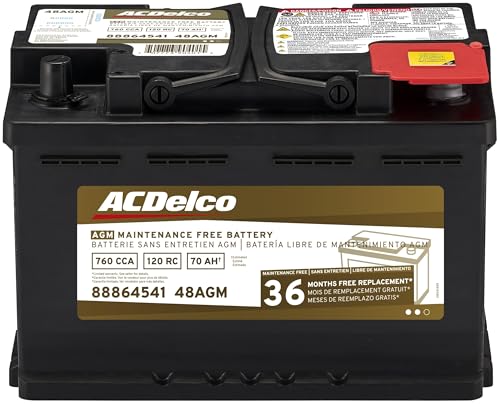
3. ACDelco Gold 48AGM — 760 CCA, Group 48, 36-Month Replacement Warranty
ACDelco Gold Automotive Battery 48AGM, 12V AGM Group 48/H6 Car Battery
The ACDelco Gold 48AGM is the OE-fit pick, and it is the one to buy when the car calls for Group 48 and nothing else will do. It is a 12-volt sealed AGM battery in a Group 48 case, also called H6, rated at 760 cold cranking amps, 70 amp-hours and 120 minutes of reserve, in a case measuring 11.9 by 7.5 by 7.6 inches and weighing 45.5 pounds. The part number is 88864541. ACDelco is General Motors’ own parts brand, so this is the battery a dealer would fit, and the 120-minute reserve is the longest run of accessory time with the engine off among the Group 48 options. The warranty is a 36-month replacement warranty. The listing uses silver-calcium alloy grids and a high-density negative paste, which the maker names for longer cycle life. One point to note: the listing does not publish cold cranking amps on every field, so confirm the 760-amp figure against the vehicle’s requirement before ordering. For a modern car with start-stop and a Group 48 tray, this is the pick.
4. XS Power D3400 — 1,012 CCA, 160-Minute Reserve, M6 Terminals
XS Power D3400 12V AGM Battery
The XS Power D3400 is the high-output pick, and it leads this guide on both cranking and reserve. It is a 12-volt AGM battery in a Group 34 case, rated at 1,012 cold cranking amps, 80 amp-hours and 160 minutes of reserve — the longest reserve here by 25 minutes. That combination suits car audio systems and performance cars that draw heavy current with the engine off, and the battery is built for sustained high-amp use. The terminals are M6 threaded posts rather than SAE posts, so check that the cables and adapters fit before ordering; adapters exist, but they are a separate purchase. The D3400 is also the pick to check most carefully on the live listing before ordering: one roundup noted no featured offers on its last check, which can be a listing artifact, but it is a reason to open the live page and confirm a live buy box. For a car with a big audio system or heavy accessory loads, this is the pick.
5. OPTIMA RedTop 35 — 720 CCA, Group 35, SpiralCell AGM
OPTIMA Batteries High Performance 35 RedTop Sealed AGM Car, Truck, and SUV Starting Battery, 720 CCA
The RedTop 35 is the compact pick, for cars with a smaller battery tray that still want a hard crank. It is a 12-volt sealed AGM starting battery in a Group 35 case, rated at 720 cold cranking amps, with the same SpiralCell design of wound pure-lead plates as the RedTop 34/78. The part number is 8020-164. It is a starting battery only: it gives a hard burst to crank the engine and then takes a charge from the alternator, and it is not built for repeated deep discharge. Its smaller case fits trays where a Group 34 battery will not sit, and its 720-amp figure is ample for most four-cylinder and six-cylinder cars in a mild or moderate climate. For a smaller car that needs a strong start in a Group 35 case, this is the pick.
Comparison Table
| Battery | Group Size | Cold Cranking Amps | Capacity | Reserve | Weight | Warranty |
|---|---|---|---|---|---|---|
| OPTIMA RedTop 34/78 | 34/78 | 800 CCA | 50 Ah | 100 min | 38.8 lb | 36-month |
| Odyssey 34-PC1500T | 34 | 850 CCA | 68 Ah | 135 min | 49.5 lb | 4-year full replacement |
| ACDelco Gold 48AGM | 48 (H6) | 760 CCA | 70 Ah | 120 min | 45.5 lb | 36-month replacement |
| XS Power D3400 | 34 | 1,012 CCA | 80 Ah | 160 min | — | — |
| OPTIMA RedTop 35 | 35 | 720 CCA | — | — | — | 36-month |
Which One Fits Your Situation
A car that takes Group 48, especially a start-stop car: the ACDelco Gold 48AGM. It is the OE-fit battery for that tray, with the longest reserve among the Group 48 options and a clear 36-month replacement warranty.
A truck or SUV that needs the hardest start: the Odyssey 34-PC1500T. Its 850 cold cranking amps, 135-minute reserve and four-year warranty make it the strongest all-round pick, and its deep-cycle tolerance covers accessory use with the engine off.
A car with a big audio system: the XS Power D3400. Its 1,012 cold cranking amps and 160-minute reserve lead the guide, but check the M6 terminals and confirm a live buy box on the listing first.
A vehicle that takes either SAE or GM terminals: the OPTIMA RedTop 34/78. Dual terminals in one case remove the fit question, and 800 cold cranking amps covers most cars, trucks and SUVs.
A smaller car with a Group 35 tray: the OPTIMA RedTop 35. It is the compact pick, with 720 cold cranking amps in the smallest case here.
FAQ
How long does a lead acid battery last?
A 12-volt starting battery usually lasts three to five years. A deep-cycle AGM battery often lasts five to seven years when it is kept charged and cycled gently. Heat, repeated deep discharge and long sits with no charge all shorten life.
What kills a lead acid battery soonest?
Heat is the main killer, because it speeds the chemical wear inside the case. After heat, the next causes are repeated deep discharge on a starting battery, which its thin plates are not built for, and long sits with no charge, which lets sulfation build on the plates.
How do I know a battery is at the end of its life?
Slow cranking on a cold morning, headlights that dim at idle, a case that bulges, and a voltmeter reading under 12.4 volts after a night at rest all point the same way. A battery past four years old with any of those signs is living on borrowed time.
Does an AGM battery last longer than a flooded battery?
Often, yes, in the same vehicle and climate. AGM batteries hold voltage better in heat, take a charge more readily and tolerate vibration better. They also need the right charger: use a charger with an AGM setting, because a standard flooded charger can overcharge them.
Can I use a starting battery for deep-cycle work?
It will work for a while and wear out in short order. Starting batteries have thin plates built for a short, hard burst, not for repeated deep discharge. For RV, marine or off-grid use, buy a battery built as a deep-cycle or dual-purpose unit, such as the Odyssey 34-PC1500T in this guide.
What group size do I need?
Check the owner’s manual or the label on the old battery. Group size sets the case size, terminal layout and hold-down fit, and the groups in this guide — 34, 35 and 48 — do not swap. Measure the tray and the cable reach if the manual is gone.
Final Take
A lead acid battery lasts three to five years in most cars, and the way to reach the long end of that range is simple: buy the right group size, keep the battery charged, keep the terminals clean, and do not ask a starting battery to do deep-cycle work. Among the five sealed AGM batteries here, the ACDelco Gold 48AGM is the OE-fit pick for Group 48 cars, the Odyssey 34-PC1500T is the strongest all-round pick for trucks and accessory-loaded cars, the XS Power D3400 leads on cranking and reserve for audio and performance use, and the two OPTIMA RedTops cover Group 34/78 and Group 35 trays. Confirm the group size and the terminals against the old battery, open the live listing before ordering, and the new battery should give years of hard starts.