Our Short List of 3
All 5 Picks at a Glance
| Product | Specs | Action |
|---|---|---|
 1. TOPDON BT100: the straightforward pick for most homes | Check price on Amazon | |
 2. KONNWEI KW208: compact, clear, and easy to store | Check price on Amazon | |
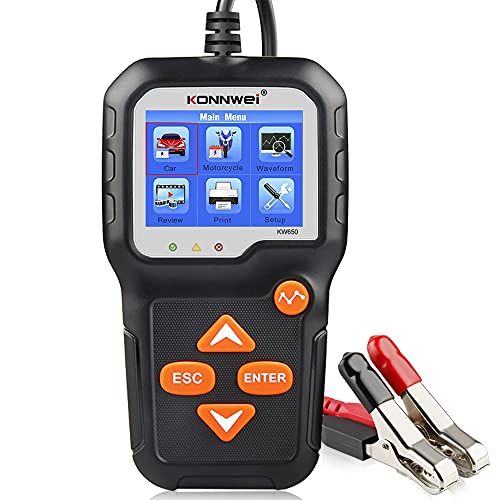 3. KONNWEI KW650: the budget pick that also handles 6V batteries | Check price on Amazon | |
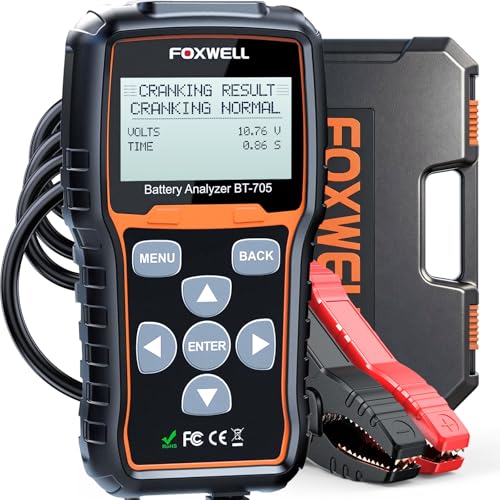 4. FOXWELL BT705: step-up coverage for 24V systems at home | Check price on Amazon | |
 5. Schumacher BT-100: the old-school load tester | Check price on Amazon |
Key takeaways
- Find the best budget battery tester for home use with five affordable 12V testers compared by CCA range, battery types, cranking and charging tests, and display style.
As an Amazon Associate we earn from qualifying purchases.
Affiliate Disclosure: This article contains affiliate links. If you buy through a link on this page, we may earn a commission at no extra cost to you. Product details and specifications are taken from the manufacturer and retailer listings, and availability should be confirmed on the product page before you order.
A battery tester is one of the few garage tools that pays for itself the first time it prevents a bad morning. A car that cranks slowly on Monday can leave you stranded on Friday, and a battery that looks fine on a simple voltage check can still collapse the moment the starter motor asks it to work. The good news for home users is that you do not need workshop-grade diagnostic equipment to get a useful answer. A budget battery tester, used correctly at home, can tell you whether a 12V battery is healthy, discharged, or genuinely at the end of its life, and it can also check whether the alternator is charging properly once the engine is running.
This guide focuses on affordable testers that suit a home garage: the car in the driveway, a motorcycle or lawn tractor in the shed, a boat battery on a bench, or the spare battery you keep for a camper. Every pick below is the same type of tool, a 12V battery tester for lead-acid batteries, and every pick was chosen because it covers the core home jobs without forcing you into professional features you will never use. Budget here is described in plain, qualitative terms only, because what matters is value for a household tool kit, not a number that changes from week to week.
What a home battery tester actually does
There are two broad families of tester in this guide. Digital conductance testers, such as the TOPDON BT100, KONNWEI KW208, KONNWEI KW650, and FOXWELL BT705, estimate battery health electronically. You enter the battery rating printed on its label, the tester measures internal resistance and voltage, and it reports state of health, state of charge, and a plain verdict such as good or replace. These testers also run cranking and charging system checks, so they can flag a weak alternator as well as a weak battery. They draw their power from the battery being tested, so there are no separate cells to replace inside the tool.
The second family is the traditional load tester, represented here by the Schumacher BT-100. A load tester applies a real, heavy electrical load for a short burst and shows how far the voltage falls on an analogue meter. It is a cruder instrument, with no state-of-health percentage and no stored rating standards, but the test itself is honest: a battery that cannot hold voltage under load cannot start an engine either. Many experienced home mechanics keep one of each style, because the two methods occasionally disagree, and the disagreement itself is useful information.
Neither type can rescue a battery that has been deeply discharged and left sitting for months, and neither type replaces a proper recharge before testing. For a fair result, charge the battery first, let it rest, clean the terminals, and then test. A tester reading taken on a flat battery mostly tells you the battery is flat, which you already knew.
How we chose these budget testers
Each tester below had to meet the same home-use criteria. It had to test standard 12V lead-acid batteries, including flooded, AGM, and gel types where the maker states that support. It had to cover a realistic cold cranking amp range for cars and light trucks. It had to give a result a non-specialist can act on, either a clear digital verdict or a clearly marked meter scale. And it had to be a tool a household would buy once and keep, rather than a disposable gadget.
Specifications in each section are taken from the product listings and maker information for that model. We have not presented any figure as the result of our own bench testing, and we recommend confirming the current listing details, including the exact model variant, before ordering, because several of these brands sell look-alike models with different voltage coverage.
Quick comparison
| Tester | Type | Voltage coverage | CCA range | Best for |
|---|---|---|---|---|
| TOPDON BT100 | Digital conductance | 12V | 100 to 2000 CCA | Most home cars |
| KONNWEI KW208 | Digital conductance | 12V | 100 to 2000 CCA | Simple, compact home use |
| KONNWEI KW650 | Digital conductance | 6V and 12V | 100 to 2000 CCA | Homes with 6V equipment too |
| FOXWELL BT705 | Digital conductance | 12V and 24V | 100 to 2000 CCA | Larger vehicles and boats |
| Schumacher BT-100 | Analogue load tester | 6V and 12V | Up to 1000 cranking amps, 100 amp load | A true load test on a budget |
1. TOPDON BT100: the straightforward pick for most homes
The TOPDON BT100 is the tester most home users should look at first. It is a 12V digital tester rated for batteries from 100 to 2000 CCA, which covers everything from a small hatchback battery to a large pickup battery. The listing states support for regular flooded, AGM flat plate, AGM spiral, and gel batteries, and the tester reports battery voltage, state of health, state of charge, and internal resistance, followed by a simple good or replace style conclusion.
Alongside the battery test, the BT100 runs a cranking test, which records how far voltage dips while the starter turns, and a charging test, which checks alternator output including ripple. For a home user, that trio matters. A healthy battery paired with a failing alternator will strand you just as reliably as a dead battery will, and this tool separates the two causes in a few minutes at the kerb.
The unit is compact, at roughly nine ounces according to the listing, and it powers itself from the battery under test. The clamps are the usual red and black crocodile style, and the screen walks you through selecting the rating standard printed on your battery label, such as CCA, EN, or DIN. Choose the standard that matches the label rather than guessing, because the health calculation depends on it.
Choose the BT100 if you want one tester for the family cars and nothing more exotic. Skip it if you need 6V testing for older equipment or 24V testing for a larger truck, because this is a 12V-only tool, and look at the KW650 or BT705 below instead.
2. KONNWEI KW208: compact, clear, and easy to store
The KONNWEI KW208 covers the same core ground as the BT100 in a slightly smaller body. It is a 12V tester for batteries from 100 to 2000 CCA, with battery, cranking, and charging system tests, and the listing gives its dimensions as about 5 by 3.07 by 0.79 inches and its weight as about 8.1 ounces. That size makes it a genuine glovebox or top-drawer tool rather than something that lives on a workshop shelf.
The KW208 displays state of charge, state of health, voltage, and internal resistance, and it supports the common rating standards used on car battery labels. The maker lists compatibility with cars, trucks, motorcycles, SUVs, and boats, which reflects the reality of a home fleet: the same tester gets used on the mower battery in spring and the car battery in winter.
Where the KW208 earns its place in a budget guide is focus. It does not add Bluetooth, printing, or app features that a home user may open once and forget. It clamps on, asks for the battery rating, and gives an answer. The trade-off is the same as with any compact digital tester: the result is an estimate based on conductance, so for a borderline battery it is sensible to recharge, rest the battery, and test again before spending on a replacement.
Choose the KW208 if storage space and simplicity are your priorities, and your vehicles are all 12V. If your household also keeps 6V batteries for a classic vehicle, a golf cart string, or older garden equipment, the next pick covers both.
3. KONNWEI KW650: the budget pick that also handles 6V batteries
The KONNWEI KW650 widens the brief. It tests both 6V and 12V batteries across a 100 to 2000 CCA range, and the maker lists compatibility with regular flooded, AGM flat plate, AGM spiral, and gel batteries. For a home with mixed equipment, that dual voltage coverage is the difference between owning one tester and owning two.
In practice, 6V still shows up at home more often than people expect: older tractors, classic cars that have not been converted, some golf carts, and a range of small utility equipment. A 12V-only tester is useless on those, and guessing their health by voltage alone is unreliable, because a tired 6V battery can show a reasonable resting voltage and still fail under load.
The KW650 keeps the same three-part test routine as its smaller sibling: battery health, cranking, and charging. The listing describes a backlit display in this model family, which helps in a dim garage or an evening driveway test, though you should confirm the exact screen specification on the current listing for the variant offered.
Choose the KW650 if your home fleet spans both voltages and you want one affordable tool for all of it. If everything you own is 12V and you prefer the smallest possible unit, the KW208 above is the simpler buy. Neither KONNWEI model is intended for lithium starting batteries, so owners who have converted a vehicle to a lithium starter battery should check the maker guidance for a compatible tester instead of assuming a lead-acid tester will read it correctly.
4. FOXWELL BT705: step-up coverage for 24V systems at home
The FOXWELL BT705 is the widest-coverage tester in this guide. It is built for 12V and 24V systems, with a 100 to 2000 CCA test range, and the maker positions it for cars, heavy-duty trucks, boats, and marine use. Most purely domestic users will never test a 24V battery, but some homes do: a larger diesel truck, a boat with a 24V bank, a motorhome with a commercial chassis, or smallholding equipment.
Beyond voltage coverage, the BT705 follows the same digital pattern, reporting battery condition, cranking performance, and charging system behaviour, with support stated for flooded, AGM, and gel lead-acid batteries. It is a larger commitment than the entry-level testers here, so it makes sense as a budget pick only in the specific sense that it replaces two separate tools for a household that genuinely has both voltages to maintain.
Choose the BT705 if 24V testing is a real requirement at your home, not a someday possibility. Buyers with ordinary 12V cars alone will get the same practical answers from the BT100 or KW208 and should not pay for headroom they will never use. As with the other digital testers, enter the rating from the battery label carefully, and treat a single borderline reading as a prompt to recharge and retest rather than as a final verdict.
5. Schumacher BT-100: the old-school load tester
The Schumacher BT-100 takes the opposite approach to everything above it. It is an analogue 100 amp load tester and voltmeter for 6V and 12V batteries, rated by the maker for batteries up to 1000 cranking amps. There is no menu, no rating standard to select, and no health percentage. You clamp it on, read the resting voltage on the meter, apply the load for the period the instructions specify, and watch where the needle settles on the colour-banded scale.
That simplicity is exactly why it belongs in a home guide. A load test answers the only question a starting battery really has to answer: can it hold voltage while doing hard work? The BT-100 also lets you watch charging voltage on the same meter with the engine running, giving a basic alternator sanity check.
The limitations are equally clear. The meter demands more interpretation than a digital verdict, the load test draws real current and warms the unit, so the maker time limits between tests must be respected, and it cannot give you internal resistance or a state-of-health figure. It is also a heavier, bench-style tool rather than a glovebox item.
Choose the BT-100 if you prefer a mechanical test you can see happening, if you distrust a single conductance estimate, or if you want a second, independent method for confirming a borderline result from a digital tester. Many home garages are best served by exactly that pairing: a digital tester for routine checks and this load tester for the final call on a suspect battery.
How to get a trustworthy result at home
Technique matters more than the badge on the tester. Start by charging the battery fully with a suitable charger, then let it sit for several hours so the surface charge fades. Clean the terminals until the clamps bite on bright metal, because a corroded connection can make a healthy battery test like a dying one. On a digital tester, select the same rating standard and value printed on the battery label. Run the test, note the result, and if the verdict is borderline, recharge and repeat the next day before deciding.
Test the charging system as well. A battery that tests weak every few months is often the victim, not the culprit: an alternator that undercharges will slowly ruin successive batteries, and an overcharging one can damage them quickly. The cranking and charging tests built into the digital picks above exist precisely to catch that pattern at home, without a workshop visit.
Finally, remember what these tools cannot do. They assess lead-acid starting and deep-cycle batteries within their stated ranges. They are not the right instrument for small household cells, power tool packs, or lithium batteries unless the maker explicitly says so, and a tester verdict is a guide to a decision, not a guarantee about how a battery will behave on the coldest morning of the year.
Verdict: which budget tester should a home buy?
For most households, the TOPDON BT100 is the balanced choice: full 12V coverage, clear health, cranking, and charging results, and a size that encourages regular use. The KONNWEI KW208 suits anyone who values compactness above all, while the KONNWEI KW650 is the better household buy when 6V batteries are part of the picture. The FOXWELL BT705 earns its place only where 24V systems genuinely live at home, and the Schumacher BT-100 remains the honest, mechanical option for a true load test and for double-checking a digital result.
Whichever you choose, the real saving a home battery tester delivers is not the purchase itself. It is the avoided breakdown, the battery replaced at the right time rather than too early or too late, and the alternator fault caught while it is still a repair instead of a recovery truck.