Our Short List of 3
- Best for: western and open-country hunters, and anyone who wants one rangefinder that will never be the limiting factor on range.

- Best for: rifle hunters who already use, or plan to use, the SIG BDX ecosystem, and long-range shooters who want an onboard solver instead of a phone app.

- Best for: bowhunters and treestand hunters, mixed-season hunters who want one light unit for both bow and rifle, and anyone who values Flightpath’s obstruction check.
All 4 Picks at a Glance
| Product | Specs | Action |
|---|---|---|
| 1. Vortex Optics Viper HD 3000 Laser Rangefinder |
| Check price on Amazon |
| 2. SIG Sauer KILO3K Laser Rangefinder |
| Check price on Amazon |
| 3. Leupold RX-1400i TBR/W Gen 2 Laser Rangefinder With Flightpath |
| Check price on Amazon |
 4. Bushnell Prime 1800 Laser Rangefinder |
| Check price on Amazon |
Key takeaways
- Find the best rangefinder for hunting with angle compensation, honest deer ranges, bright displays and waterproof builds from Vortex, SIG Sauer, Leupold and Bushnell.
A rangefinder earns its place in a hunting pack by answering one question fast and honestly: how far is that animal, and what distance should you actually shoot for? Guess wrong by twenty yards on a steep downhill shot and a clean hit turns into a miss or, worse, a wounded animal. The models below were chosen by comparing published manufacturer specifications, ranging modes and listing details rather than by repeating headline numbers, and every pick is a dedicated laser rangefinder built for hunting, with angle compensation, a game rating well beyond normal shooting distances, and weather sealing suited to cold, wet mornings.
As an Amazon Associate I earn from qualifying purchases.
What Actually Matters in a Hunting Rangefinder
Reflective range versus deer range. The big number on the box is measured against a reflective target such as a sign or a rock face. The deer range, usually a third to a half of that figure, is the one that predicts performance on a low-contrast animal in timber or sage. Compare deer ratings to deer ratings and ignore everything else.
Angle compensation. Gravity acts on the horizontal distance to the target, not the slope distance. A rangefinder with an angle-compensated mode, called HCD by Vortex, AMR by SIG Sauer, TBR by Leupold and ARC by Bushnell, does that trigonometry instantly. On flat ground it changes nothing; in canyon country, treestands and mountain basins it is the single most valuable feature on this page.
Target modes. First mode reports the nearest object, which helps when an animal stands behind light brush. Last or Best modes report the farthest or strongest return, which helps when you are ranging through grass or branches to an animal behind them. Scan mode updates the reading continuously while you pan, which is useful for confirming a landmark before an animal steps out.
Display. A red OLED or TOLED display stays readable against dark timber at first light, when a plain black LCD can disappear. Adjustable brightness matters because a display set for noon sun will wash out your night vision at dusk.
Build and battery. Look for waterproof or strongly water-resistant sealing, rubber armor that keeps its grip with gloves, and a common battery type you can replace in the field. Tripod adaptability is a genuine bonus at long range, because hand shake, not laser power, is what usually limits readings past a thousand yards.
The Picks
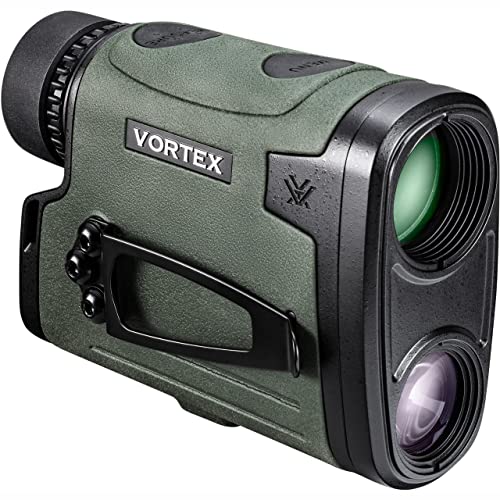
1. Vortex Optics Viper HD 3000 Laser Rangefinder
- Best for: western and open-country hunters, and anyone who wants one rangefinder that will never be the limiting factor on range.
western and open-country hunters, and anyone who wants one rangefinder that will never be the limiting factor on range.
it is the heaviest and bulkiest unit here, and its menu system rewards ten minutes of setup at home rather than fiddling in the field.
See the Vortex Viper HD 3000 on Amazon
The Viper HD 3000 is the long-range anchor of this list. Vortex rates it to 3,000 yards on reflective targets, 2,300 yards on trees and 2,000 yards on deer, figures that leave enormous headroom for the way most hunters actually work: ranging a hillside, a waterhole or a far ridgeline as a reference long before any shot is possible. The 7x magnification and 25mm objective lens sit in the sweet spot for a handheld monocular, steady enough to hold one-handed yet wide enough to find an animal quickly, with a linear field of view of 314 feet at 1,000 yards.
The HD optical system uses select glass elements with XR Plus coatings, which Vortex positions for resolution and light transmission at dawn and dusk. The red OLED display keeps the reticle and readout visible against shadowed backgrounds. Four target modes, Normal, First, Last and ELR, cover everything from a deer behind grass to deliberate ranging from a tripod, and the two ranging modes are HCD for the angle-compensated shoot-to distance and LOS for the raw line-of-sight figure plus angle. Maximum angle reading is plus or minus 89 degrees, so treestand and cliff shots are well inside its envelope.
On the construction side, ArmorTek coatings protect the exterior lenses from scratches, oil and dirt, the rubber-armored body is waterproof and shockproof, and the unit is tripod adaptable for ELR work. It runs on a single CR123 battery, weighs 9.1 ounces with the battery fitted, and ships with a soft carry case, wrist and bungee lanyards, a lens cloth, a utility clip and a hex wrench. Vortex backs it with its unlimited, unconditional lifetime VIP warranty, which is the strongest ownership promise in this group.
Watch out for: it is the heaviest and bulkiest unit here, and its menu system rewards ten minutes of setup at home rather than fiddling in the field.
2. SIG Sauer KILO3K Laser Rangefinder
- Best for: rifle hunters who already use, or plan to use, the SIG BDX ecosystem, and long-range shooters who want an onboard solver instead of a phone app.
rifle hunters who already use, or plan to use, the SIG BDX ecosystem, and long-range shooters who want an onboard solver instead of a phone app.
the ballistic features only pay off if you take the time to build and confirm a profile for your load, and IPX-4 is splash resistance rather than full waterproofing, so it deserves more shelter in driving rain than the Vortex or Leupold.
See the SIG Sauer KILO3K on Amazon
The KILO3K is the ballistic option. SIG rates the 6x22mm monocular to 3,000 yards on reflective targets, 1,800 yards on trees and 1,500 yards on deer, and pairs that reach with the BDX 2.0 system. In BDX-U mode the onboard Applied Ballistics Ultralite solver uses built-in temperature, pressure and humidity sensors to turn a range reading into a holdover in MOA or MIL. Pair it over Bluetooth with a compatible SIG BDX riflescope and the scope presents the illuminated hold point directly. BDX-X mode goes further, accepting data from external ballistic applications and compatible devices.
Five ranging modes cover the full spread of hunting situations: Line of Sight, Angle Modified Range for the angle-compensated figure, a dedicated Archery mode, and the two BDX ballistic modes. Five target modes, First, Best, Last, Fog and Extended Range, give you control over which return the unit reports in clutter or poor visibility. The red OLED display shows the targeting circle, holdover and angle information together, and the LightWave DSP engine is built for fast, repeated readings, with HyperScan-style continuous updates while panning.
The housing is compact at 4.6 inches long and light at roughly 5.6 ounces with its CR2 battery, carries an IPX-4 water-resistance rating, and uses SpectraCoat anti-reflection coatings on the glass. Eye relief is a comfortable 18mm, which glasses wearers will appreciate. SIG covers its electro-optics with the transferable Infinite Guarantee.
Watch out for: the ballistic features only pay off if you take the time to build and confirm a profile for your load, and IPX-4 is splash resistance rather than full waterproofing, so it deserves more shelter in driving rain than the Vortex or Leupold.
3. Leupold RX-1400i TBR/W Gen 2 Laser Rangefinder With Flightpath
- Best for: bowhunters and treestand hunters, mixed-season hunters who want one light unit for both bow and rifle, and anyone who values Flightpath’s obstruction check.
bowhunters and treestand hunters, mixed-season hunters who want one light unit for both bow and rifle, and anyone who values Flightpath’s obstruction check.
the 5x view and shorter maximum range make it the wrong tool for dedicated long-range rifle work, and the wind hold is calculated for a fixed full-value crosswind, so it is a starting point rather than a complete wind solution.
See the Leupold RX-1400i TBR/W Gen 2 on Amazon
The RX-1400i Gen 2 is the lightest serious hunting rangefinder in this group at about 5.1 ounces, and it is the one aimed most squarely at hunters who split their seasons between bow and rifle. Leupold rates it to 1,400 yards on reflective targets and 1,200 yards on trees. Those numbers look modest next to the two picks above, but they cover every realistic bow shot many times over and most rifle shots taken outside dedicated long-range country.
True Ballistic Range with Wind, TBR/W, is the core technology. In rifle mode it applies one of the selectable ballistic groups to the angle-compensated range and can present a hold point for a 10-mph wind crossing at 90 degrees. In bow mode it produces the corrected horizontal distance archers actually need, and the Flightpath feature goes a step further by indicating the highest point of your arrow’s trajectory, so you can see whether a branch between you and the animal is genuinely in the way or only looks that way through the optic.
The 5x magnification keeps the view steady at close, brushy distances where higher power becomes a liability, and the red TOLED display offers selectable brightness levels so it stays legible in both noon glare and last light. The aluminum body is waterproof and fogproof, the controls are simple enough to run with a gloved thumb, and the whole unit disappears into a harness pouch in a way the bigger units here do not.
Watch out for: the 5x view and shorter maximum range make it the wrong tool for dedicated long-range rifle work, and the wind hold is calculated for a fixed full-value crosswind, so it is a starting point rather than a complete wind solution.
4. Bushnell Prime 1800 Laser Rangefinder
- Best for: hunters who want angle compensation, target modes and an auto-adjusting display in a compact unit, and whitetail hunters whose shots live well inside the deer rating.
hunters who want angle compensation, target modes and an auto-adjusting display in a compact unit, and whitetail hunters whose shots live well inside the deer rating.
the 700-yard deer rating is the shortest here, so open-country rifle hunters should step up to the Viper HD 3000 or KILO3K, and IPX4 sealing means heavy rain calls for a pouch rather than a lanyard carry.
See the Bushnell Prime 1800 on Amazon
The Prime 1800 is the value workhorse of the group, built around one clever idea: the ActivSync display. The readout fluidly shifts from black against bright backgrounds to red against dark ones, which solves the oldest complaint about LCD rangefinders, a black reticle vanishing against a shadowed animal, without forcing you to manage brightness settings manually. Bushnell pairs it with an all-glass optical system and a larger objective lens for low-light brightness, in a 6x24mm format.
Ranging runs from 5 to 1,800 yards on reflective targets, with tree readings to 1,000 yards and deer readings to 700 yards in the manufacturer’s specification, and accuracy quoted at plus or minus one yard. ARC, Angle Range Compensation, provides bow and rifle modes, and the rifle side offers multiple ballistic groups so the unit can present a hold value matched to common cartridge classes. Brush mode ignores foreground twigs and reports the background target, Bullseye mode does the opposite and reports the nearest small target, and scan mode refreshes the reading four times per second while you pan across a hillside.
EXO Barrier coating on the exterior lenses repels water, oil, fog and dust, the housing is rated IPX4 water resistant, and at about 6 ounces with its CR2 battery it carries easily on a harness. A tripod adapter socket is molded in, a small detail many rivals omit at this level, and Bushnell’s Lifetime Ironclad warranty covers the unit.
Watch out for: the 700-yard deer rating is the shortest here, so open-country rifle hunters should step up to the Viper HD 3000 or KILO3K, and IPX4 sealing means heavy rain calls for a pouch rather than a lanyard carry.
Side-by-Side Comparison
| Model | Magnification | Reflective range | Deer range | Angle compensation | Display | Weight |
|---|---|---|---|---|---|---|
| Vortex Viper HD 3000 | 7x25mm | 3,000 yards | 2,000 yards | HCD and LOS | Red OLED | 9.1 oz |
| SIG Sauer KILO3K | 6x22mm | 3,000 yards | 1,500 yards | AMR, LOS, Archery, BDX | Red OLED | 5.6 oz |
| Leupold RX-1400i TBR/W Gen 2 | 5x21mm | 1,400 yards | Not separately rated in sources checked | TBR/W with bow mode | Red TOLED | 5.1 oz |
| Bushnell Prime 1800 | 6x24mm | 1,800 yards | 700 yards | ARC bow and rifle | ActivSync LCD | 6 oz |
How to Choose Between Them
Start with the country you hunt. Timber and treestand hunters rarely range past a few hundred yards, so display quality, a good First or Bullseye mode and light weight matter more than headline range, which points to the Leupold or the Bushnell. Open-country hunters should buy deer range first, because a unit that reads an animal reliably at twice your maximum ethical shot distance will also read it confidently at the real distance in rain, glare and mirage.
Next, decide how much ballistics help you want. A plain angle-compensated distance, paired with a confirmed drop chart, is enough for most hunters and keeps the workflow simple. If you shoot far enough that wind and atmosphere genuinely move your point of impact, an onboard solver like the KILO3K’s removes a step at the exact moment you least want extra steps.
Finally, think about the warranty and the carry. A rangefinder lives on a harness, gets knocked against treestand steps and rides in a wet pack. The Vortex VIP warranty is unconditional, the SIG guarantee is transferable, and both reduce the long-term risk of an expensive optic. Whichever model you choose, spend an evening ranging known distances at home, a fence line, a measured field, a target butt, so the menu and modes are automatic before an animal is standing in front of you.
Frequently Asked Questions
Is angle compensation worth it for treestand hunting? Yes. A shot from a stand at a steep downward angle is exactly where slope distance misleads you. The horizontal distance is shorter than the reading suggests, and an angle-compensated mode gives you the number your sights or pins are calibrated for.
Why does my rangefinder struggle on deer at long range? Animals are small, dark and non-reflective, and hand shake moves the laser off the target. Brace against a tree, use scan mode, range a larger nearby object such as the ground at the animal’s feet or a tree at the same distance, and stay within the published deer rating rather than the reflective maximum.
Can I use one of these for golf as well? These are hunting rangefinders first. Their target modes are designed to reach through brush to an animal, which is the opposite of the flag-locking behavior golfers want, and none of the picks here were selected for course features. If golf matters equally, shop for a dedicated golf unit instead of compromising both jobs.
How long does the battery last? All four picks use a single CR123 or CR2 lithium cell and are rated for thousands of ranging cycles. Cold weather shortens lithium battery life noticeably, so carry a spare in an inside pocket during late-season hunts.
The Bottom Line
For most hunters who want one rangefinder and no regrets, the Vortex Viper HD 3000 pairs the strongest deer rating here with excellent glass and an unconditional lifetime warranty. The SIG Sauer KILO3K is the pick when onboard ballistics and scope pairing matter. The Leupold RX-1400i Gen 2 is the lightest and the smartest choice for bow and treestand work, and the Bushnell Prime 1800 covers the core hunting features, including angle compensation and an auto-adjusting display, in the most compact value package of the four.